
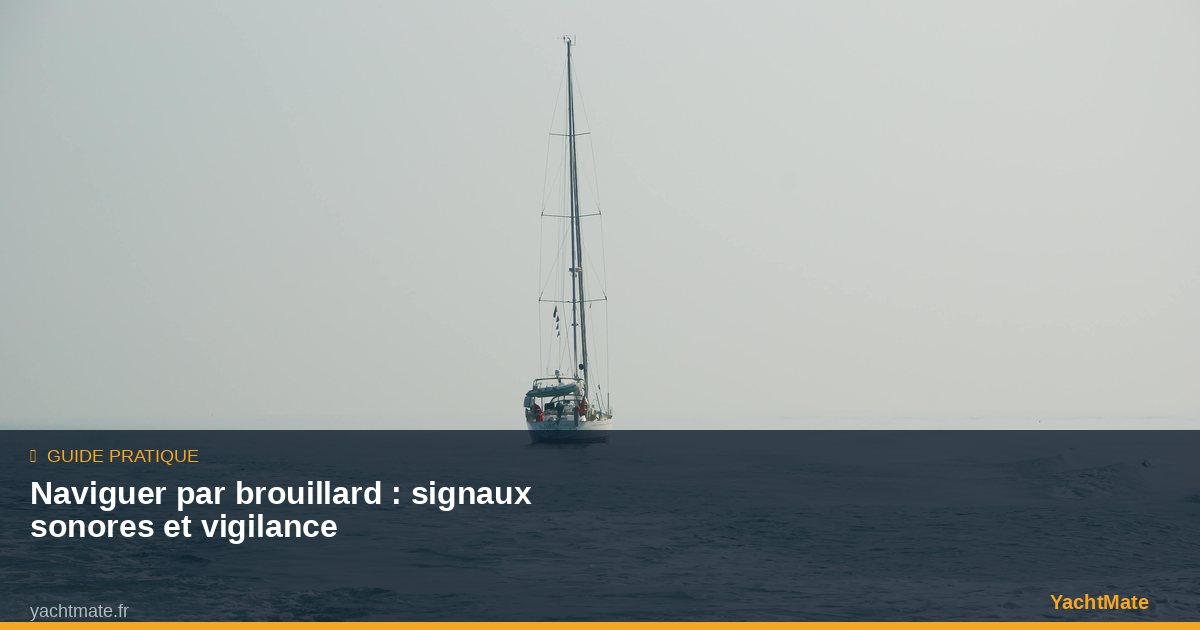
Fog is one of the most feared conditions at sea. It can set in within minutes, erasing all visual references and turning a calm passage into a high-risk situation. Every year, several collisions occur in reduced visibility conditions, often because crews do not know or fail to apply the basic rules of the COLREGS (International Regulations for Preventing Collisions at Sea). Yet sailing in fog is perfectly manageable if you know the rules, the right equipment to use, and the correct reflexes to adopt.
In this article, YachtMate gives you all the keys to confidently handle navigation in reduced visibility: mandatory sound signals, use of radar and AIS, safety checklist, and practical tips from experienced sailors.
Understanding Sea Fog: Origins and Risks
Sea fog forms when water vapour in the air condenses as the temperature drops to the dew point. There are two main types of marine fog. Advection fog is the most common at sea: it forms when a warm, moist air mass passes over a cooler water surface. This typically occurs in the English Channel, on the French Atlantic coast or in Brittany, where it can persist for several hours or even a full day. Radiation fog forms at night over land and can extend to coastal areas in the early morning.
In both cases, visibility can drop to less than 200 metres, sometimes just a few tens of metres. At sea, there are no road signs to warn you and no lighthouse is visible at a safe distance. Vigilance must be total and procedures applied without delay.
Before departing, check coastal fog forecasts. The difference between air temperature and dew point is a key indicator: if it is less than 3°C, the risk of fog is high. YachtMate displays these data points directly on your navigation screen.
Mandatory Sound Signals (COLREGS Rule 35)
Rule 35 of the COLREGS requires every vessel to signal its presence with sound signals in restricted visibility. These signals must be emitted at regular intervals, regardless of whether your radar is operating or not.
The essential signals to know
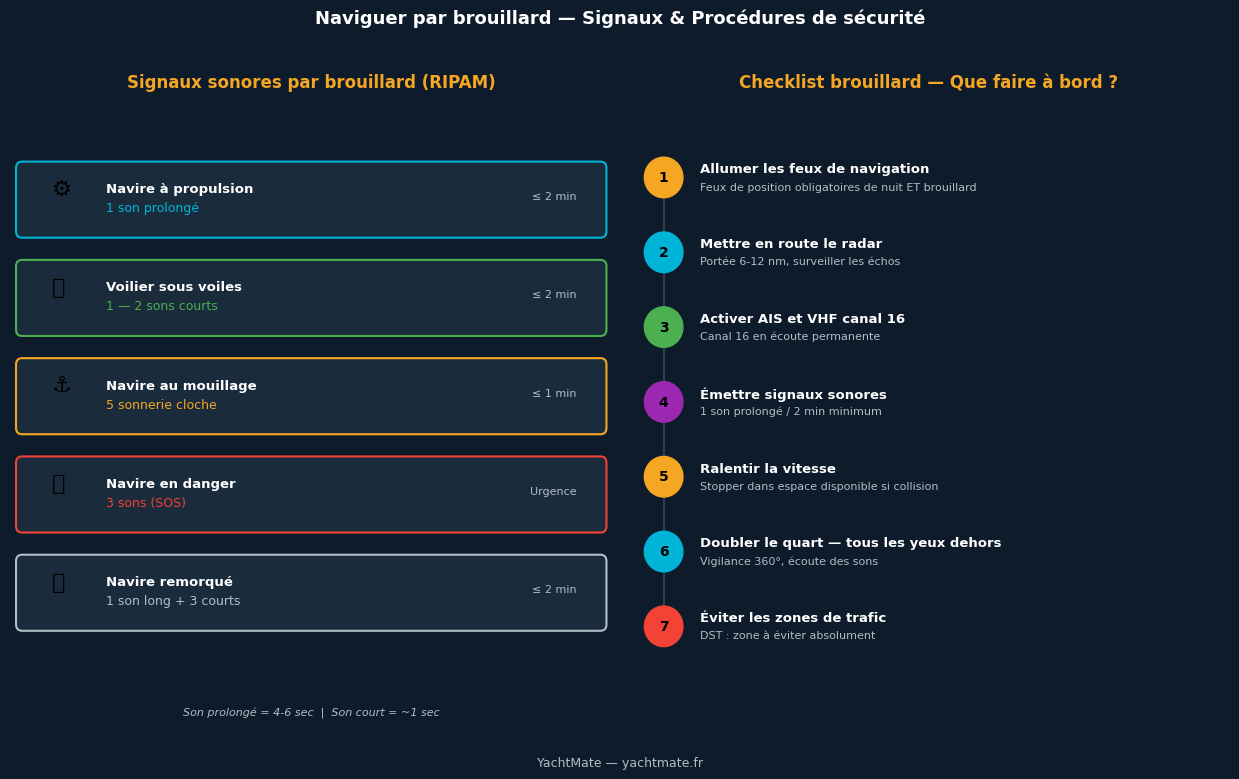
- Power-driven vessel underway making way: 1 prolonged blast at intervals of not more than 2 minutes
- Sailing vessel underway: 1 prolonged blast followed by 2 short blasts at intervals of not more than 2 minutes
- Power-driven vessel underway but stopped: 2 prolonged blasts at intervals of not more than 2 minutes
- Vessel at anchor: rapid ringing of the bell for about 5 seconds at intervals of not more than 1 minute
- Vessel being towed: 1 prolonged blast followed by 3 short blasts at intervals of not more than 2 minutes
- Vessel aground: bell signal + 3 separate strokes on the bell before and after each bell ring
A prolonged blast lasts between 4 and 6 seconds. A short blast lasts about 1 second. Your sound signalling device (whistle, electric or gas foghorn) must be in working order and immediately accessible. Do not wait until you are in fog to check that your foghorn works.
"At sea, sounds travel in unpredictable ways in fog. A vessel you hear may appear to come from a very different direction than its actual position. Never rely solely on sound to determine the location of another vessel."
What experts say about fog sound propagation
Sound propagation at sea is particularly deceptive in fog. Studies have shown that the human ear can be off by more than 90° in identifying the direction of a sound at sea, due to acoustic refraction effects caused by layers of air at different temperatures. This is why sound signals should be treated as an alert signal, not as a precise positioning tool.
Using Radar in Fog: Best Practices
If your boat is equipped with radar, fog is precisely the situation it was designed for. However, it must be used correctly. Many recreational sailors switch on their radar in fog without having practised enough beforehand, which creates stress and misinterpretation of echoes.
Setting the range appropriately
Start with a range of 6 to 12 nautical miles to get an overview of the surrounding traffic. Then switch to 3 miles or less to monitor nearby objects. Regularly adjust gain and sea clutter suppression to eliminate false echoes caused by waves without suppressing real contacts.
Interpreting echoes
A strong, stable echo generally corresponds to a metal vessel. A weak, irregular echo may be a fibreglass boat (poor radar reflector), a buoy or even a wave. This is why installing a radar reflector is strongly recommended for all sailing yachts. The reflector should be hoisted as high as possible to be detectable at a sufficient distance.
YachtMate overlays real-time AIS data on your navigation chart. Combine radar view with AIS positions to identify vessels in your sector. A vessel that appears on radar but not on AIS could be a recreational boat without a transponder: be even more vigilant.
AIS and VHF: Essential Allies
AIS (Automatic Identification System) has become indispensable for modern navigation. If your boat is equipped with an AIS receiver, you can see on your navigation screen the position, heading, speed and name of all AIS-equipped vessels within a 10 to 30 nautical mile radius. In fog, this information is invaluable: it allows you to anticipate collision risks well before they become critical.
VHF Channel 16 at all times
Keep your VHF switched on and tuned to channel 16 at all times. This is the international distress and calling channel. If you find yourself in a potentially dangerous situation with another vessel, call them directly on channel 16 to coordinate avoidance manoeuvres. Do not hesitate to report your position to the nearest coastguard centre so they can include you in their surveillance.
Adjusting Speed and Course
COLREGS Rule 6 requires every vessel to proceed at a safe speed adapted to the circumstances and prevailing visibility conditions. That speed must allow them to manoeuvre effectively and stop within a distance appropriate to the prevailing conditions.
In practice, in dense fog, you must significantly reduce your speed. A sailing boat able to stop within 3 boat lengths should navigate at less than 3 knots if visibility is below 100 metres. A motor vessel, more manoeuvrable, can maintain a slightly higher speed, but always remain able to stop or turn quickly.
Avoiding high-traffic areas
Traffic Separation Schemes (TSS) should be avoided in fog if at all possible. These shipping lanes concentrate commercial vessels travelling at 15–20 knots that may not detect you in time. If you must cross them, do so at a 90° angle, at your maximum speed, after confirming the lane is clear on radar and AIS.
Before entering a fog bank, plan a fallback anchorage nearby. YachtMate shows authorised anchorage areas and their depths on your chart. If visibility becomes zero and you are in a safe area, it is sometimes wiser to anchor and wait for the fog to lift.
On-Board Checklist in Fog
At the first signs of fog — a slight haze thickening, outlines becoming blurred — do not wait for the situation to become critical. Immediately apply your safety checklist:
- Switch on navigation lights — required at night and also in reduced visibility during daytime
- Start the radar and set range to 6–12 nm to monitor traffic
- Activate AIS and verify that nearby vessels are identified on screen
- Switch to VHF channel 16 and maintain a permanent watch
- Begin sound signals appropriate to your vessel type
- Reduce speed to a value allowing stopping within available space
- Double the watch — put as many eyes as possible forward
- Notify coastguard or marina if you are running late to your destination
- Hoist radar reflector if not already done
- Identify a fallback anchorage on the chart in case of further deterioration
Specific Situations to Know
Fog on approach to harbour
Harbour approaches in fog are particularly tricky: dense traffic, buoys to locate, shallow water. If you have accurate GPS and a good chart, navigate at very slow speed, strictly following your GPS track. Contact the harbour master on their working VHF channel to announce your presence and get traffic information. Some harbours have port radar and can guide you to the berth.
Night fog
The combination of fog and night is the most challenging situation. Navigation lights of other vessels are visible but distort distances. Stay focused on your radar and AIS. Reduce speed to the minimum navigable. If sailing with crew, organise short watches (30 minutes) to maintain maximum alertness.
Clearing fog
When visibility returns, do not immediately relax your vigilance. Vessels may emerge from the still-foggy zone nearby. Maintain your sound signals until you are certain visibility is good across your entire horizon. Also check your GPS position to confirm you have not drifted during your fog navigation.
🧭 Navigate with Confidence Using YachtMate
YachtMate integrates AIS data, marine weather and your navigation charts in a single app. See vessels around you, receive weather alerts and plan your stopovers even in poor visibility.
Download YachtMate for Free