
Few breakdowns cause as much anxiety as the sudden loss of steering. In an instant the boat stops responding, rounds up or bears away, the sails flog and the crew is left with no control over direction. Yet a rudder or steering-gear failure is rarely fatal: with a cool head, a clear understanding of the problem and a few proven techniques, you can almost always regain control of your heading and reach shelter. This guide explains how to react in order, diagnose the cause and rig effective emergency steering.
Understanding the anatomy of a steering system
Before you repair or improvise, you need to know what can break. A steering system is made of several parts, and the failure can occur at any link in the chain. The rudder (the submerged blade) is attached to a stock (the vertical shaft that passes through the hull). At the top of that stock sits the control: either a tiller fitted directly onto the head of the stock, or a quadrant connected to a wheel by cables (wire or chain) or by a hydraulic system (ram and hoses).
Identifying the source of the problem changes everything. If the stock and rudder are intact but the wheel no longer responds, the rudder can probably still be worked directly — the most favourable scenario. If, on the other hand, the rudder itself is broken, bent or lost (a collision with floating debris, structural fatigue), you must create a steering surface from scratch.
Know your boat before you leave. At the dock, locate the emergency stock head (often a square fitting under a cockpit hatch) and check that the emergency tiller supplied by the builder fits it properly. Five minutes of practice alongside can save you a critical hour at sea.
Immediate reflexes when steering is lost
The first minute sets the tone for everything that follows. Panic wastes time and energy; a clear procedure, by contrast, restores calm on board.
1. Stop the boat and reduce the loads
Your priority is not to keep moving but to regain control of the situation. Ease the sheets to let the sails flog, or heave to in order to stop the boat. Under power, throttle back. A boat charging along and lying broadside in the swell is dangerous and makes any diagnosis impossible: slow down first.
2. Secure the crew
Get everyone into lifejackets and harnesses, especially in a rough sea. Count the crew, clip everyone on and forbid unnecessary movement on deck. Steering failures often strike in bad weather — precisely the moment when a man overboard would be hardest to manage.
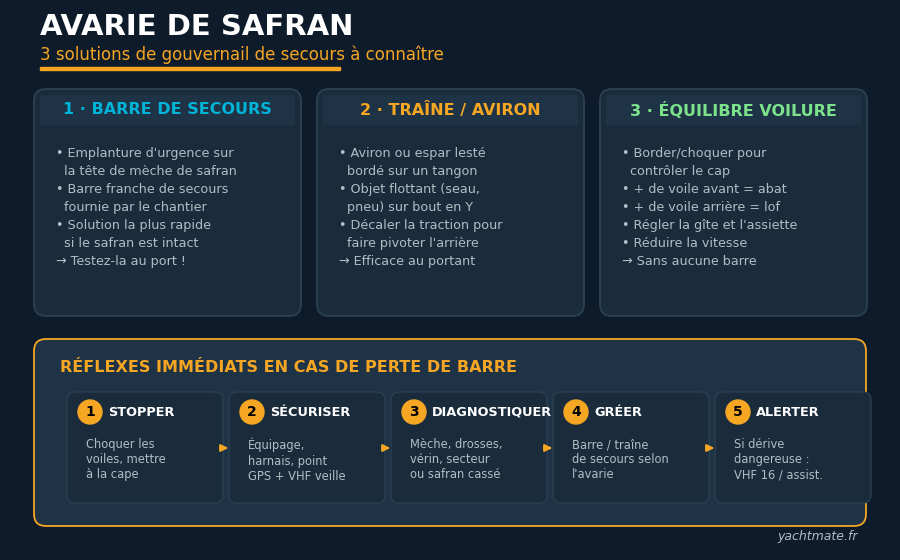
3. Fix a position and give notice
Immediately note your GPS position, heading and the time. Assess your drift: are you closing on a coastline, a shoal, a traffic lane? Keep a listening watch on VHF channel 16. You are not yet obliged to make a call, but be ready to do so if the situation worsens. Reporting a difficulty early to the rescue services or a nearby boat, even without distress, is good practice.
4. Diagnose the failure
Open the access hatch to the steering gear. Look for the cause: a derailed or broken cable, a cracked sheave, a hydraulic leak, a detached quadrant, or a stock turning freely (broken rudder). A cable that has simply jumped its sheave can sometimes be put back; an emergency tiller instantly cures a wheel-steering failure if the rudder is sound.
Solution 1: the emergency tiller
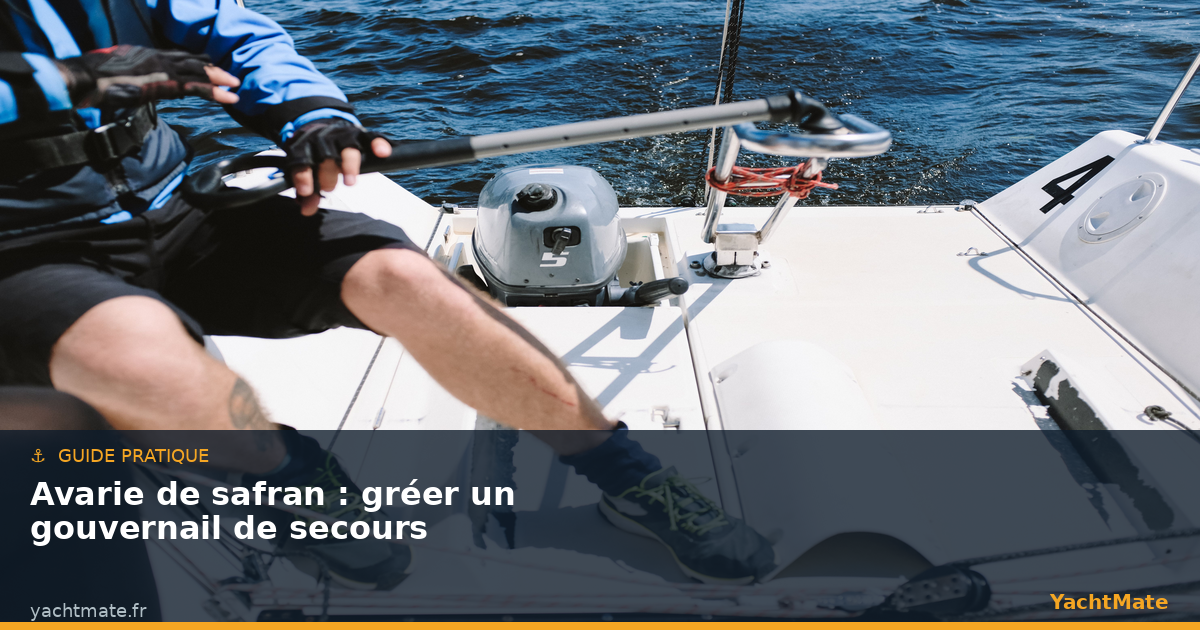
This is the fastest and most effective answer, provided the rudder and its stock are intact. Almost all cruising yachts come with an emergency tiller (a metal tube) that fits directly onto the square of the stock head, bypassing the wheel and its failed transmission.
Locate the stock head, remove any cover, fit the emergency tiller and lock it. You now steer directly, as on a small dinghy. Helm effort can be considerable in a rough sea, but the boat becomes manoeuvrable again. On boats with an original tiller, a system failure is rare — but a tiller can break: carrying a spare tiller or a tube capable of replacing it remains wise.
If the failure is a broken cable on a wheel, don't waste time attempting an acrobatic repair in the open sea: go straight to the emergency tiller. You'll fix the cables in peace back in harbour, with the right tools and in shelter.
Solution 2: drag steering and a steering oar
If the rudder is lost or completely unusable, you must create a force capable of pivoting the stern of the boat. Two main techniques exist, often complementary.
Steering with a drag
The principle: tow behind the boat an object that slows it and that you shift to one side or the other to turn the stern. Use a strong bucket, a tyre, a drogue cone or a bundle of lines, attached to a bridle whose two legs run to the aft cleats or winches. By taking up one leg and easing the other, you shift the drag to one side, which alters the course. It's imprecise but enough to hold a rough heading downwind.
Improvising an oar-rudder
An oar, a spinnaker pole, a strong board or a weighted spar can serve as a makeshift rudder. Lashed along the transom or fixed to an improvised bracket (on the aft pushpit or a reinforced stanchion, for example), it acts as a blade you angle to deflect the water flow. The larger the immersed surface and the further from the boat's centreline, the stronger the steering effect — but the greater the load. Lash it down securely: a jury rudder torn away at speed can cause injury.
"Emergency steering doesn't have to be elegant. It only has to let you hold a rough heading towards shelter, at reduced speed."
Solution 3: steering under sail, with no helm at all
This is the least-known and yet most valuable technique: a well-balanced sailboat steers on its sails alone. The principle relies on shifting the centre of sail effort relative to the hull's centre of lateral resistance.
- Sheet in the headsail / ease the mainsail to push the bow to leeward: the boat bears away (turns away from the wind).
- Sheet in the mainsail / ease the jib to bring the boat up: it luffs (turns towards the wind).
- By constantly playing these two trims against each other, you hold a surprisingly stable heading, especially on downwind and reaching points of sail.
Also adjust heel and trim: moving the crew to one side changes the balance and helps hold the course. Reduce sail to lessen the loads and make corrections easier. This method takes anticipation and a little practice, but it has brought many crews home after losing their entire steering system. It combines perfectly with a drag to fine-tune control.
Practise in good weather at steering under sail with the helm locked amidships. An hour of exercise upwind and downwind will teach you how your boat reacts. The day you really need it, you'll already know which trim produces which effect.
When and how to call for assistance
Regaining control doesn't always mean you can get home unaided. If your emergency steering isn't enough to control the drift, if you're approaching a dangerous area (a lee shore, rocks, heavy traffic) or if conditions deteriorate, don't wait until the last moment to raise the alarm.
A PAN-PAN on channel 16 signals an urgent situation with no immediate threat to life — ideal for requesting advice, assistance or a tow. Reserve the MAYDAY for grave and imminent danger to the life of the crew or the vessel. Always give your position, the nature of the failure, the number of people on board and your intentions. If you're taken in tow, prepare a strong line made fast to a strong point (bow roller, reinforced cleats) and keep a knife within reach to cut loose in an emergency.
Prevention beats reaction
The best breakdown is the one that never happens. A few habits sharply reduce the risk: inspect regularly the cables, sheaves, bearings and any play in the stock; grease the joints; watch for corrosion around the rudder fittings. Check the condition of the hydraulic hoses and the oil level on the systems concerned. Finally, put together a small steering-failure kit on board: emergency tiller, strong lines, ties, straps, a few shackles and the makings of a bridle. Know where everything is, and don't wait for the first gale to open the technical hatch.
Stay on course with YachtMate
In a breakdown, knowing your position, your drift and the nearest shelter makes all the difference. YachtMate brings charts, AIS and weather together in a navigation app built for boaters — available on iOS and Android.
Discover YachtMate →