
Eating fresh after several days at sea can feel like a small miracle. Aboard, cold is an expensive luxury: it weighs on the power budget, depends entirely on the quality of the insulation and tolerates no shortcuts. Yet with the right system and a few good habits, you can easily keep vegetables, dairy and protein fresh through a long cruise. This guide reviews the main refrigeration solutions, their real consumption, the art of good insulation and the preservation techniques that extend your range, with or without a fridge.
1. Why cold is a challenge aboard
At home, the fridge runs without a thought, plugged into an endless supply. At sea everything changes: energy is counted, produced and stored aboard, and every amp-hour spent on cold is one less for the autopilot, the electronics or the lights. At anchor, cold becomes the single largest consumer on most cruising boats.
The marine environment adds its own constraints. Ambient heat is often high in summer, especially in the Mediterranean, forcing the compressor to run almost continuously. Humidity and salt attack the components. And heel and motion demand careful stowage of food and a system that works while leaning. Managing cold well, then, starts with understanding that it is a balance between food comfort and energy autonomy.
2. The cooling systems
Four broad families equip cruising boats, from the simplest to the most refined. The choice depends on the volume to cool, the cruising programme and the boat's electrical capacity.
The insulated cool box
The simplest and cheapest option: an insulated box filled with ice packs or eutectic blocks frozen ashore. No electricity, but autonomy limited to a day or two and the need to renew the ice. Perfect for a day out or a weekend, it quickly shows its limits on a cruise.
The portable compressor cool box
A genuine standalone fridge, it carries its own 12/24 V compressor and works without ice. Plug it in, set the temperature, and it will even reach freezer levels. Flexible and portable, it suits boats with no fixed installation, at the cost of significant consumption and some clutter in the saloon.
The compressor refrigerator
The reference for coastal cruising. A Danfoss/Secop compressor feeds an evaporator housed in an insulated, built-in box. Properly sized and insulated, it offers the best compromise between comfort, reliability and consumption. Most modern units allow a speed setting to limit current peaks.
The eutectic holding plate
The premium system for long passages. A plate filled with eutectic fluid stores cold while the compressor runs — typically while the engine or generator is on — then releases it slowly for hours with the compressor off. Ideal for large volumes and fewer cycles, but more expensive and more demanding to install.
3. Choosing for your programme
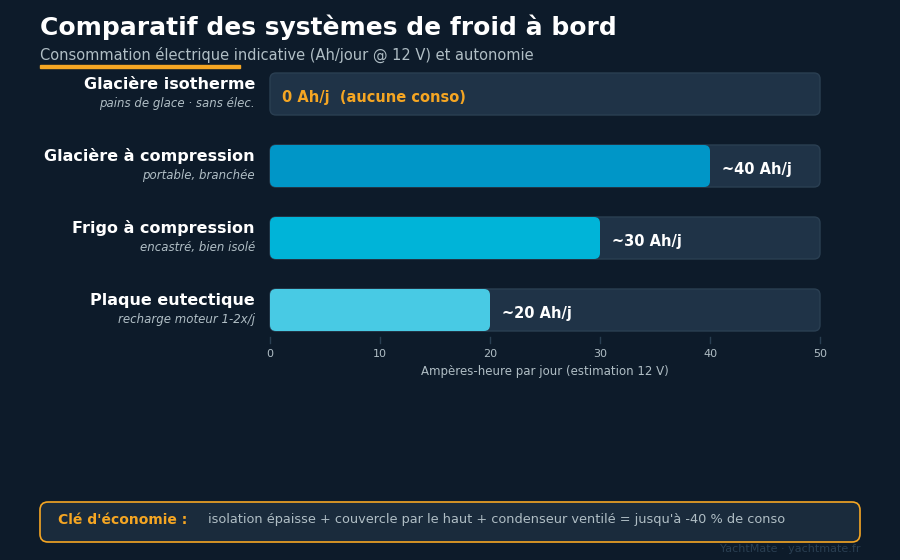
There is no universal system: the right choice follows your actual use, the length of your passages and your ability to generate electricity. The table below sums up the orders of magnitude to guide the decision.
| System | Ideal programme | Typical use | Budget |
|---|---|---|---|
| Insulated cool box | Day trip, weekend | 0 Ah/day (ice) | € |
| Compressor cool box | No fixed install | ~30–40 Ah/day | €€ |
| Compressor fridge | Coastal cruising | ~20–50 Ah/day | €€€ |
| Eutectic plate | Long cruise, big volume | Recharge 1–2×/day | €€€€ |
Ask yourself three simple questions. How many days will you spend without recharging in port or under engine? What volume do you want to cool — a crate of drinks, or enough to feed a crew for a week? And above all, how much energy can you produce each day, from solar panels, alternator and wind generator? A fridge too ambitious for a modest battery bank will leave you running the engine for cold alone.
Before buying, measure the real consumption over a typical day by fitting a wattmeter or a shunt on the circuit. You will know exactly what your cold costs in amp-hours and can size solar and batteries with no nasty surprises.
4. The power budget
Cold is almost always the biggest single consumer at anchor. Thinking in amp-hours per day is therefore essential. A fridge using 40 Ah/day requires, to stay in balance, at least as much production — two well-oriented solar panels or a daily engine charge, for instance — and a battery bank able to ride out the night without dropping too low.
Consumption is never fixed: it rises with the outside temperature, the number of openings and warm food just loaded in. In a Mediterranean summer the same fridge can use 50 % more than in spring. Better, then, to size for the worst case, and remember that every degree gained on insulation translates directly into amps saved.
Cold is not chosen alone: it is sized together with the batteries and the solar panels. The three form a single energy system.
5. Insulation and installation
No compressor, however good, makes up for poor insulation. It is the insulation that decides how long the cold stays trapped between two cycles. On a production boat, the original box insulation is often inadequate: reinforcing it is the most profitable investment aboard.
- Thickness: aim for 60 to 100 mm of polyurethane foam on every face, with no thermal bridge. Doubling weak insulation can cut consumption by a third.
- Top opening: a horizontal lid keeps the cold in, since cold air is heavier than warm and would pour out of a vertical door at every opening.
- Condenser ventilation: it rejects the extracted heat; placed in a closed, hot locker it chokes. Provide airflow, or even a small fan.
- Seals and drainage: sound seals prevent air leaks, and a small drain stops condensation from pooling.
Chill food ashore or in the cool of the evening before loading it. Putting in warm produce forces the compressor into a long catch-up cycle — one of the biggest energy wastes aboard.
6. Preserving with little cold
Cold is not the only weapon. Provisioning well also means knowing how to preserve differently to relieve the fridge and last longer. Many foods do perfectly well without refrigeration if chosen and stowed correctly.
Root vegetables (onions, potatoes, carrots), squash, garlic and citrus keep for weeks in a dry, dark, ventilated place. Unwashed eggs last a long time out of the fridge, turned regularly. Fruit should be separated by ripeness, as the fast ripeners spoil the rest. Think too of tinned food, freeze-dried meals, UHT products and dry goods (pasta, rice, pulses) that form the backbone of long-distance provisioning.
For protein, vacuum packing, salting and canning greatly extend shelf life. Reserve the cold space for genuinely fragile items — opened fresh products, dairy, the day's meat — and everything else will find its place in dry, well-ventilated lockers.
7. Organisation and tips
Once the system is chosen, it is daily habits that make the difference between cold under control and a flat battery. A few simple reflexes extend autonomy without sacrificing comfort.
- Open it as little as possible and for as short a time: every opening lets in warm air the compressor must then cool.
- Fill the empty space with cold water bottles or ice packs: a cold mass stores cold and smooths the cycles.
- Stow by use and note what must be eaten first, to limit rummaging with the lid open.
- Fit a thermometer and never set it colder than needed: 4 to 6 °C is plenty for everyday storage.
- Use the engine: on a eutectic plate or a thirsty fridge, time intensive cycles for when you are motoring.
Cold aboard is neither a gadget nor an energy curse: it is a system in its own right, to be thought of as a whole, from the choice of unit to the quality of the insulation and the way you fill your lockers. Set up well, it gives you the simplest of luxuries at sea — a cold drink and a proper meal, wherever you are anchored.
The best boat fridge is the one you rarely open, fill cold and have carefully insulated. The rest is just a matter of habits.
Plan your passages with peace of mind
YachtMate brings together your provisioning checklists, your logbook, your favourite anchorages and your equipment tracking. Free.
Discover YachtMate