
An outboard motor that vanishes from a tender, electronics stripped out over winter, an entire dinghy stolen at anchor in a quiet bay: theft remains one of the most common — and most infuriating — misfortunes in a boat owner's life. Unlike a mechanical breakdown, it gives no warning, often strikes while you are away, and leaves a lingering feeling of violation. The good news is that most of these thefts are crimes of opportunity: the thief picks the easiest, least protected target. By making your boat visibly harder to steal from, you deflect the overwhelming majority of attempts. This guide runs through the right habits, in the marina and at anchor, and what to do if the worst happens.
Understanding boat theft: who, what, when
Before protecting yourself, you need to know what you are up against. Insurer and rescue-service data paint a fairly consistent picture. The most stolen items are, in order: outboard motors (especially small engines, easy to remove and resell), rigid inflatable tenders, portable electronics (GPS, handheld VHF, tablets, autopilots), safety gear (liferafts, lifejackets), and unfastened deck equipment. Theft of an entire hull happens but is rarer, since a boat is hard to move on.
The riskiest time is when the boat sits alone and unwatched: winter storage ashore or afloat, long weekday absences, and nights at an isolated anchorage. Dry stacks, trailer parks and open anchorages are among the most exposed spots. A boat that is lived in, lit and surrounded by other occupied vessels is far less likely to be targeted than one sitting isolated and obviously empty.
The golden rule of deterrence fits in one sentence: your boat should never be the easiest target on the pontoon. A thief in a hurry compares opportunities and picks the one with the best risk-to-reward ratio. Two visible locks and a tidy deck are often enough to send them to the boat next door.
In the marina and alongside: lock down access
The marina gives a false sense of security. A harbour office, cameras or a gate will not deter a determined thief who blends in among the boaters. Security therefore starts on board.
Close and lock the openings
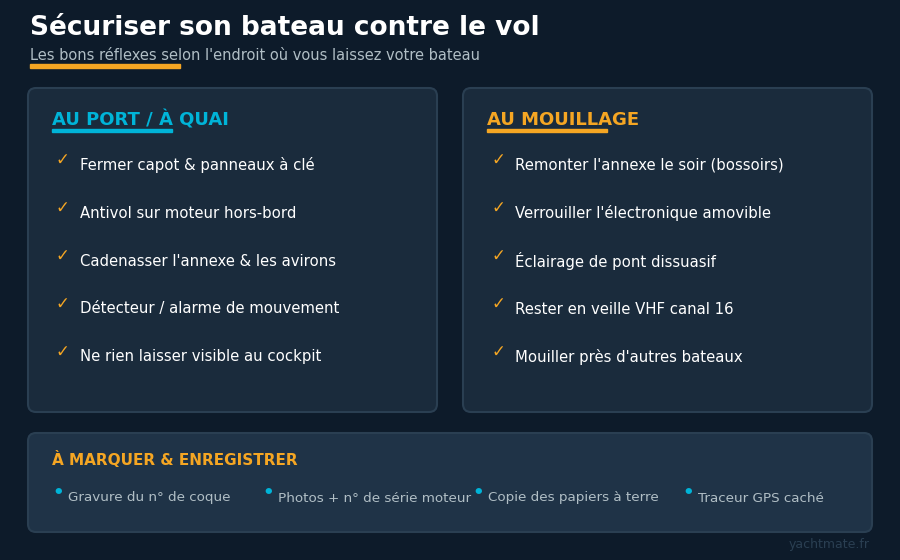
It seems obvious, yet many thefts happen without forced entry, simply through a hatch left open. Always lock the companionway and deck hatches, even for a short absence. On a sailboat, the sliding companionway hatch should be secured by a system that prevents it from being lifted or slid open from outside. Opening ports and coachroof hatches are classic entry points: fit them with sturdy interior latches.
Secure the outboard and the tender
The outboard motor is the number one target. A simple clamp lock (a lock that blocks the tightening screws on the transom) stops the motor being unscrewed in seconds. Add a sheathed security cable linking the motor to a robust fixed point on the tender or boat. For the tender itself, a chain or cable padlocked to a quay ring or the mother ship is essential; hoist it onto davits or the deck as soon as possible rather than leaving it alongside all night.
Leave nothing visible or easily removable
A clear cockpit is a cockpit that draws no attention. Stow portable electronics, removable instruments, bags and valuables inside and out of sight. Fixed gear that unbolts by hand — VHF antenna, wind vane, portable solar panels, floodlights — is best mounted with tamper-proof fasteners or thread lock. The fewer visible, easy-to-grab items there are, the less your boat holds a thief's attention.
At anchor: night-time vigilance
An open anchorage, far from pontoons and cameras, calls for particular vigilance. Most thefts at anchor target the tender and its motor, left alongside for the night.
Raise and lock the tender in the evening
The most effective measure is also the simplest: hoist the tender in the evening, onto davits, flat on deck or at least firmly padlocked alongside with the motor tilted up. A tender in the water, motor in place, tied off with a single line, is an invitation. If you must leave it afloat, remove the key or kill cord, lock the motor and chain the whole thing to the boat.
Choose your anchorage and keep watch
A busy anchorage near other occupied boats offers passive security: thieves avoid places where they risk being seen. Conversely, avoid isolated coves if you are carrying valuable gear. At night, motion-activated deck or cockpit lighting is a strong deterrent, as is simply leaving a cabin light on. Keep the VHF on watch on channel 16: in the event of an intrusion, a call can alert neighbouring boats and rescue services.
With YachtMate you can note and easily find your trusted anchorages: depth, seabed type, how busy they are. Favouring a well-sheltered, reasonably busy anchorage is safer both for the boat's hold… and for your gear. A boat with company is a boat that is protected.
Mark, register, track: prepare for the aftermath
No protection is foolproof. It pays to prepare, ahead of time, whatever will help with identification, recovery and compensation in the event of theft.
Marking and serial numbers
Gear that is marked and registered is much harder to resell and much easier to recover. Record and keep ashore the serial numbers of the motor, electronics and valuable equipment, together with dated photos. Have the hull identification number (HIN) engraved both visibly and discreetly, and mark your motor (engraving, UV marking, plate). These marks deter the thief and serve as proof of ownership.
Trackers and alarms
Hidden GPS trackers (self-contained battery beacons with a subscription) make it possible to locate a stolen boat or motor and have already led to many recoveries. An onboard alarm — intrusion, motion or bilge-water sensor with a phone alert — adds a layer of active security and warns you in real time. These devices are increasingly affordable and discreet.
Insurance and paperwork
Check that your insurance policy covers theft, including of the motor and tender, and under what conditions (lock required, excess, cap). Many policies require a means of protection before paying out for a stolen outboard. Keep ashore a copy of the boat's papers, invoices and photos: this file considerably speeds up the claim and the settlement.
"The best security rarely costs much: a motor lock, a tender padlock and a tidy deck rule out the vast majority of opportunistic thefts."
What to do if theft occurs?
If a theft happens despite everything, act methodically. Report it to the authorities without delay, providing serial numbers, photos and a precise description of the stolen gear. Notify the harbour office and neighbouring boaters: stolen gear is sometimes spotted quickly nearby. Declare the loss to your insurer within the policy deadline (often two to five business days), with the police report. If you have a tracker, pass the position to the police rather than intervening yourself. Finally, list the serial number on stolen-property registers and watch second-hand listings, where gear sometimes resurfaces.
Build a digital "boat file" now: photos of every piece of equipment, serial numbers, invoices, a copy of the papers, and your insurer's contact details. Store it in the cloud and keep a copy ashore. The day you need it, everything is ready in minutes.
In summary
Anti-theft security rests on a simple idea: make your boat less attractive and harder to steal from than the others. In the marina, lock everything, secure the motor and tender, leave nothing visible. At anchor, raise the tender in the evening, choose busy spots and keep watch. Ahead of time, mark and register your gear, consider a tracker and an alarm, and check your insurance cover. These steps, most of them inexpensive, rule out the overwhelming majority of opportunistic thefts and, if the worst happens, let you react fast and maximise your chances of recovery.
Sail and anchor with greater peace of mind with YachtMate
Find your trusted anchorages, follow the weather and keep all your navigation info at hand. YachtMate is the app built for boaters — nautical charts, AIS and weather, on iOS and Android.
Discover YachtMate →