
A successful cruise is won before you cast off the lines. Whether you're planning a Mediterranean tour, an Atlantic crossing, or a week along the French coast, the quality of your preparation will determine your safety, comfort and enjoyment on board. In this complete guide, we walk through the six fundamental steps to organise a cruise from A to Z — avoiding the classic mistakes even experienced sailors make.
Step 1: Choose Your Destination and Weather Window
First, define your destination taking into account seasonal wind patterns. The Mediterranean is navigable almost year-round, but July and August concentrate strong thermal winds (Mistral, Meltemi) and heavy traffic. The North Atlantic is ideally planned from May to October to take advantage of the trade winds. For cruises in Brittany or the Channel, May-June and September often offer the best conditions: fewer boats and moderate winds.
Anticipating Weather Corridors
Consult multi-year climatological data for your area (national met services, pilot charts) to identify periods with cyclone risk or average winds above force 5. Never base your planning on a single short-term forecast: conditions change. Build in a two-to-three-day margin per stopover to absorb unexpected weather delays.
Enable automatic weather alerts in YachtMate for your route: you'll be notified 48 hours in advance of any significant front approaching your planned stops.
Step 2: Get Your Administrative Documents in Order
A sailing or motor vessel heading on a cruise must carry a complete set of mandatory documents — and their absence can be costly during a check in a foreign port. In France, the navigation title, civil liability insurance, the skipper's licence, and the crew list are indispensable. Abroad (EU countries outside Schengen, Turkey, Morocco…), add each crew member's passport and, where applicable, the VHF radio licence.
Often-Forgotten Papers
- Ship radio station licence if you carry a fixed VHF
- Certificate of registration or ship's papers for seagoing vessels
- Comprehensive navigation insurance contract with towing assistance
- Vaccination health record for cruises outside the EU
- Port health clearance in ports that still require it
Keep digital copies in a secure cloud space and laminated photocopies on board, separate from the originals.
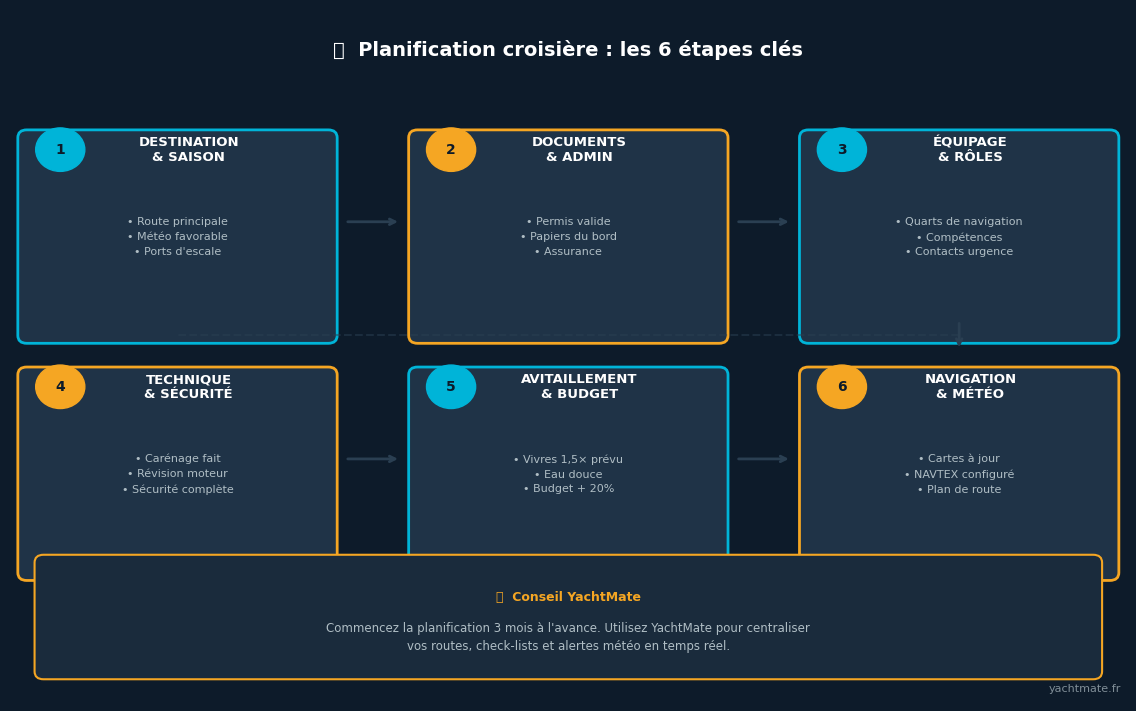
Step 3: Build and Organise Your Crew
Crew composition is often underestimated in cruise planning. A crew of four for a 12-metre sailing boat is comfortable for coastal passages; for an offshore passage of several days, think about watch schedules — ideally a four-hour rotation (2 on watch, 2 resting). Make sure watch-keeping doesn't fall to just one or two people over a long passage.
Defining Roles on Board
Clearly assign responsibilities before departure: skipper, watch officer, galley manager, safety officer. Ensure every crew member understands the basics: VHF, flares, life raft, manual bilge pump. Note emergency contacts and the route plan in the ship's log, accessible to all.
Create a digital ship's log in YachtMate: each crew member can consult the route, waypoints and emergency procedures from their smartphone — even offline.
Step 4: Prepare the Boat Technically
No administrative planning replaces the mechanical reliability of the boat. At least two weeks before departure, carry out a full service or have one done by a professional: engine and transmission oil change, belt and stern gland inspection, steering cable and halyard check, navigation lights and battery verification.
The Mandatory Safety List
In France, safety equipment depends on the category of navigation (coastal, offshore). For offshore navigation it includes notably:
- Approved life raft with valid service
- EPIRB (distress beacon) with valid battery
- 150N lifejackets for each person, with harness and tether
- Fire extinguisher(s) up to date
- Signalling mirror and parachute flares
- Complete first aid kit with medical manual
Expired safety equipment is almost as dangerous as absent equipment: check the validity date of every item before departure.
Step 5: Provisioning, Fresh Water and Budget
Provisioning is the delicate art of estimating what you'll need — and planning for more. For food, allow around 2 kg of provisions per person per day for demanding sailing, and always keep a 48-hour emergency reserve. Favour tinned goods, pulses and stable cereals that don't need refrigeration.
Fresh Water: A Critical Resource
Fresh water consumption on board ranges from 2 to 5 litres per person per day with careful use (seawater for washing up, short showers). Calculate your real autonomy by dividing your tank volume by this consumption, then apply a safety factor of 1.5. If your cruise exceeds the boat's capacity, plan for spare jerrycans or a portable watermaker.
Enter your fuel budget in YachtMate by specifying your engine's hourly consumption and distances between stops. The app automatically calculates the volume needed and alerts you if your reserve is insufficient.
Step 6: Navigation and Operational Weather
Your charts must be up to date — corrections to Sailing Directions and charts are published regularly. For digital navigation, choose a recognised charting app (Navionics, Garmin, YachtMate) and complement it with paper charts as backup for critical areas.
Daily Weather Briefing
During a cruise, the morning weather briefing is an immutable ritual. Combine several sources: NAVTEX received on board, official marine forecasts (downloaded the previous evening), coastal radio bulletins, and GRIB forecast apps like Windy or PredictWind. Identify fair-weather windows for exposed passages and don't hesitate to extend a stopover if conditions are unfavourable.
Before each departure, leave your route plan with a shore contact (family, marina) and agree on a radio sked frequency. On offshore passages, a daily position report by VHF DSC or satellite is wise practice that maritime rescue services appreciate.
YachtMate Centralises Your Cruise Planning
Routes, checklists, weather alerts, digital ship's log and emergency contacts — all in one mobile app available offline.
Download YachtMate for Free