
There was a time when casting off meant cutting yourself off from the world. Today, most boaters want to stay reachable: to check an up-to-date weather forecast, let family know they're safe, download charts, or even work remotely from an anchorage. The good news is that having Internet on board has never been easier. The catch is that the market has become crowded, and you need to understand the trade-offs between range, speed, power consumption and budget.
In this guide, we review the three main families of solutions — marina Wi-Fi, coastal 4G/5G and satellite Internet (led by Starlink) — to help you build the setup that fits your cruising program.
Why stay connected at sea?
Beyond comfort, a reliable connection has become a genuine safety and navigation tool. It gives access to up-to-date forecasts and GRIB files, lets you follow traffic through online AIS services, download charts or app updates before a passage, and stay reachable if something goes wrong.
For a growing number of boaters, connectivity also means working remotely during long cruises, or simply enjoying a little streaming at anchor in the evening. Each use has its own demands: checking the weather needs very little bandwidth, a professional video call needs far more, and needs it to be stable.
Marina Wi-Fi: the free but limited baseline
Most marinas now offer a Wi-Fi network, often included in the berth fee or available via a code. It's the cheapest way to pick up email, update charts and back up data while you're alongside.
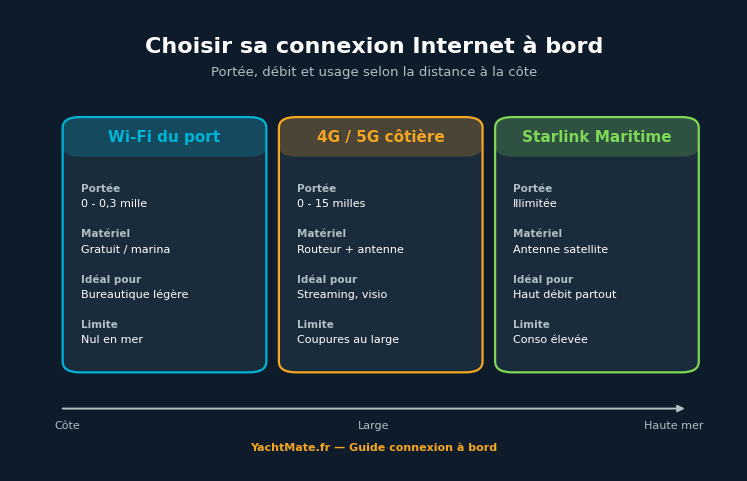
Its main weakness is range and quality: the signal, shared among many boats, fades as soon as you move away from the access point. A long-range Wi-Fi repeater (an antenna mounted on the pushpit or masthead, wired to an indoor router) markedly improves reception and can pick up networks hundreds of metres away. But as soon as you leave the harbour, Wi-Fi no longer keeps up.
Never send banking data or sensitive passwords over a public marina Wi-Fi without a VPN. These open networks are poorly secured: a VPN encrypts your traffic and protects your accounts.
Coastal 4G/5G: the versatile solution
As long as you sail along the coast, the terrestrial mobile network remains the best value for money. Depending on the area and the height of the masts, 4G generally reaches 10 to 15 nautical miles offshore, sometimes more near large cities. 5G offers higher speeds but a shorter range.
The right equipment
A smartphone hotspot can do in a pinch, but for reliable reception it's better to invest in a marinised 4G/5G router paired with an external antenna mounted high up. This combination picks up signals a phone left in the saloon can't reach, and broadcasts clean Wi-Fi to the whole boat. Dual-SIM routers can switch automatically between two carriers to maximise coverage.
Data plans
Choose a plan with a large data allowance, and check the roaming conditions if you sail abroad. In Europe, "roam like at home" makes things easier, but is capped outside your zone. Some boaters keep a local SIM from the country they're visiting for long stopovers.
Antenna height matters more than raw power. Gaining a few metres by mounting it on the pushpit or masthead can double your reception distance. Mind the cable too: excessive loss between antenna and router cancels the benefit.
Starlink and satellite Internet: connection everywhere
This is the revolution of recent years. Thanks to its constellation of low-orbit satellites, Starlink delivers high-speed Internet where no terrestrial network reaches, with speeds and latency far beyond older satellite systems. For offshore sailors, it's a radical change.
Which plan to choose?
Starlink offers several tiers. The mobile "Roam" plans, with a standard dish, are enough for coastal sailing and anchoring, at an affordable price. For true open-ocean and heavy use, the "Maritime" plan and its high-performance dish provide oceanic coverage and better behaviour in heavy weather, but at a significantly higher cost.
The downside: power consumption
A satellite system is power-hungry. A Starlink dish draws several dozen watts continuously on average, which quickly weighs on a sailboat's battery bank. You need to factor this load into your energy budget and plan to switch the dish off when it's not in use. It's often the real limiting factor on board, even before budget.
Choosing according to your program
The ideal setup depends on your sailing:
- Port-to-port sailing, day trips: marina Wi-Fi topped up with 4G is more than enough. No need to invest in satellite.
- Coastal cruising over several weeks: a 4G/5G router with a good antenna becomes the central tool, possibly with a backup SIM from a second carrier.
- Long passages and offshore sailing: satellite Internet becomes essential for weather and safety, alongside 4G near the coast.
- Working from the boat: combine 4G/5G and Starlink to guarantee a stable connection in all conditions, with automatic failover.
Many well-equipped boats adopt a hybrid approach: a router able to aggregate marina Wi-Fi, 4G/5G and Starlink, and to automatically pick the best available source. It's the most robust solution, at the price of a larger budget and installation.
Installation and consumption: watch points
Whatever solution you choose, a few rules apply. Mount antennas as high and clear as possible, away from the radar and other transmitters. Use quality cable of adequate cross-section to limit losses. Protect connections from moisture and salt. And above all, build the power consumption of your gear into the sizing of your battery bank and charging sources.
Always keep a safety backup independent of the Internet: a VHF, and for offshore a distress beacon. However good a connection may be, it never replaces the mandatory safety communication equipment.
In summary
Staying connected on board is now within everyone's reach, provided you choose the solution suited to your sailing. Marina Wi-Fi covers your needs alongside, coastal 4G/5G remains the best option along the coast, and Starlink opens high-speed Internet to the open sea — at the price of a power consumption to watch closely. It's up to you to build your setup around your uses, your program and your budget. And once connected, always remember that true freedom at sea also means knowing how to switch off.
Sail with confidence using YachtMate
Plan your cruises, check marine weather and manage your passages with confidence using the YachtMate app — the reference for recreational boaters.
Discover YachtMate →