The French offshore boating license, known as the "permis hauturier," is the essential maritime qualification required to navigate legally beyond six nautical miles from the French coast and for any navigation during darkness, regardless of distance. This extension of the coastal license opens access to international waters of the Mediterranean, Atlantic, and beyond, with corresponding increased responsibilities matching the superior meteorological and hydrodynamic complexity of offshore environments. Training encompasses comprehensive understanding of dead reckoning navigation, instrument operation, COLREGs maritime rules, applied marine meteorology, and tidal phenomena affecting French coasts. This practical guide explores every aspect of the French offshore license, from administrative prerequisites through examination techniques, common pitfalls, and recommended educational resources ensuring success and maritime safety for professional and recreational navigators.
Prerequisites and Access Requirements for Offshore Certification
Access to the offshore license first requires possession of the French coastal license (or equivalent recognized certification), limiting navigation to six nautical miles from shore. Minimum age is 16 years at examination, though most candidates hold the diploma by age 17-18 after acquiring sufficient practical experience. A medical certificate from an approved physician is mandatory, confirming absence of contraindications to offshore navigation. Minimum visual acuity is 5/10ths corrected per eye (8/10ths with correction acceptable). No color blindness restrictions apply, even for partial color vision deficiency. Simple declaration of absence of seizure disorders, vertigo, or syncope is required. Candidates must provide valid identity, proof of residence, and official birth certificate extract. Training is available through French Sailing Federation-affiliated schools, government-approved centers, or the National Maritime Education Institute (INEMM). The complete training-to-certification process typically requires 4-6 weeks including theoretical instruction, personal study, and examination scheduling.
Theoretical Training Structure and Curriculum Content
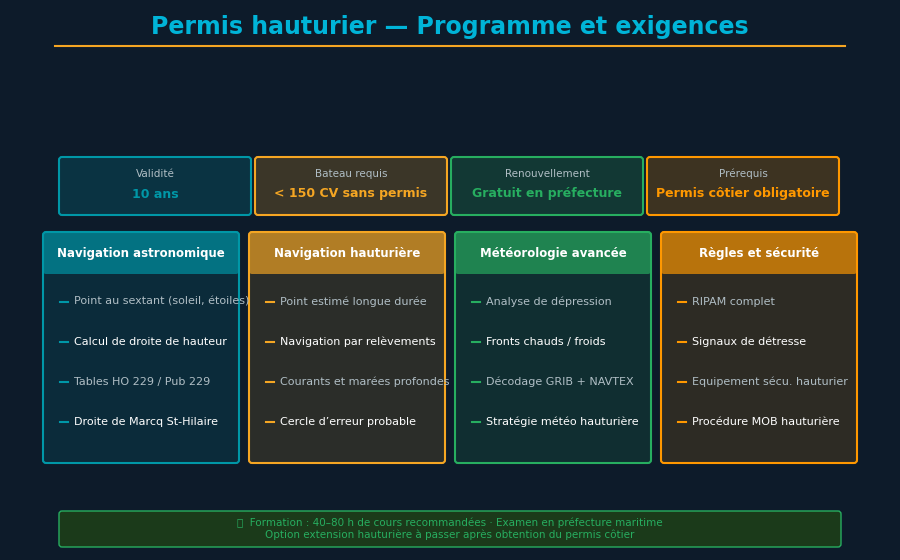
Offshore license training spans two to three intensive classroom days complemented by 40-60 hours personal study. Curriculum covers four primary domains: (1) Cartographic navigation using SHOM (French Hydrographic and Oceanographic Service) charts, including magnetic compass operation, symbol identification, route plotting, and magnetic-to-true course conversion; (2) COLREGs (International Regulations for Preventing Collisions at Sea), 18 rules applied to realistic maritime traffic scenarios; (3) Positioning techniques including dead reckoning, observed position from bearings, GPS integration within redundancy protocols; (4) Marine meteorology featuring isobar chart interpretation, depression and anticyclone system identification, fetch calculation for wave height prediction, and dangerous phenomenon prevention. SHOM charts at examination typically cover French coastal zones (English Channel, Atlantic, Mediterranean) at scales 1:250,000 or 1:500,000. Candidates master magnetic declination calculation (annual adjustment typically -2° to -3° in metropolitan France), combined variation with compass error, and precise conversion between true, magnetic, and compass courses. Dead reckoning requires understanding drift elements (current, apparent wind), route versus displacement relationships, and estimated position calculation from initial position, departure time, vessel speed, and navigation duration. COLREGs covers 18 international rules emphasizing determination of stand-on or give-way duty, appropriate sound signals, and defensive maneuvers in potentially critical situations.
Specialized Domains: Tides and Current Calculations
The French Tides Atlas (SHOM) is fundamental for offshore certification, providing high/low water times, amplitude ranges, and coefficients for French reference ports. The offshore license requires applied understanding of the "rule of twelfths," approximating hourly water height variation based on amplitude. This method assumes predictable rise/fall pattern: 1/12th amplitude during first hour post-low water, 2/12ths second hour, 3/12ths third hour, then 3/12ths, 2/12ths, 1/12ths for final three flood hours. Practical application is critical: during a Brittany to Bay of Biscay crossing, navigators must anticipate tidal current effects (reaching 4-5 knots in passages like Raz de Sein) on effective course, adjusting magnetic heading accordingly. Tidal resonance phenomena (bore, tidal bore) aren't directly tested but understanding extreme tides (coefficients 95+) proves invaluable. Current tables and tidal stream atlases provide directional information essential for offshore route planning, particularly in areas with complex bathymetry creating non-linear current patterns. Practical examination questions frequently require calculating water depth at specific times or estimating current vector for course correction calculations.
Examination Structure and Scoring System
The offshore license examination is a multiple-choice questionnaire of 22 questions completed in 90 minutes. Passing score is 16 correct responses (72.7%). Questions distribute evenly across four domains: cartographic navigation (5-6 questions), COLREGs (5-6 questions), marine meteorology (5-6 questions), and tides/currents (3-4 questions). Each question typically offers four response options with single correct answer. Cartographic questions require candidates to plot routes on provided SHOM charts, determine magnetic courses (accuracy typically ±5°), or calculate arrival times. COLREGs questions present two-vessel scenarios with defined positions and trajectories, requiring identification of mutual duty and appropriate defensive maneuver. Meteorology questions demand isobar chart interpretation, depression system identification, or wave height estimation from fetch and wind duration. Tidal questions typically require calculating water depth at specific times. Average pass rate is approximately 65-75%, indicating moderate difficulty. Candidates most frequently fail COLREGs questions (scenario complexity) and cartographic questions (magnetic conversion errors). Immediate retake same-day is impossible; candidates must await next examination cycle (typically 2-4 weeks) for second attempt. Examinations occur in local sessions organized by Maritime Affairs Departments (DAM) with frequency of 4-6 sessions annually per region throughout France.
Educational Resources and Recommended Books
Major reference text is "Code Vagnon du Navigateur Hauturier" (Vagnon edition), 400+ pages covering all curriculum aspects with full-color SHOM charts, detailed pedagogical diagrams, and corrected practical exercises. Complementary resource is "Bloc Marine Hauturier" (Bloc edition), 50+ training chart exercises for dead reckoning and compass practice. For marine meteorology, "Météorologie Marine" by Bernard Chuffart (Naval edition) provides accessible explanations of phenomena specific to French coastal zones. ENIMER (National Maritime Education School) publishes detailed manuals on COLREGs and positioning techniques. Candidates strongly recommend completing classroom instruction with 20-30 personal study hours, including 10-15 practical cartographic navigation exercises with real-world scenarios. Online platforms increasingly offer interactive simulations of COLREGs scenarios and chart plotting exercises with immediate feedback, accelerating learning curves and improving examination readiness substantially.
European Equivalences and International Recognition
French offshore license is recognized equivalent to ICC (International Certificate of Competence) issued by numerous European nations under International Sailing Federation convention. UK RYA Day Skipper (theory) covers similar but not identical content; RYA Day Skipper holders must take French supplementary examination, generally limited to COLREGs and tides review. Italian system (Patente Nautica Category A for motor, B for mixed, C for sailing) also requires supplementary examination due to geographically different coverage zones (Tyrrhenian instead of Bay of Biscay). Spanish mariners holding Patrón de Navegación Básica (PNB, coastal equivalent) or Patrón de Yate (offshore equivalent) are automatically recognized in France and EU without additional examination if mutual recognition is established by decree. Holders of French or Spanish Capitaine 200 or commercial licenses are obviously authorized for French offshore navigation without supplementary certification, as commercial qualifications exceed recreational offshore licensing requirements.
Commercial Extension: Capitaine 200 Qualification
Natural progression from offshore license is commercial qualification "Capitaine 200 Tonnage," authorizing command of commercial vessels to 200 gross tons up to 12 nautical miles from coast. This training adds 5 days instruction covering ship stability, cargo management, safety procedures, and rescue operations. Total cost is approximately 600-800 euros through approved schools. While not mandatory for recreational navigation, this qualification elevates overall competency and creates seasonal employment opportunities as charter captain. Offshore license candidacy fees are approximately 100-150 euros through Maritime Affairs Department (DAM) registration, plus 150-250 euros school training (total 250-400 euros). Schools typically offer complete packages including training, examination, and textbooks. Professional navigators and serious recreational sailors view the offshore license investment as essential preparation for commanding seagoing vessels responsibly in complex maritime environments.
Insurance Implications and Legal Responsibility
In France, offshore license is mandatory for commanding motorized vessels exceeding 6 horsepower (or sail vessels exceeding 1800 cm² sail area) navigating beyond 6 nautical miles from coast or during darkness. Navigation without required certification exposes captain to minimum 1500 euros fine, potentially 10,500 euros for endangerment charges. Liability insurance typically requires commanding officer hold appropriate certification; uninsured incidents (collision, pollution) without proper licensing can expose vessel owner to unlimited liability. Insurers apply majorized deductibles or coverage refusal if captain lacks required brevets. French yacht clubs require offshore license for borrowing sailing vessels in offshore exploration flotillas (multi-day high-sea excursions). Vacation charters (sailing yacht rentals) in Mediterranean or Atlantic demand equivalent certification or professional skipper employment. Understanding these legal and insurance requirements motivates serious sailors toward proper qualification, ensuring both personal safety and financial protection in maritime emergencies.
Common Examination Pitfalls and Error Patterns
Magnetic declination causes approximately 30% examination errors, with candidates confusing declination direction (east or west). In metropolitan France, declination is WEST (approximately -2° to -3° by region), meaning magnetic north lies west of true north. Therefore: Magnetic Course = True Course - Declination (negative values = addition). Second major error is forgetting compass error (vessel-specific compass deviation); though not explicitly provided, examination questions assume neutral compass. Third frequent source involves confusing loxodromic (constant-heading route, straight line on Mercator chart) and orthodromic (great circle, shortest spherical distance). For French coastal navigation distances (under 500 km), difference is negligible; loxodromic navigation applies. COLREGs most common error involves relative aspect misinterpretation (parallel, converging, diverging); candidates must verify aspect every minute during collision avoidance situations to confirm convergence (collision risk) or divergence (diminishing risk). These systematic errors are preventable through targeted practice and careful review of fundamental concepts before examination day.
Practical Tips for Examination Success
Practice minimum 15 training charts under time constraints (5 minutes per chart) before examination. Familiarize yourself with common SHOM symbols: crosses indicate rock hazards, diamonds mark wrecks, violet dotted lines show restricted zone boundaries. Memorize 18 COLREGs in thematic groups rather than rote learning; for instance, rules 4-7 cover approaches and maneuvers, studying these four together reinforces logical understanding. For meteorology, practice reading minimum 10 historical isobar charts from Météo France archives; identify systems, trace pressure gradient vectors, estimate fetch for five different coastal zones. During examination, read each question twice; subtle phrasing ambiguities can cause misunderstanding on second reading. Manage time strictly: 22 questions in 90 minutes provides 4 minutes per question; allocate 2-3 minutes to complex cartographic questions, 1-2 minutes to simpler COLREGs scenarios. Answer all questions; leaving blanks guarantees zero points while educated guesses offer probability of correct answers. After completing examination, review answers only if time permits; hasty second-guessing frequently introduces errors into previously correct responses.
Refresher Training and Mandatory Updates
Since 2015, French offshore license theoretically remains valid for life, unlike certain commercial certifications. Official recommendation (non-mandatory) suggests refresher training every 5 years, particularly if navigation has been inactive. Training organizations offer 4-8 hour update sessions, typically costing 150-300 euros, including COLREGs review, current meteorology, and cartographic exercises. No legal sanctions apply for absent refresher, but demonstrating recent training strengthens legal position in maritime incidents. Yacht clubs and insurers may require refresher certificates before renting sailing vessels to mariners inactive for exceeding 3 years. Maintaining currency through regular maritime practice and periodic formal refreshers ensures sustained competency and safety throughout extended boating careers.
Conclusion: Offshore License as Safety Investment
The French offshore boating license represents far more than administrative formality; it demonstrates formally certified competency sufficient for navigating safely in demanding coastal and offshore waters. Training covers complex mathematical, physical, and regulatory disciplines requiring serious preparation and profound understanding, not mere memorization. Mariners investing necessary time in thorough preparation not only pass examination but acquire genuine navigation skills protecting their lives and crew safety. In contexts of Mediterranean and Atlantic France, where Mistral generates 8-meter waves within 24 hours and tidal currents dominate coastal navigation, competency certified by offshore license is invaluable asset and prudent investment in maritime safety. Whether recreational sailor pursuing international cruising or professional navigator commanding chartered vessels, the offshore license represents essential certification for responsible offshore boat operation in complex marine environments demanding sophisticated seamanship knowledge.
Prepare With Confidence
Access complete learning resources and track your progress toward certification.
Discover YachtMate →