
Night at sea is a world of its own: the cockpit silence, the starlit sky, the lights of other vessels blinking on the horizon. Yet sailing at night demands thorough preparation and a firm grasp of specific rules. Every year, numerous accidents occur due to inadequate lighting or a misreading of the situation. This comprehensive guide gives you all the tools to approach night navigation with confidence.
Why is night sailing different?
Night radically changes your perception of the maritime environment. Familiar visual references — coastlines, buoys, other vessels — disappear or transform into mere points of light. Without a solid understanding of navigation lights and optical conventions, it becomes very difficult to judge the distance, size and direction of other boats.
Fatigue also plays a decisive role. The human body is not naturally wired to stay alert between 2 am and 5 am. That is precisely why watch organisation is the cornerstone of any successful night passage.
Mandatory navigation lights (COLREGS)
The International Regulations for Preventing Collisions at Sea (COLREGS) precisely define the lights every vessel must display between sunset and sunrise — and in conditions of restricted visibility by day. These rules (Articles 20 to 31) are universal and apply to all vessels in international waters.
The basic lights to know
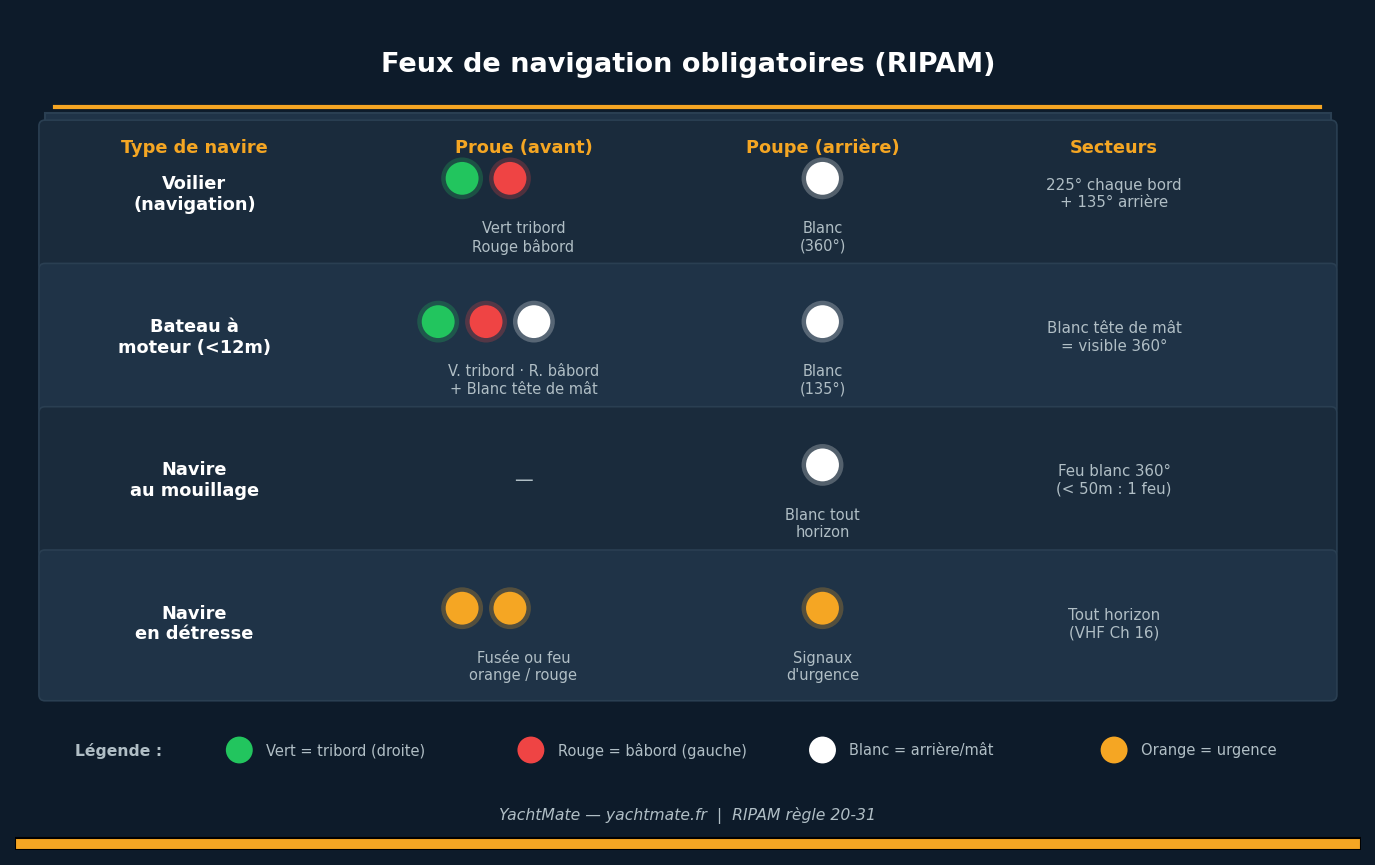
The logic of navigation lights is simple and memorable: red on the left (port), green on the right (starboard). These two sidelights each cover a sector of 112.5° forward. A white stern light (135°) completes the arrangement at the rear.
- Red light (port): left side of the vessel, visible at minimum 2 nautical miles
- Green light (starboard): right side of the vessel, visible at minimum 2 nautical miles
- White stern light: rear of the vessel, 135° sector, visible at 2 miles
- White masthead light: power-driven vessels only, 225°, visible at 3–5 miles depending on size
YachtMate integrates a real-time AIS view that displays surrounding vessels with their heading and speed. At night, this lets you correlate the lights you see visually with AIS/radar targets, so you can anticipate collision risks long before they become critical.
Special cases: sailing vessels, vessels at anchor, vessels in distress
A sailing vessel under sail alone displays sidelights and a stern light — it may also use a tricolour masthead light (red-green-white combined). As soon as it uses its engine, even partially, it must display a masthead light like a power-driven vessel.
A vessel at anchor must display an all-round white light visible at 2 miles. This obligation is frequently overlooked by recreational sailors who assume all lights can be switched off once anchored.
Vessels in distress use flares, red lights or coded light signals (groups of three short flashes). Golden rule: if you see repetitive or unusual signals, call Channel 16 on the VHF and check.
Reading and interpreting other vessels' lights
Identifying another vessel's situation from its lights alone is a fundamental skill. Here are the most common configurations you will encounter at sea:
Vessel coming head-on (collision course)
If you can see both the red and green lights of a vessel (plus possibly a white masthead light above), that vessel is approaching head-on. The COLREGS rule is clear: both vessels must alter course to starboard (turn right) to avoid each other — the same as the right-hand rule on the road.
Vessel on your beam or overtaking
If you see only the red light of a vessel, it is on your left and has right of way — you are the "give-way" vessel and must alter course. If you see only the green light, the reverse applies: you have priority, but stay alert since not every mariner knows the rules.
A single white light in the darkness usually indicates a vessel moving away from you (stern light) or a vessel at anchor.
With YachtMate, enable proximity alerts: the app calculates the closest point of approach (CPA) in real time and warns you if a vessel risks passing too close. Especially valuable during night watches when concentration can flag.
Organising night watches
Fatigue is the number-one enemy of night sailing. A drowsy watch-keeper is more dangerous than no watch-keeper at all. Watch schedules must be planned before departure, never improvised as tiredness sets in.
The most widely used watch systems
Several rotation patterns have proven their worth. The three-hour watch system is most common on coastal passages: each crew member stands a 3-hour watch, then sleeps for 6 hours (with two crew alternating). This rhythm provides sufficient sleep cycles while maintaining adequate alertness.
For three-person crews, the Swedish system (watches of varying length: 4h/3h/2h in rotation) avoids the same crew member always standing the most difficult watch (2 am–5 am).
- 2 crew: 3-hour alternating watches (very taxing on long passages)
- 3 crew: 3-hour watches or Swedish system
- 4 crew: 2-hour watches, two crew on watch simultaneously
The duties of the night watch
The watch-keeper is responsible for the safety of the vessel. Their duties: scan the horizon through 360° every 10 minutes, maintain course, check instruments (GPS, depth, speed), monitor VHF Channel 16, and never hesitate to wake the skipper if in doubt.
"At sea, a false alarm and a slightly grumpy skipper is far better than a real emergency and a crew caught off guard."
Essential equipment for night sailing
Beyond the mandatory lights, several items of equipment significantly improve night-time safety:
Lighting and visibility
- Red-light head torch: essential for working on deck without dazzling the watch-keeper or destroying your night vision (eyes take 20 minutes to adapt to darkness)
- Dimmable cockpit lighting: adjustable and directable to read instruments without glare
- Low-light binoculars: 7×50 binoculars are ideal at night — the large objective gathers more light
Navigation and watchkeeping
- Radar or AIS: radar detects all objects; AIS identifies equipped vessels. Ideally have both. Most modern mobile apps such as YachtMate integrate AIS via Wi-Fi with a dedicated AIS receiver
- Autopilot: reduces helmsman fatigue, especially on offshore passages
- VHF with Channel 16 watch: mandatory — never switch it off at night
- Depth sounder: for night coastal approaches, stay alert to changes in sea bed depth
YachtMate features a night mode tailored to sailing: dark background, readable nautical chart, and all critical data (heading, speed, depth, ETA) grouped on a single screen. Perfect for checking the chart from the cockpit without destroying your dark adaptation.
Pre-departure checklist for night sailing
A good night passage begins in daylight. Here are the essential points to check before you leave:
Technical checks
- Test all navigation lights (switch them on and check from the dock)
- Spare bulbs (LED or incandescent depending on your installation)
- Fresh batteries in head torches and emergency lights
- Full charge on phone, tablet and electronic instruments
- Check the main battery bank (voltage above 12.4 V)
Navigation and weather
- Download offline charts on YachtMate before departure (no signal at sea)
- Check NAVTEX and the marine weather forecast for the night ahead
- Identify possible bail-out points if conditions deteriorate
- Plan your route to avoid busy shipping lanes at night
Personal safety
- Lifejackets with harness and tether — wear them at all times at night
- Personal light on lifejacket (strobe lamp or AIS MOB device)
- Safety lines rigged on deck for night manoeuvres
- EPIRB or PLB within easy reach
Tips from experienced sailors
A few golden rules passed down through generations of sailors:
Double your caution near the coast. At night, a rocky shore that is clearly charted can appear deceptively close or far depending on light conditions. Always keep a minimum 2 nautical miles' clearance from charted hazards.
Never rely on merchant vessels to give way. A 300-metre container ship at 20 knots is almost silent but entirely unstoppable. Its radar watch may not detect you if your radar reflector is inadequate. Always get out of its way rather than insisting on your right of way.
Fatigue distorts judgement. If you are no longer confident about a situation, wake someone up. That is the golden rule. A sleeping skipper knows they may be called — that is why they are on board.
🌙 Sail at Night with YachtMate
Night mode, real-time AIS, proximity alerts and offline nautical charts: YachtMate is designed to accompany sailors in all conditions, including the most demanding ones.
Download YachtMate for free