
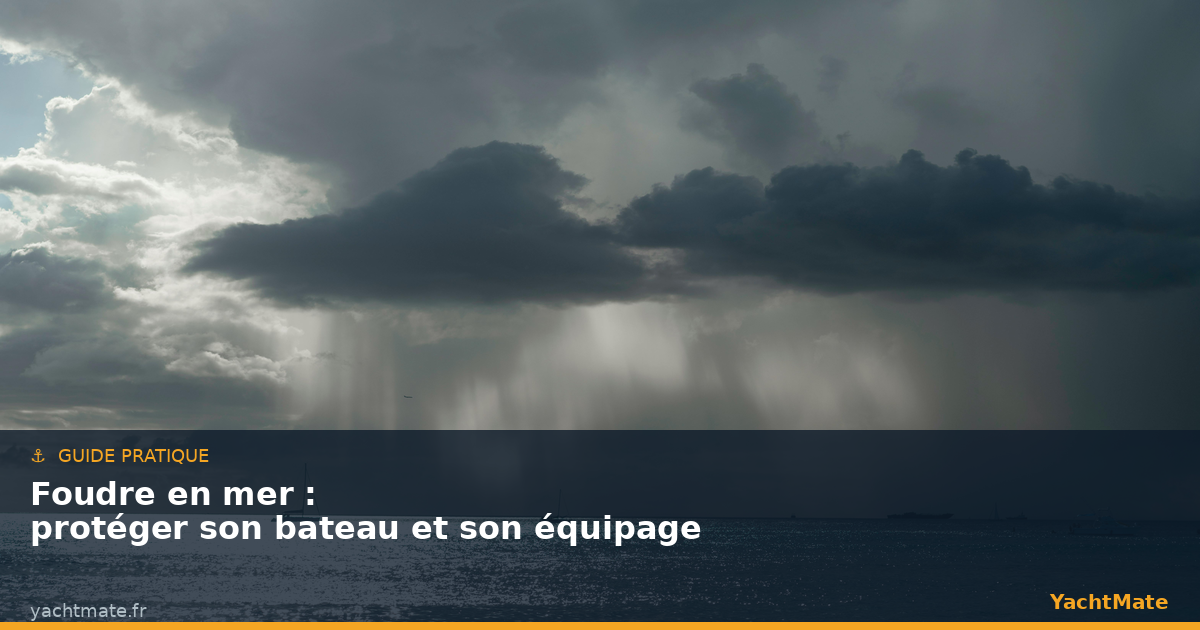
A sky that darkens within minutes, the sea stirring, and suddenly the first rumbles of thunder — lightning at sea is one of the most feared situations for sailors. Unlike on land, at sea you are often the highest point for miles around. A sailboat's mast is a prime target for lightning strikes, and the consequences of a direct hit can range from fried electronics to a boat fire. Yet with the right equipment and the right procedures, it is perfectly possible to sail safely even when a storm is threatening.
In this comprehensive guide, YachtMate explains how to assess the risk, equip your boat, and respond effectively when lightning threatens at sea.
Understanding the Risk: Why Boats Attract Lightning
Lightning always strikes the highest point in its vicinity. On open water or in a quiet bay, your sailboat — with its 12 to 20-metre mast — naturally becomes an involuntary lightning rod. Motor boats, though lower, are also vulnerable whenever a VHF antenna or radar arch protrudes above the hull.
A direct lightning strike carries a current of up to 30,000 amps and a voltage of several million volts. Even an indirect strike, several hundred metres away, can send a surge through your electrical system powerful enough to instantly destroy all your electronics: GPS, VHF, radar, autopilot, AIS… Losing those instruments mid-passage represents a genuine danger.
Learn the 30/30 rule: if you hear thunder less than 30 seconds after the lightning flash, the storm is within 10 km and it's time to secure the boat. Wait 30 minutes after the last thunderclap before resuming normal activity.
Essential Protection Equipment
1. The Lightning Rod: Essential on Sailboats
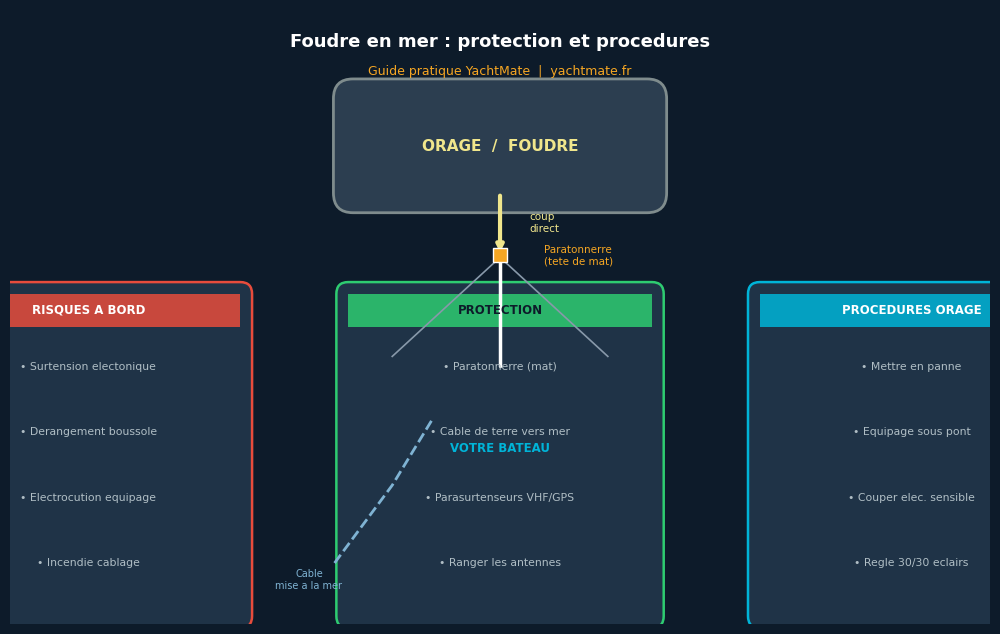
A marine lightning protection system is not a legal requirement in France, but it is your first line of defence. It consists of three essential components:
- The air terminal (or ionising lightning conductor) mounted at the top of the mast — the highest point on the boat
- The down conductor: a copper cable with a minimum cross-section of 16 mm², connecting the masthead to the sea via the most direct route possible, without sharp right-angle bends
- The sea ground plate: a permanently immersed copper plate of at least 900 cm² that dissipates the energy into the sea water
On a sailboat, the down conductor should ideally run outside the mast or in a dedicated conduit, never alongside the boat's wiring. The goal is to give the energy a low-resistance path to the sea, preventing the current from passing through your electronic circuits.
2. Surge Protectors for Your Electronics
Even with an excellent lightning protection system, indirect strikes can cause surges powerful enough to destroy your instruments. Surge protectors are wired into the supply lines of each sensitive piece of equipment: VHF, GPS, radar, autopilot, navigation instruments. They divert the voltage spike to ground before it reaches the electronics.
Budget around €30 to €80 per device for quality marine surge protectors — a modest investment compared to replacing a GPS or autopilot after a lightning strike.
3. The Boat's Natural Faraday Cage
On sailboats with an aluminium mast connected to the keel (itself conductive), the whole assembly naturally forms a partial Faraday cage. To maximise this effect, make sure that:
- The shrouds are properly connected to the chainplates, which are in turn bonded to the grounding circuit
- The lead or cast-iron keel is connected to the down conductor
- The ground cables of all electronic equipment converge to a single common ground point
If you don't have a permanent lightning protection system, you can make a temporary protection by connecting an anchor chain to the masthead (via a spare halyard) and trailing it in the water. This emergency solution provides a rudimentary conduction path but can limit damage from a direct strike.
Prevention: Reading the Weather to Avoid Storms
The best protection against lightning is avoiding storms altogether. Most incidents could have been prevented with a careful reading of marine weather forecasts. In the Mediterranean, summer storms typically fire up in the late afternoon after very hot days. In the Atlantic, they often accompany the passage of cold fronts.
A few practical rules before casting off:
- Check the GRIB weather forecast and the 48-hour outlook via the YachtMate app, Météo-France Marine or Windy
- Watch out for cumulonimbus (Cb) on the charts: their presence always signals a risk of violent thunderstorms
- On coastal passages, plan to arrive at the marina before 15:00 in summer to avoid late-afternoon storms
- At sea, watch the sky: Cb clouds develop very quickly (sometimes in under 30 minutes)
Emergency Procedures on Board During a Storm
If the storm is foreseeable (30+ minutes' warning)
As soon as the 30/30 rule alerts you or NAVTEX announces thunderstorms, begin preventive procedures:
- Head for shelter if you are within 2 hours of a port or a sheltered bay
- Bring portable antennas below (cockpit GPS, phones, handheld VHF) into the saloon
- Disconnect non-essential equipment from their power supplies and antenna connections
- Protect sensitive equipment in the microwave oven or in a closed metal box (Faraday cage effect)
- Put on wet-weather gear and safety equipment (harness, lifejackets)
- Notify someone of your position via VHF or phone before switching off the devices
During the storm
Once the storm is upon you, your absolute priority is the safety of the crew. Equipment can be replaced; people cannot:
- Get the whole crew below deck — the interior of the boat is the safest place (Faraday cage)
- If someone must remain in the cockpit, they should stay seated and not touch any metal parts (winches, stays, stainless-steel rails)
- Avoid touching the handrails, mast, shrouds or any conductive element connected to the mast
- Do not swim or dive during a storm — water conducts electricity very well
- Maintain heading into the wind for stability, or heave-to if sea conditions allow
"After a direct lightning strike, the priority is to check hull integrity before anything else — an exit hole in the hull is the leading cause of sinking after a lightning strike."
After a lightning strike
If your boat is struck by lightning, several checks are immediately required:
- Check the underwater hull: inspect the hull below the waterline for any holes or cracks caused by the current's exit point
- Pump the bilge if necessary and check the seacocks
- Test the magnetic compass: a lightning strike can permanently magnetise and throw off a compass
- Reset the breakers one by one and test each piece of equipment
- Report the incident to the coastguard and your insurer as soon as possible
Consider keeping a spare tablet or phone in a sealed metal tin (like a biscuit tin). Even if all your built-in electronics are destroyed, you will still have a working navigation device to reach port.
Insurance and Lightning: What You Need to Know
Most marine insurance policies cover lightning damage under their "all risks" or "perils of the sea" cover. However, check your policy carefully on several points:
- Does the cover apply both at the dock and under way?
- Are on-board electronics covered separately or included in the boat's agreed value?
- Is there a specific lightning deductible?
- Does the insurer require a lightning protection system to maintain cover?
Some specialist insurers offer an "on-board electronics" extension that specifically covers surge damage, often for a modest additional premium. On a modern boat fitted with a chartplotter, autopilot and AIS, this extension may protect €2,000 to €10,000 worth of equipment.
Conclusion: Prepare and Equip to Sail with Confidence
Lightning at sea is a real but manageable risk. The three pillars of good protection are weather anticipation (don't set sail if storms are forecast), preventive equipment (lightning rod, surge protectors, Faraday cage) and on-board procedures (crew below deck, sensitive equipment disconnected). By combining all three, you dramatically reduce the risk of serious damage.
YachtMate integrates real-time weather alerts and GRIB forecasts directly into the app, letting you detect approaching storms before you leave the dock. Prepare every outing with the right tools, and sail with peace of mind — even when the sky turns dark.
⚡ Stay safe at sea with YachtMate
Real-time weather alerts, GRIB forecasts, integrated NAVTEX and safety guides for all sailors.
Download YachtMate for free