
The liferaft is probably the most paradoxical piece of equipment on board: you spend a serious amount of money on something you hope never to open, you tuck it away in a corner and forget it for years. And yet, on the day you have to abandon ship — fire, uncontrollable flooding, a destructive dismasting, a collision — it is the liferaft, and only the liferaft, that stands between your crew and the open water. Choosing the right raft, equipping it properly, stowing it where it belongs and having it serviced on time is therefore anything but optional. This guide covers everything you need to make sure your liferaft is genuinely ready when it matters.
What a liferaft is for — and what it is not
A liferaft is a self-righting inflatable craft designed to keep a crew afloat, dry and sheltered while they wait for rescue. It deploys when you pull on a line (the painter), inflates automatically from a compressed-gas cylinder, and unfolds a canopy, a floor and ballast pockets that stabilise it. It is not a tender: it cannot be steered, it has no propulsion, and it is not meant to reach the shore. Its one job is to keep you alive until rescuers arrive.
Hence a universal golden rule among sailors: you only get into the raft when you have to "step up" into it — that is, literally when the boat is sinking beneath your feet. A yacht, even flooded or dismasted, is almost always a better survival platform than a raft: it is more visible, more stable, better equipped. The liferaft is the last resort, not the first reaction.
"Step up into the liferaft, never down." As long as you have to climb down to get into the raft, stay with the boat. You abandon ship only when the deck goes under the waterline. This old maxim has saved many a crew tempted to evacuate too soon.
Choosing your raft: the ISO 9650 standards
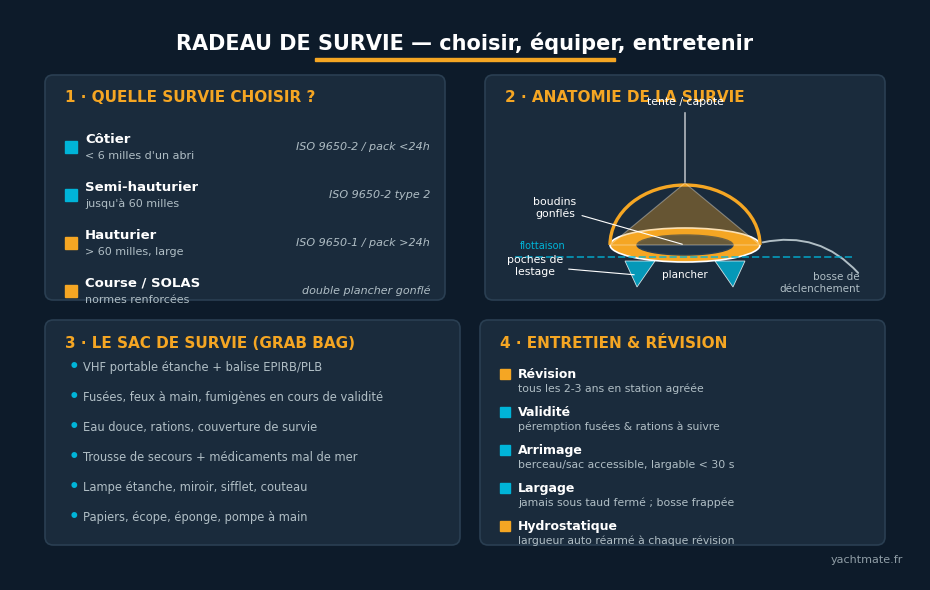
Since 2005, most recreational liferafts have complied with the ISO 9650 standard, which defines two broad families according to your sailing programme. The choice is driven above all by how far you go from a safe haven and the conditions you are likely to meet.
ISO 9650-1: the offshore raft
Designed for the open sea and severe conditions, it assumes low temperatures and large waves. It comes in two types depending on the temperature range (type 1 for cold waters, type 2 for temperate waters) and requires floor insulation, a robust canopy and a complete equipment pack. It is the mandatory choice as soon as you head genuinely offshore.
ISO 9650-2: the coastal raft
Intended for navigation close to the coast and in moderate conditions, it is lighter and cheaper. Its equipment pack is reduced because a quick rescue is assumed. It is fine for staying within a few miles of a refuge, but it quickly shows its limits offshore.
Beyond ISO, national regulations generally require a liferaft for offshore-category sailing (more than 6 miles from a refuge), and most offshore races demand rafts meeting the even stricter ISAF/World Sailing standards (inflated double floor, enhanced equipment). Then comes the choice of equipment pack: a <24 h pack, lighter, for fast assistance, or a >24 h pack, far more complete (water, rations, extra signalling gear) for a prolonged wait.
Capacity, packaging and stowage
A raft is chosen for a specific number of people: never pick one sized "just right" for your usual crew without thinking about guests. Conversely, a raft that is far too large stabilises poorly with only a few occupants. The practical rule: one raft for the maximum number of people you ever carry.
The packaging matters as much as the raft itself. Two options exist:
- The rigid canister (valise): watertight and UV-resistant, it mounts on a cradle on deck or on the stern rail. This is the ideal solution because the raft is exposed, immediately accessible and can be launched in seconds.
- The soft valise: lighter and cheaper, it must be stowed in a dedicated, ventilated and easy-to-reach locker. Never at the bottom of a cluttered locker or under a pile of gear: an inaccessible raft is useless.
Stowage is a critical point that is too often neglected. The raft must be able to be released and launched in under 30 seconds, at night, in bad weather, by a single person. Check that the cradle releases with one movement, that nothing blocks the path, and above all that the painter is firmly secured to a strong point on the boat before launching — without it, the inflated raft would drift away without you.
A hydrostatic release unit (such as a "Hammar") automatically frees the raft in a sudden sinking: under about 1.5 to 4 m of water, the water pressure cuts the strap, the raft floats to the surface and inflates. Essential if the boat goes down faster than you can react — but it must be re-armed at every service.
The grab bag: your seize-and-go kit
The raft contains a basic equipment pack, but it does not replace the grab bag you snatch as you leave the boat. This watertight, floating bag holds what really makes the difference between merely surviving and being found. Prepare it in advance and keep it near the companionway, ready to go:
- Alerting devices: a distress beacon EPIRB (or an individual PLB), a waterproof handheld VHF and, ideally, a satellite phone in a waterproof pouch.
- Signalling: parachute flares, hand flares and smoke signals within their validity dates, a signalling mirror, a waterproof torch, a whistle.
- Subsistence: fresh water (or a manual watermaker for offshore), energy rations, a survival blanket.
- Health: a first-aid kit, seasickness medication (a sick crew in a raft is a crew that dehydrates), sun protection.
- Practical items: a knife, a bailer and sponge, a spare inflation pump, the ship's papers and IDs in plastic, some cash.
One life-saving detail: also grab your warm clothes and a hat before leaving the boat. Hypothermia, even on a Mediterranean night, kills faster than hunger or thirst.
Boarding and surviving: the right moves
The abandon-ship scenario should be mentally rehearsed, ideally briefed at the start of the season. In order: get everyone into lifejackets and harnesses, send a Mayday on the VHF and activate the EPIRB before evacuating, secure the painter to a strong point, launch and inflate the raft on the leeward side of the boat, then board while staying as dry as possible. You take the grab bag, and you cut the link with the boat only when it threatens to sink and drag the raft down with it.
Once aboard: close the canopy, bail out, set up the rainwater collection system, appoint a lookout, and conserve flares and energy for the moment a ship or aircraft is in sight. The raft is not an end in itself, it is a waiting room: your job is to stay detectable, warm and hydrated.
A good liferaft is not just an approved raft: it is a raft that is well chosen, well stowed, up to date on its service, paired with a ready grab bag and a crew who know what to do.
Maintenance and servicing: the link everyone forgets
A liferaft is not a fit-and-forget item. The gas cylinder can lose its charge, flares and rations expire, the inflation collars degrade, and the hydrostatic release unit has an expiry date. Servicing at an approved station is therefore mandatory and vital: depending on the manufacturer and the standard, it usually happens every 2 to 3 years. There the raft is opened, inflated, inspected throughout, its equipment renewed and its container repacked.
Between two services, a few checks fall to you:
- Every season: check the next-service date printed on the container, the condition of the cradle and strap, the absence of impacts or cracks on the canister.
- Validity dates: keep track of the expiry dates of the flares and rations in your grab bag — they are not inside the raft but under your responsibility.
- Accessibility: regularly make sure nothing has come to obstruct access to the raft or block the cradle.
- After any incident: impact, a dropped container, accidental immersion — have the raft checked without delay.
Conclusion: the boat's life insurance
The liferaft is the equipment you fervently hope never to use, and that is precisely why it gets neglected. Yet its value only reveals itself at the worst possible moment, and by then it is too late to discover it was undersized, expired or impossible to find. Choose it according to your real sailing programme, stow it for an immediate launch, prepare a complete grab bag and keep the servicing up to date. That is the price for this canister you hope never to open to keep its promise: bringing the whole crew back to shore.
Keep your safety gear up to date with YachtMate
Track your liferaft service dates, the validity of your flares and all your safety equipment, and get your reminders at the right time, straight from your phone.
Discover YachtMate →