
Among all the mandatory safety equipment on board, the life jacket and safety harness top the list. Yet these devices are too often poorly chosen, poorly maintained, or — worse — left at the bottom of a locker for the entire season. Every year, tragedies at sea could have been prevented if the skipper or a crew member had been wearing their life jacket. This complete guide explains how to choose, use and maintain these essential pieces of equipment.
Life Jackets: Understanding ISO Standards
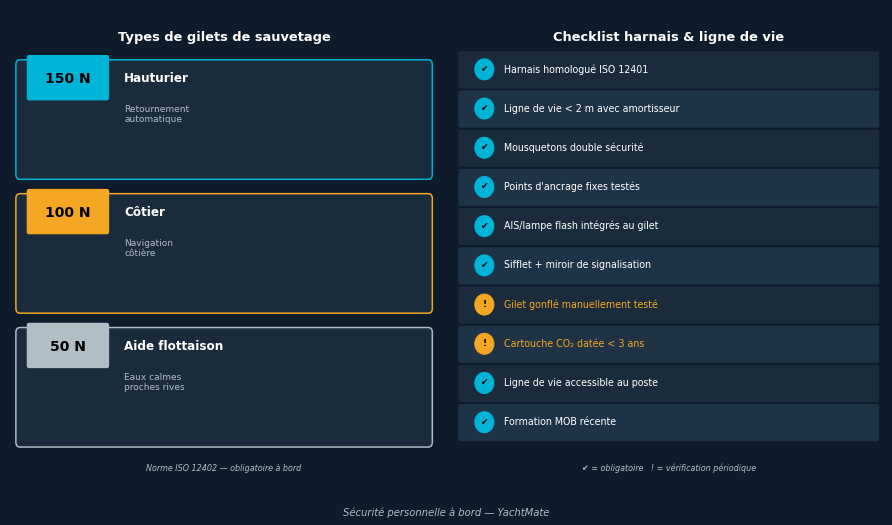
In France and throughout the European Union, life jackets for recreational boating must comply with the ISO 12402 standard. This standard defines several categories based on buoyancy expressed in Newtons (N) — a unit measuring the upward force exerted on the wearer.
The Three Main Categories
The 150 N life jacket (offshore) is the most powerful and the only one capable of automatically turning an unconscious person onto their back to keep the airway above water. It is indispensable for any offshore sailing, out of sight of land, or at night. Inflation can be automatic (hydrostatic or dissolving) or manual. For offshore sailing, always choose an automatic inflation model.
The 100 N life jacket (coastal) provides sufficient buoyancy for coastal navigation, within 2 nautical miles of the coast. It does not guarantee automatic self-righting of an unconscious person, but it keeps a conscious person's head above water. A good compromise for bay or estuary sailing.
The 50 N buoyancy aid is not a true life jacket in the regulatory sense. It is only suitable in calm water, close to shore, and for people capable of keeping themselves afloat. Reserve it for certain sporting activities very close to the bank.
Always check that the jacket bears the CE marking with the standard reference (e.g. "ISO 12402-3" for a 150 N jacket). A jacket without this marking is not recognised as compliant by French maritime authorities.
Safety Harness: Not the Same as a Life Jacket
A safety harness has a fundamentally different role from a life jacket: while the life jacket keeps you at the surface once you've fallen into the water, the harness prevents you from falling overboard in the first place. It is used in combination with a safety line (tether) that connects the harness to a fixed attachment point on the boat.
ISO 12401 Standard
Safety harnesses for recreational sailors must comply with ISO 12401. They must be able to withstand a dynamic load of 2.5 kN without failure. The harness typically includes a chest strap, shoulder straps and a waist strap, with a central attachment point on the sternum or back. Choose a model with adjustable straps to fit different body shapes if you sail with varied crew.
Combined Harness + 150 N Life Jacket
Many manufacturers now offer combination models integrating a 150 N life jacket and harness in a single jacket. These are particularly practical as they reduce the number of items to manage and encourage systematic wearing. Some high-end models even integrate an AIS beacon and a flash lamp, visible from several nautical miles away.
Safety Lines and Attachment Points
A harness is only useful if it is correctly connected to the boat. Safety lines (tethers) generally come in two forms: simple tethers (1.5 to 2 m) and adjustable Y-shaped twin-branch tethers, which allow you to remain permanently attached while moving around the deck — by clipping the second branch before unclipping the first.
The Shock Absorber: A Crucial Element
A 2 m tether without a shock absorber subjects the wearer to a potentially fatal impact force in the event of a fall. Always opt for a tether with a shock absorber (red indicator deployed = tether must be replaced) that limits the force to approximately 4 kN. Tethers compliant with EN 1095 must incorporate this shock absorber.
Jacklines and Fixed Attachment Points
Jacklines are safety lines stretched fore and aft along the deck, allowing crew to move without ever unclipping. Made from flat webbing (preferred over steel cables that can roll underfoot), they should be inspected at the start of each season. Fixed attachment points — deck rings, mast fittings and guard rails — should be regularly checked for corrosion or loose fixings.
Keep your tether as short as possible. A 1 m tether limits the impact zone and reduces the risk of being dragged under the hull. If you use a Y-tether with a 2 m branch, opt for a short 1 m branch that you keep on the main attachment point.
French Regulations
In France, the regulations for recreational vessels are set by the decree of 23 November 1987 as amended, and detailed in Division 240 (recreational navigation). Key points to remember:
- One approved life jacket per person on board is mandatory on all recreational vessels, regardless of navigation category.
- In categories A and B (offshore and semi-offshore, beyond 20 miles from shelter), 150 N life jackets are required.
- In category C (coastal, up to 20 miles), 100 N life jackets are sufficient.
- Wearing a life jacket is mandatory at night, in bad weather and in any dangerous situation.
- Children under 12 must wear their life jacket at all times on deck.
- Life jackets must be immediately accessible — do not store them in locked lockers.
"Wearing a life jacket is not optional: it's the difference between being found alive or not." — SNSM (French Sea Rescue Society) recommendation
Maintaining Inflatable Life Jackets
A poorly maintained inflatable life jacket may fail to deploy when you fall overboard. Carry out the following checks at least once a year, ideally before the start of each season:
CO₂ Cartridge Check
Remove the CO₂ cartridge and check its expiry date: usually engraved on the cartridge or printed on the label. A punctured, corroded or out-of-date cartridge must be replaced immediately. Weigh it to check it has not lost gas (compare with the stated weight).
Manual Inflation Test
Manually inflate the buoyancy chamber via the oral tube to check for leaks. The jacket should hold inflated for at least 24 hours without significant pressure loss. If you notice a loss, a seal or valve usually needs replacing.
Automatic Trigger Mechanism
Automatic mechanisms use either a dissolving pellet (bobbin) that melts on contact with water, or a hydrostatic sensor. Check that the bobbin is not damp or damaged, and that it bears the approval mark of your mechanism (UML, Hammar, etc.). If in doubt, replace the insert.
Photograph your life jackets (serial number, service date, mechanism type) and log annual maintenance reminders in the YachtMate app. You'll receive a notification before each season so you never sail with expired equipment.
Good On-Board Habits
Having the right equipment isn't enough — you also need to use it correctly. Here are some fundamental rules to adopt on board:
- Crew briefing: at every departure with new crew, show where life jackets are stored and how to put them on. It takes 3 minutes and can save lives.
- Strap adjustment: a poorly fitted life jacket can ride up above the head of an unconscious person in the water. Everyone must adjust their jacket to their own body shape.
- Anticipate wearing: put on your harness BEFORE going on deck in rough seas or at night. A simple rule: if you're hesitating, put it on.
- MOB alert: activate the integrated AIS beacon if you fall overboard. Without AIS, a whistle and mirror can be vital in open water.
Manage your boat's safety with YachtMate
Schedule annual checks, log your safety equipment and receive reminders before each season. YachtMate helps you sail with peace of mind.
Download YachtMate for free