
Antifouling and careening are two essential elements of boat maintenance. The hull is constantly exposed to harsh marine conditions that promote proliferation of marine organisms (algae, mollusks, microorganisms) capable of degrading sailing performance and damaging boat structure. Careening, or complete hull cleaning, is a major maintenance operation typically performed every 2-3 years, while antifouling, this special protective paint, plays a crucial role in preventing biological fouling between two careening cycles.
Understanding the mechanisms of biofouling and appropriate antifouling solutions allows you to extend your boat's lifespan, maintain its sailing or motorized performance, and significantly reduce long-term maintenance costs. This nautical expertise is essential for all pleasure boaters, whether sailing the Mediterranean, North Atlantic, or tropical waters.
Understanding Biological Fouling and Its Impacts
Biological fouling of the hull begins as soon as the boat touches water. Within the first few days, bacteria and diatoms colonize the hull surface, forming a practically invisible biofilm. Over weeks and months, larger organisms attach themselves: algae, barnacle shells (small mollusks), oysters, mussels, and in tropical waters, sponges and corals. This process accelerates in warm water, shallow water, and in areas with high nutrient input.
Consequences on Sailing Performance
A boat with a fouled hull consumes 40 to 50% more fuel than a clean boat for the same speed. Under sail, performance loss can be equally dramatic: a fouled hull increases drag proportionally, reducing speed and requiring better sail trim. Performance degrades progressively, often without the owner immediately noticing.
Structural Damage and Corrosion
- Hull osmosis — A phenomenon where water penetrates the gelcoat layer and causes blistering in polyester resin. Biological fouling accelerates this process by trapping moisture against the surface.
- Galvanic corrosion — Marine organisms create micro-electrochemical environments that accelerate metal corrosion (zinc, aluminum, stainless steel). Sacrificial anodes wear out faster.
- Cracks and delamination — The weight and pressure of heavy fouling, combined with contraction/expansion cycles, can create microcracks in the resin.
Use the sailing performance tracking in YachtMate to detect speed degradation. If your boat shows a progressive decline in average speed under the same wind and sail conditions, it may be time to schedule hull cleaning or careening. A loss of more than 10% of performance suggests significant biological fouling.
Antifouling Solutions: Types and Function
Modern antifouling paints use several chemical strategies to prevent marine organisms from adhering. The choice of antifouling type depends on boat type, operating environment, planned sailing duration, and growing environmental considerations.
Copper-based Antifouling (Leaching)
Traditional formulations contain copper oxide that dissolves slowly in water, creating a toxic layer around the boat. They are very effective but gradually being abandoned due to copper toxicity to marine ecosystems. They remain popular for boats sailing in cold waters where they last 18-24 months. Copper concentration is typically 30-50%.
Silicone-based Antifouling (Non-toxic)
These modern formulations use a smooth silicone surface that mechanically prevents organisms from gripping. They are environmentally friendly, very effective, and last 24-36 months. They are ideal for boats sailing in environmentally sensitive waters (Mediterranean, protected areas). The silicone layers partially regenerate during sailing, extending their lifespan.
Hybrid Antifouling (Copper + Silicone)
These formulas combine copper effectiveness with the durability and environmental benefit of silicone. They suit navigators seeking the best compromise, with a lifespan of 24-30 months under temperate water conditions.
- Polyurethane — Polyurethane base offering great hardness and durability, resisting abrasion well. Excellent for hulls frequently beached or exposed.
- Epoxy — Epoxy base very hard, excellent adhesion, long lifespan (up to 36 months). More difficult to remove at next careening.
- Polyester — Classical polyester base, cheaper, but shorter lifespan (12-18 months).
Plan your careening using YachtMate's voyage planning calendar. Set a reminder 2 months before your antifouling expires (typically 24 months after application) to give yourself time to find a haul-out slot and prepare. A spring careening before the summer season is often the best logistical choice.
Careening: A Major Maintenance Intervention
Careening is the complete and thorough cleaning of the hull out of the water. This operation requires a minimum of 3-5 days in the boatyard, a substantial investment (€2,000-€5,000 depending on boat size), but absolutely necessary to preserve the boat's value and performance. This regular preventive maintenance is infinitely preferable to accumulated damage requiring costly and complex structural repairs.
Steps of Professional Careening
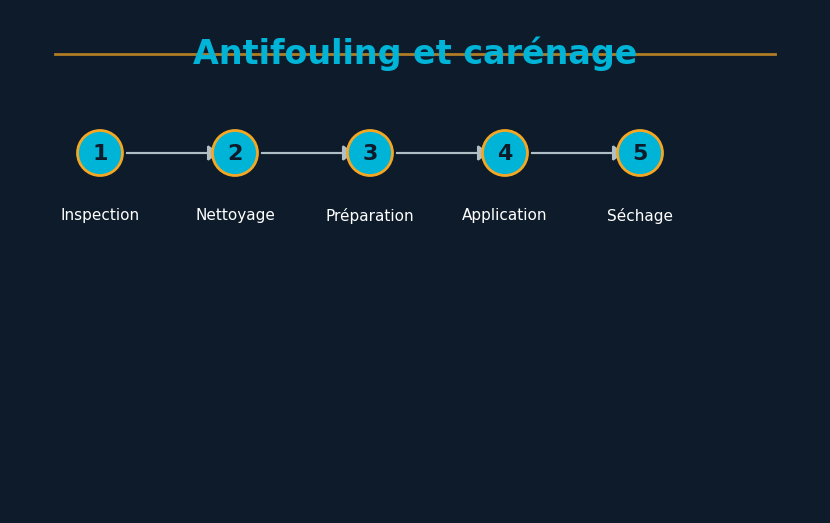
A complete careening begins with hauling the boat out of the water, usually at a boatyard equipped with haul-out facilities (some boats use floating docks or boat cranes). Once the boat is dry and supported, the cleaning and preparation work begins.
- Removal of sacrificial anodes — Worn zinc and aluminum are removed for inspection and possible replacement. This is an opportunity to check wear: if zinc disappears in 12 months, it signals accelerated galvanic corrosion.
- High-pressure washing — A high-pressure nozzle (80-200 bars) removes biological deposits, algae, and flaking old antifouling. This step is critical and requires expertise to avoid hull damage.
- Grinding and sanding — With an orbital grinder, remaining antifouling layers are removed and the surface prepared for optimal new antifouling adhesion. Work must be meticulous: any poorly sanded area will compromise adhesion.
- Thorough inspection — This unique opportunity allows detection of cracks, delamination, osmosis, or hidden corrosion. Careening every 2-3 years enables preventive maintenance.
- Minor repairs — Small gelcoat cracks, corroded areas, are repaired before new antifouling.
- Primer application — A primer coat adapted to the antifouling type is applied for optimal adhesion.
- Antifouling application — Usually 2 thin coats are applied with brush, roller, or spray gun, depending on boat size and boatyard. Each coat must be well-smoothed and properly cured.
A well-done careening every 2-3 years costs less long-term than accumulated structural damage and progressive performance degradation.
Choosing a Boatyard and Preparation
Choosing the right boatyard is crucial. Poorly executed careening (poorly prepared surface, antifouling applied in bad weather conditions, rushed repairs) will cause problems for 2-3 years until the next careening. Visiting the boatyard beforehand, talking with other boat owners, and checking references is very helpful.
Important Checkpoints
- Haul-out equipment — Does the boatyard have fixed haul-out ways, boat cranes, or floating docks? Fixed ways are generally safest for sailing yachts.
- Weather conditions — Antifouling can only be applied at 10-25°C temperatures, with no rain expected in the following 24 hours. Fall or winter careening risks delays.
- Insurance coverage — Verify the boatyard has good insurance. Some boatyards require deposits or demand complete boat insurance before hauling.
- Price transparency — Request a detailed estimate before careening. "Surprises" during careening (hidden corrosion requiring repairs, water infiltration) can double costs.
Use YachtMate's voyage planning to find reputable boatyards in your sailing regions. Schedule your annual careening 4-6 months in advance: top boatyards are fully booked March-September. Proactive planning avoids sailing with severely degraded antifouling.
Maintenance Between Careening: Intermediate Cleaning
Between two complete careening cycles, regular cleanings extend antifouling lifespan and maintain performance. These cleanings don't replace careening but slow fouling accumulation.
In-Water Cleaning
A diver cleans the submerged hull with a soft brush or scraper, without damaging antifouling. This operation costs €200-€400 and takes 2-3 hours. It's recommended every 12 months in warm waters or 18 months in cold waters. It's an excellent opportunity to verify overall hull condition, anode wear, and detect problems early.
Mooring Cleaning
For boats remaining at anchor, regular manual cleaning (every 3-4 months) with a soft brush and seawater limits biological fouling. This technique only effectively removes fine algae and biofilms; it's insufficient against established barnacles or mussels.
Ecological Considerations and Regulation
Environmental regulations regarding antifouling have strengthened considerably. The 2001 International Convention on Control of Harmful Anti-fouling Systems banned toxic organotin compounds (like TBT) in many countries. The European Union has also strengthened standards, with marine protected areas prohibiting certain antifouling types.
- Copper antifouling — Tolerated but increasingly limited. Protected areas (certain Mediterranean bays, oyster farming zones) ban copper above concentration thresholds.
- Biocide-free antifouling — Silicone or mechanical formulations (smooth surface) are encouraged and often mandatory in sensitive waters.
- Compliance declaration — Some ports require an antifouling declaration during careening to trace environmental impact.
Choosing ecological antifouling costs only €200-€400 more than traditional formulation, protecting the marine ecosystems you love to visit.
Costs and Budgeting
The total cost of careening includes several items: haul-out fees (€500-€1,500 depending on type and region), preparation labor (€500-€1,500 depending on surface area), antifouling (€500-€1,500 depending on type), miscellaneous unexpected repairs (€500-€2,000 on average), and re-launching (€300-€800). For a 12m boat, expect €3,500-€7,500 total for complete careening every 2-3 years.
Though significant, this expense is sound investment. Regular careening increases resale value, reduces fuel costs through optimal hull performance, and prevents costly major repairs from corrosion or osmosis. A well-maintained boat with regular careening sells 20-30% higher than a neglected one.
Navigate Smarter with YachtMate
Discover how YachtMate improves your coastal and offshore sailing with planning tools, performance tracking, and maintenance management features.
Discover YachtMate →