

On most modern cruising sailboats, the headsail is no longer hoisted — it is unrolled. The genoa furler has transformed life on board by letting you set and shorten the headsail straight from the cockpit, without going forward onto a pitching foredeck. It is a huge convenience, but also a permanently loaded mechanical system that deserves to be understood and maintained. Here is how it works, how to use it cleanly, and how to keep it reliable season after season.
1. What a furler is for
A furler lets you set, roll and reef the headsail simply by pulling a line from the cockpit. No more hauling on the halyard, dropping the sail on deck and stuffing a soaked genoa into a bag: the sail stays on the forestay, ready to use. This safety gain is decisive when the wind builds, because shortening sail no longer means sending crew forward.
A distinction should be made between the genoa furler (headsail) and the mainsail furler (in the mast or in the boom), which follows different rules. This article covers the former, by far the most common. The trade-off for the convenience: a partly furled sail loses efficiency once reefed, and the system adds weight and fragility at the top of the forestay. Correctly set up and maintained, it nonetheless remains one of the best compromises in cruising.
2. How it works
A classic furler is built from a few connected parts. At the bottom, the drum takes the furling line and turns its pull into rotation. A rigid foil (or extrusion) slides over the forestay, fitted with a groove — the luff track — into which the sail's luff is fed. At the top, the halyard swivel lets the sail rotate freely while the forestay itself stays still. Turning the drum rotates the foil and rolls or unrolls the sail like a blind.
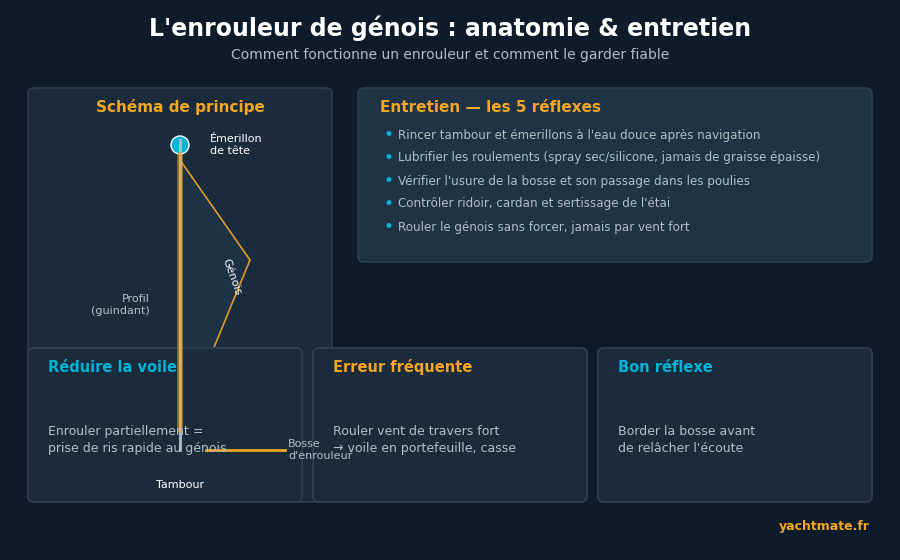
The key point: the furler does not replace the forestay, it encloses it. The cable holding the mast forward is still the same safety-critical part, but it becomes invisible and harder to inspect. This is why a forestay failure on a furler-equipped boat is often spotted too late — hence the checks described below.
3. Everyday use
To unfurl, ease the furling line gradually while taking in the sheet on the winch. The sail comes out under control: never let the furling line run free, or the sail deploys all at once and can flog violently. To furl, do the opposite: ease the sheet slowly while pulling firmly on the furling line, ideally bearing away a little to blanket the sail. A slight residual tension on the sheet guarantees a tight, even roll.
Three moves that change everything
- Blanket the sail before furling: bearing away slightly or sheeting in the mainsail to shadow the genoa greatly reduces the load and the risk of a jam.
- Keep tension on the sheet while furling for a tight roll that will not unfurl by itself.
- Watch the wraps on the drum: the furling line must wind the right way and stay neatly stowed, or it jumps out of its groove.
Before every manoeuvre, glance at the drum: the line should be clean, without whipping snags or knots, and wound flat. An overriding or overlapping line is the number one cause of a jam mid-manoeuvre.
4. Reefing with the furler
The furler lets you progressively reduce genoa area, the equivalent of a reef. It is handy, but has limits. Beyond 30 to 40 % reduction the sail becomes very full, the clew rises and efficiency collapses: the boat heels without moving. To hold course under a reefed genoa, many sails have a foam luff that offsets the draft and keeps a flatter profile.
In a breeze, the good practice is to anticipate: better to take a turn or two early than to force a loaded system once the wind has already built. You should also move the sheet car forward as the sail shrinks, to keep a correct sheeting angle and flatten the foot.
5. Mistakes to avoid
- Furling in strong wind on a beam or close reach: the full sail takes enormous loads and can wrap on itself. Bear away to blanket it first.
- Leaving the line slack and unsecured: a genoa unrolling on its own at anchor in a gust is a classic breakage. Always cleat the furling line and take one turn on the sheet.
- Neglecting the foam luff and expecting a good shape when deeply reefed: without it, the reduced genoa sets poorly.
- Forcing on the winch when it jams: stop, find the cause (overriding line, seized swivel) instead of breaking a part.
6. Maintenance
A furler is a simple mechanism, but exposed to salt, UV and permanent tension. Light, regular care is enough to make it very reliable. The golden rule: fresh water and nothing greasy. Modern bearings run dry or with a dry lubricant; thick grease traps salt and grit and eventually seizes them.
| Frequency | Task |
|---|---|
| After every salty outing | Rinse drum, swivel and foil with fresh water |
| Monthly (in season) | Inspect the furling line, its lead blocks and wear |
| Each season | Lubricate bearings (dry/silicone spray), check drum fastening |
| Each season | Check the turnbuckle, toggle, swage and strands of the forestay |
| Every 8-10 years | Remove and replace the forestay (wire) even with no visible fault |
Use a lowered mast or a yard visit to have the lower swage of the forestay inspected: it is the first zone to fail and is often hidden by the drum. A broken wire strand ("meat-hooking") calls for immediate replacement.
7. Common failures
The most frequent failure is not mechanical but the furling line: it overrides on the drum and jams everything. Fix it by fully unfurling then rewinding cleanly under light tension. Next comes the seized swivel, giving a sail that turns badly or twists: a vigorous rinse and a dry lubricant often solve it; otherwise, strip it down.
Rarer but serious: a cracked foil at a joint, which snags the luff, and above all invisible forestay corrosion under the foil. At the slightest doubt — abnormal noise, play, rust spots at the drum or masthead — have a rigger examine the whole assembly before going back out. A well-maintained furler lasts decades; it is the wire inside that sets the deadline.
Keep your maintenance checklists at hand
YachtMate centralises your maintenance reminders, sail settings and logbook, and warns you before every deadline. Free.
Discover YachtMate