

Cooking a hot meal after a day under sail, boiling water for tea at anchor: on the vast majority of pleasure boats, gas remains the simplest and most efficient energy source for the galley. It is also one of the most dangerous systems on board when neglected. Liquefied petroleum gas (LPG) — butane or propane — is heavier than air: in the event of a leak it does not disperse, it sinks and pools in the bilge, where the smallest spark can trigger an explosion.
The good news is that the risk is almost entirely controllable. A compliant installation, regular checks and a few good habits are enough to make gas perfectly safe. This guide reviews the anatomy of a gas circuit, the essential inspections and what to do when in doubt.
Why gas demands special vigilance
Ashore, a gas leak dilutes into the atmosphere. On board, the boat is a closed hull where air circulates poorly. LPG, roughly twice as dense as air, behaves like an invisible liquid: it slides down bulkheads, crosses floorboards and stagnates in the bilge, the engine bay or the cabin sole. A few litres are enough to form an explosive mixture.
Marine insurers' statistics leave no doubt: the majority of onboard explosions are caused by gas or fuel vapours, and they almost always occur on ageing or improvised installations. The reference standard in Europe, ISO 10239, precisely governs the design of these circuits. Following it is not an administrative formality: it is what separates a reliable appliance from a time bomb.
Anatomy of a compliant gas installation
A correctly designed gas circuit reads like a logical chain, from bottle to burner. Each link plays its safety role.
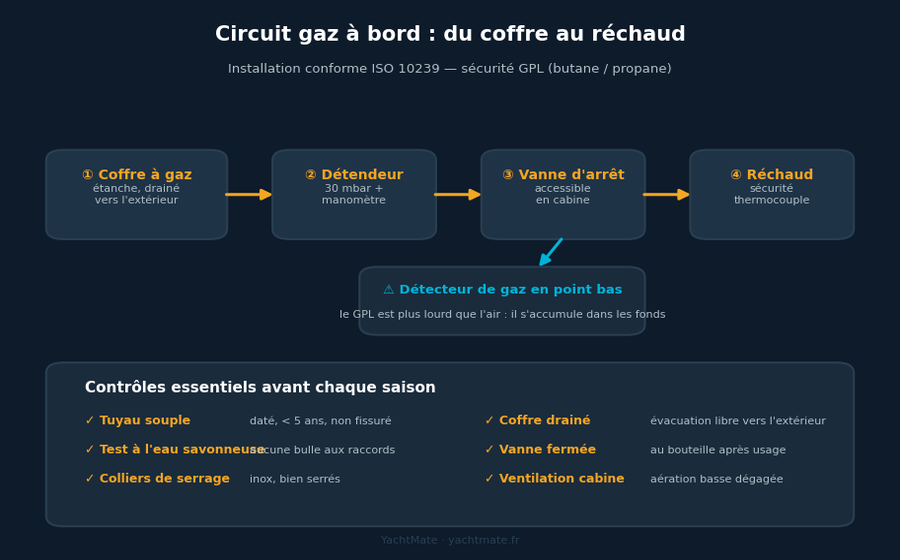
The gas locker
The bottle(s) must be housed in a sealed, dedicated locker drained to the outside, on deck or in a compartment opening only outward. The principle is simple: if a bottle leaks, the gas flows out through the drain at the bottom of the locker and escapes overboard, never into the boat. The drain must never be blocked and must exit above the waterline.
The regulator and hose
The regulator lowers the bottle pressure (several bar) to working pressure, generally 30 mbar for butane and propane in Europe. A regulator fitted with a pressure gauge lets you check the tightness of the circuit at a glance. The flexible hose connecting the system is the most fragile element: it ages, hardens and cracks. It carries an expiry date; beyond five years, replace it without question. Connections are secured with stainless steel clips, never hand-tightened alone.
The shut-off valve and stove
An accessible shut-off valve must be installed in the cabin, ideally near the stove, to cut the supply without having to open the locker. A modern stove is fitted with a thermocouple flame-failure device on each burner: if the flame goes out, the gas supply cuts off automatically. It is essential protection against flames blown out by a gust or a boiling-over pot.
Get into the habit of closing the valve at the bottle after every use, not just the stove knob. You isolate the whole circuit and purge the hose: in the event of a micro-leak at a fitting, no gas lingers in the boat overnight.
Gas detectors: your safety net
The odour added to LPG remains the first warning, but the sense of smell tires quickly and detects nothing during sleep. An electronic gas detector, with its sensor placed at the lowest point of the cabin — where LPG accumulates — provides decisive safety. It sounds an alarm well before the concentration reaches a dangerous level.
Distinguish two complementary devices: the combustible gas detector (LPG, propane) is mounted low; the carbon monoxide (CO) detector — a deadly gas produced by incomplete combustion or a nearby engine — is mounted at berth height. On a liveaboard boat, both have their place.
Regular checks and maintenance
A gas installation is never "fitted once and forgotten". It must be checked, ideally at the start of each season and after any lay-up. Here are the basic verifications:
- The flexible hose: check the date, the absence of cracking, stiffening or crushing marks.
- Tightness with soapy water: brush the connections under pressure; any bubbling indicates a leak to fix immediately.
- The stainless clips: properly in place and tight.
- The locker and its drain: clear, clean, free flow to the outside.
- The low ventilation of the cabin: vents clear, never blocked by stowage.
- The gauge test: close the bottle, the circuit stays pressurised; if the needle drops, there is a leak.
Never look for a leak with a flame. Soapy water applied with a brush to each fitting is the only safe method: bubbles reveal escaping gas with no risk of ignition.
What to do in case of a smell or leak
If you smell gas on board, act methodically and without panic:
- Shut off the supply at the bottle immediately.
- Do not operate any electrical switch, do not start the engine, light nothing: the smallest spark is the trigger for an explosion.
- Ventilate wide open: open hatches and companionway to flush the air.
- Clear the bilge: since gas pools low, it sometimes has to be removed manually with a bilge blower or by emptying the bilge.
- Only restore the circuit once the leak is located and repaired, and the smell has completely dissipated.
Plan your stopovers and anchorages with YachtMate to anticipate bad-weather days when you will be confined on board with the stove running. A well-ventilated cabin and a checked installation mean peace of mind when the weather keeps you inside.
Butane or propane: which to choose?
Both gases run on the same 30 mbar installation, but they differ on one decisive point: cold. Butane stops vaporising as soon as the temperature approaches 0 °C; it suits summer sailing in the Mediterranean or the tropics. Propane stays usable down to about -40 °C: it is the obligatory choice for winter sailing, the North Atlantic or high latitudes. In exchange, propane works at a higher bottle pressure, requiring a suitable regulator and components.
One last tip: abroad, bottle connection and deposit systems vary enormously from one country to another. Before a long cruise, check the availability of your bottle type along your route, or carry a set of adapters.
Sail with peace of mind with YachtMate
Marine charts, weather, anchorages and stopover points: prepare every outing and every cruise in a single app built for boaters.
Discover YachtMate →