
Freshwater is undoubtedly one of the most precious resources on board any vessel. Whether you are coasthopping with frequent marina stops or crossing the Atlantic singlehanded, mastering freshwater management is an essential skill for every sailor. Miscalculating your needs can turn a pleasant cruise into a serious source of stress.
In this article we offer a complete guide to calculating your consumption, optimising storage, reducing water expenditure and equipping yourself correctly to sail confidently even at a remote anchorage.
Calculating Your Daily Freshwater Consumption
Before departure, it is essential to estimate how many litres you will use each day. In economical navigation mode, an experienced sailor can manage on 15 to 20 litres per day, while a crew unused to boat life may consume two or three times more without even noticing.
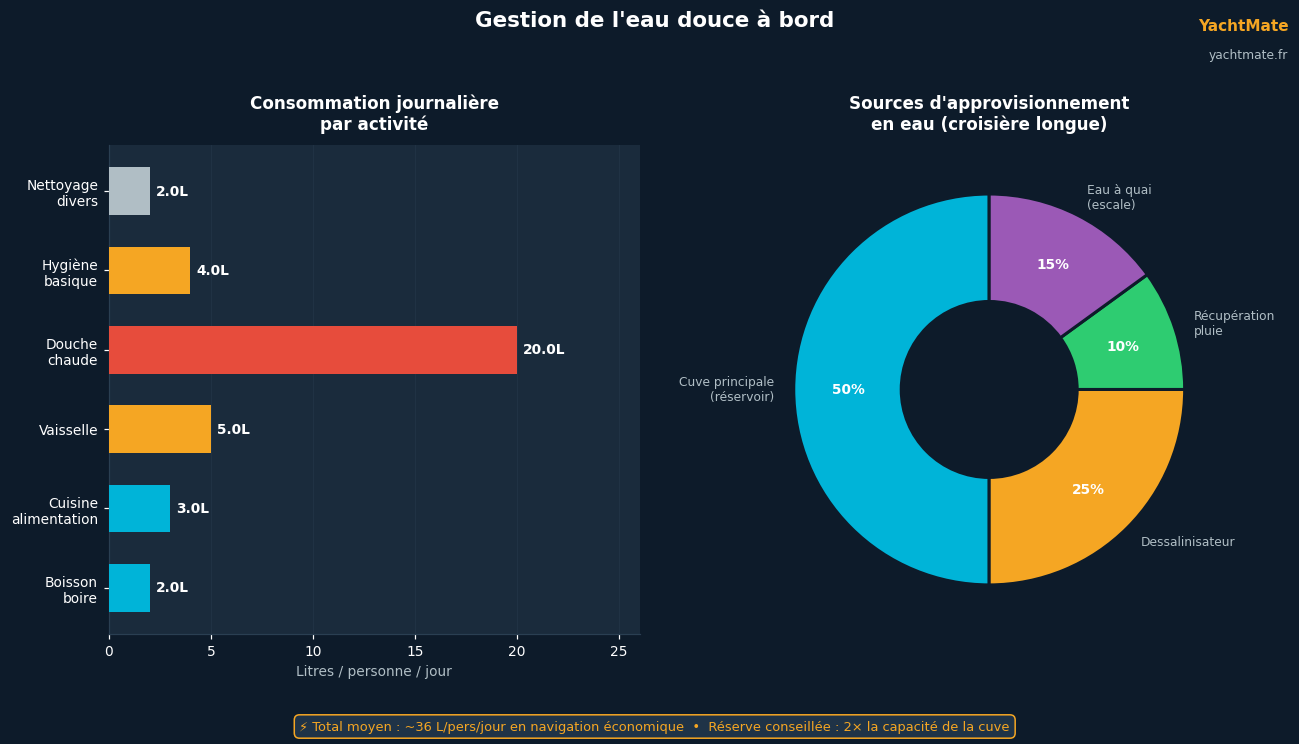
Here are the main consumption categories and realistic estimates for economical sailing:
- Drinking: 2 litres per person per day (vital minimum)
- Cooking: 3 litres (pasta, rice, coffee, tea, etc.)
- Washing up: 5 litres using the two-basin method
- Basic hygiene (hands, face): 4 litres
- Hot shower: 15–20 litres (best reserved for marina stops)
- General cleaning (deck, cockpit): 2 litres
That totals around 36 litres per person per day in normal use, or roughly 16 litres in ultra-economical mode (no hot shower). For a crew of four over a week, plan between 450 and 1,000 litres depending on your usage profile.
Use YachtMate to plan your stopovers by identifying ports and marinas where freshwater is available at the pontoon. This lets you optimise your range without overburdening your tanks.
Understanding and Optimising Your Onboard Storage
Freshwater storage capacity varies enormously by boat type and size. A small 30-foot sailboat typically carries 100 to 150 litres, while a catamaran or large cruiser can hold 500 to 800 litres or more.
Types of Water Tanks
Polyethylene food-grade tanks are the most common and affordable. Stainless-steel tanks are more durable and do not affect water taste, but are heavy and expensive. Some boats have integrated tanks moulded into the GRP hull — a compact solution but difficult to inspect and clean.
It is recommended to divide your storage capacity into two or more tanks with independent isolation valves. If one tank becomes contaminated, you can continue sailing on the other. Many sailors also add 10- or 20-litre jerrycans as an emergency reserve.
Tank Maintenance
A neglected tank can develop algae, biofilm or lime-scale deposits that make the water unfit to drink. Best practices include rinsing and disinfecting tanks at least twice a year, using food-safe chlorine purification tablets (never domestic bleach), flushing the whole circuit after filling, and regularly inspecting hose joints and fittings.
Techniques for Saving Freshwater Under Sail
Developing good habits from the very start of a cruise can double your range without any notable sacrifice in comfort. Water management is primarily a question of habits and organisation.
In the Galley
The galley accounts for a significant share of consumption. Simple tricks make a real difference: cook pasta or rice in seawater (mixed with a little fresh water to avoid excess saltiness), use a pressure cooker that requires less water, or prepare sauced dishes rather than boiled ones.
Washing Up
The two-basin technique is indispensable on board. Fill one basin with soapy water (fresh or sea water with biodegradable washing-up liquid) for washing, and a second basin with clean fresh water for rinsing. This method washes up for four people using only 3–5 litres of freshwater.
In the Mediterranean, seawater is clean enough for pre-rinsing vegetables or a first wash of crockery. Always reserve freshwater for the final rinse and drinking. Avoid using seawater for rinsing in polluted harbour areas.
Showers and Personal Hygiene
Showers are the largest individual freshwater consumer on board. Several solutions help reduce this: a solar shower bag (10–15 litres on deck in the sun gives ample warm water), a low-flow showerhead (4–6 L/min instead of the standard 10–15 L/min), a sea-water deck tap for pre-rinsing salt off your body, and rinse-free shower gel for tough passages.
Supplementary Solutions: Watermaker, Rainwater, Marina Supply
The Reverse-Osmosis Watermaker
For offshore cruisers or anyone seeking full autonomy, a reverse-osmosis watermaker is the game-changer. It converts seawater into drinking water by forcing it through a semi-permeable membrane under high pressure. A standard 12V unit produces 30–60 litres per hour consuming 4–8 amps.
A quality watermaker costs between €2,000 and €6,000 to purchase, plus running costs (membrane replacement every 3–5 years, regular filters). It requires a suitable electrical system and careful battery or solar-panel management. For a cruise longer than one month or an Atlantic crossing, the investment pays back rapidly in peace of mind.
Rainwater Collection
A simple and cost-effective solution is to channel rainwater collected on deck into your tanks. A sail or cockpit awning, slightly angled toward a low point with a hose, can collect tens of litres during a tropical downpour. Important: the first few minutes of rain wash the deck (salt, dust) — do not collect this run-off. Wait 2–3 minutes before opening your collection circuit.
Refilling at Marinas
Intelligent passage planning lets you refill regularly without ever running low. Most marinas offer a potable water tap on the pontoon. Rates vary by country (free in many French ports, metered elsewhere). Navigation apps like YachtMate indicate water availability and access hours at ports along your planned route.
Always calculate your water autonomy with a safety margin of at least 30 %. If you depart with exactly the quantity calculated for the voyage, any delay, weather event or higher-than-expected consumption will leave you short. Build in the buffer.
Recommended Equipment to Improve Onboard Water Management
Beyond water-saving behaviour, certain pieces of equipment significantly improve onboard water management: an electronic tank level gauge with cockpit display, a foot or hand pump (more economical than an electric pump and naturally discourages waste), an inline activated-carbon filter for taste and odour, a solar or engine-heat water heater, and a thermostatic mixer tap to avoid wasting cold water while waiting for hot.
Plan Your Cruise with YachtMate
YachtMate is designed to help you anticipate all the logistical constraints of a cruise, including the management of essential resources like freshwater. Using its stopover database, you can locate in advance every port with potable water along your planned route and adjust your navigation schedule accordingly.
Whether you are preparing a Mediterranean crossing, a tour of Corsica or an ocean passage, good freshwater management is just as fundamental as fuel planning or weather preparation. Don't leave it to chance.
🌊 Sail with Full Autonomy Using YachtMate
Plan your stopovers, manage your resources and navigate confidently with the YachtMate mobile app — available on iOS and Android.
Discover YachtMate