
Fishing from a sailboat merges navigational mastery with ichthyological expertise, creating a rich maritime experience where contemplative waiting transforms into piscatorial exhilaration. Unlike coastal fishing where a vessel remains stationary, anchored or underway fishing demands sophisticated understanding of aquatic habitats, seasonal migrations, and technique adaptation to dynamic weather conditions. This comprehensive guide explores specialized fishing equipment, navigation tactics optimized for fishing success, and conservation regulations governing maritime fishing activities.
Equipment Selection and Casting Technique
Shipboard fishing equipment must be robust, compact, and corrosion-resistant to marine salt exposure. Unlike freshwater rods designed for light applications, marine fishing rods must handle substantial catches and withstand persistent salt corrosion. Multiplier reels offer superior control and recovery power against oceanic prey. For sailboat fishing, choose lightweight, portable systems that neither compromise boat stability nor interfere with rigging integrity.
Marine Rod and Reel Categories
Marine fishing rods categorize by line class and power rating. A 15-30 pound class rod suits Mediterranean species (gilt-head bream, mackerel, greater amberjack), while a 30-50 pound class handles robust species (bluefin tuna, swordfish). Modern multiplier reels include magnetic braking systems reducing backlashes and improving casting precision. Select models featuring corrosion-resistant gearboxes and alloy spools for saltwater environments.
- Spool capacity and line type — A 300-400 yard spool manages long-distance fights and strong currents. Braided lines offer superior sensitivity compared to monofilament.
- Leaders and knot systems — Use 30-50 pound fluorocarbon leaders attached with Albright or Palomar knots to prevent breakage during powerful strikes.
- Artificial lures and live bait — Lures imitating forage fish (anchovies, sardines) effectively attract predators. Small jigs (7-14cm) excel in drift fishing applications.
Use YachtMate's integrated fishing log to record GPS positions of catches, species captured, and weather conditions. This digital history reveals seasonal patterns and dramatically improves success rates over time.
Adaptation to Wind and Current Conditions
Fishing from a moving sailboat presents unique challenges. Drift caused by wind and currents affects lure trajectory and strike detection sensitivity. Learn to calculate drift angles and adjust casting technique accordingly. Trolling (towing lures behind the vessel) exploits the sailboat's natural movement simulating fleeing forage fish.
Trolling Techniques and Navigation
Coastal trolling remains effective even in light breezes. Maintain speeds of 3-5 knots for natural lure action. Trolled lures must attach to 40-60 pound lines with outriggers to maximize distance from boat wake. Use YachtMate navigation to identify bathymetric variations (sandbars, reefs) where fish concentrate. Transition zones between shallow and deep waters (drop-offs) constitute highly productive areas.
- Lure spacing and depth — Troll multiple lures at different depths (surface, mid-water, bottom) using outriggers to increase coverage area.
- Speed and lure selection — Adjust speed based on fish response. Slow lures suit winter fishing; fast lures stimulate spring aggression.
- Sounder monitoring — An integrated fishfinder reveals depth and fish school presence enabling instant strategy adjustments.
Navigation Optimized for Fishing Success
Effective fishing navigation combines bathymetric knowledge, understanding of seasonal migrations, and recognition of productive habitats. Pelagic migratory species follow specific corridors dictated by temperature and currents. Demersal species inhabit rocky areas or underwater pinnacles offering shelter and abundant food.
Recognition of Productive Fishing Habitats
Reefs, seagrass beds, and high-productivity marine zones attract fish concentrations. Consult detailed bathymetric charts and marine productivity data to identify target zones. Coastal areas with upwellings (cold nutrient-rich water rising) constitute fishing magnets. Coastal currents create thermal fronts where fish concentrate exploiting abundant forage.
Successful fishing begins with site selection. The best sailboat fishermen are first oceanographers understanding habitats, migrations, and marine ecological rhythms.
- High-resolution bathymetric charts — Use YachtMate's detailed nautical charts including bathymetry, currents, and marine protected areas.
- Fishfinder and sounder technology — A quality sounder detects depth, rocky structures, and submarine fish schools.
- Water temperature logging — Record temperature variations; certain species prefer specific ranges (16-19°C for bream, 18-22°C for amberjack).
Activate YachtMate's fishing zone alerts notifying you when approaching productive recorded habitats. The app creates personalized digital mapping of favorite fishing zones based on catch history.
Advanced Capture Strategies
Beyond equipment and navigation, fishing success depends on adaptable strategies and instant reactivity. Pelagic species demand constant vigilance and hook-setting technique establishing solid connection without line breakage. Robust demersal catches require sustained recovery power and mechanical tension management.
Hook Setting and Recovery Technique
When a fish strikes the lure, a sharp, powerful hook-set establishes the hook firmly in the fish's mouth. Raise your rod explosively while maintaining pressure. Once hooked, maintain constant tension avoiding extreme tension surges risking breakage. Large catches demand patient recovery allowing the reel to progressively spool while managing asymmetric tension loads.
- Drag adjustment — Set reel drag to slip under vigorous pressure; too tight breaks the line, too loose loses the fish.
- Pump and retrieve cycles — Raise the rod recovering line, then lower while reeling. This "pumping" maximizes recovery efficiency.
- Boat balance management — Large catches create asymmetric loads. Reposition yourself maintaining boat balance avoiding excessive heel.
Coastal Species and Regional Techniques
Each marine region features unique fish species requiring specific techniques. The Mediterranean abounds with gilt-head bream, greater amberjack, and Atlantic mackerel. Coastal Atlantic France harbors robust species: sea bass, pollack, and saithe. Understanding regional species biology and feeding preferences dramatically amplifies fishing success.
Mediterranean and Atlantic Species Profiles
Gilt-head bream (Sparus aurata) seek rocky shallow areas and seagrass beds, striking small crustaceans and forage fish. They respond well to medium-sized natural-colored lures (8-12cm). Greater amberjack prefer deeper water and currents, feeding on larger forage fish. Atlantic sea bass inhabit surf zones and estuaries, particularly during spring and autumn migrations.
- Gilt-head bream — Optimal fishing during dawn and dusk. Use 8-12cm lures imitating bream or small forage fish.
- Greater amberjack — Pelagic migratory species. Troll larger lures (15-20cm) at moderate speeds. Catchable year-round in Mediterranean.
- Atlantic sea bass — Seasonal migrants. Optimal in autumn and spring. Seek rocky coastal zones and estuaries.
Consult YachtMate's integrated marine species database documenting regional habitats, breeding seasons, and legal size regulations. This digital reference ensures regulatory compliance and marine ecosystem respect.
Safety Equipment and Regulatory Compliance
Maritime fishing is governed by strict regulations concerning protected species, minimum sizes, and catch quotas. Before any outing, familiarize yourself with local legislation and required safety equipment. An enhanced first aid kit, sharp knives, and protective gloves constitute minimal equipment for safe catch handling.
Onboard Safety and Conservation Regulations
Maintain a clear fishing area aboard avoiding cables and obstacles. Combative catches cause sudden movements; ensure crew remains informed and positioned safely. Check CITES regulations concerning threatened species (certain swordfish, giant grouper) prohibited from coastal capture. Respect minimum catch sizes protecting juvenile populations critical for reproduction.
- Safety equipment — Rod security straps, protective gloves, sharp knives, and a hook remover for safe hook extraction.
- Documentation and compliance — Maintain catch records and sizes justifying regulatory compliance during coastal inspections.
- Protected species and quotas — Consult official fishing notices identifying protected species and seasonal closure periods.
Maintenance of Shipboard Fishing Equipment
The corrosive marine environment deteriorates fishing equipment rapidly if neglected. After each outing, rinse rods, reels, and accessories with filtered freshwater. Lubricate reels monthly with marine-grade grease resisting salt. Regularly inspect rod guides for damage risking line fraying.
- Post-fishing rinsing — Systematically rinse all equipment with filtered freshwater after each outing eliminating salt deposits.
- Reel lubrication — Apply specialized marine grease to pivot points and gearboxes every 4-6 weeks during intensive use.
- Secure storage — Store rods horizontally in protective cases away from corrosive elements and excessive humidity.
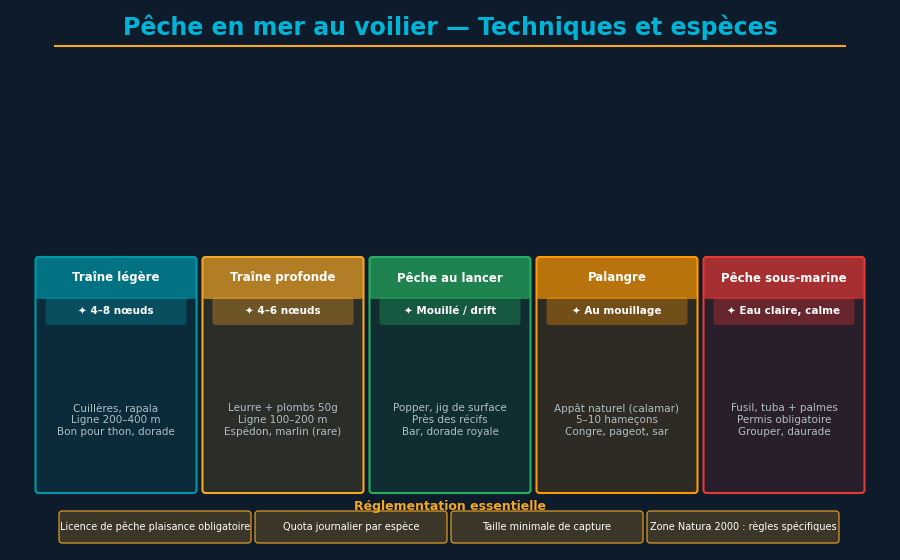
Optimize Your Fishing Outings
YachtMate integrates bathymetric charts, electronic sounder, and fishing log to maximize your catches.
Explore Coastal Fishing →