
First aid at sea comprises essential emergency medical skills that every boat crew must master. Navigating far from shore means emergency services may be hours away, making first aid and pre-evacuation medical decisions absolutely critical. This exhaustive exploration of sea-based first aid procedures covers common maritime emergencies, from hypothermia to trauma, gastrointestinal emergencies, and diving accidents.
Every boat must maintain a first aid kit specifically designed for marine environments, with medications, bandaging equipment, and procedures adapted to unique sea conditions. Experienced navigators complement this physical kit with maritime first aid training, reliable communication with coastal authorities, and psychological preparation for potential emergency situations.
Exposure and Hypothermia Emergencies
Hypothermia is the most serious environmental emergency encountered in maritime navigation. The human body loses heat much faster in cold water than in cold air, with particular prevalence in temperate and cold waters of northern and Atlantic latitudes. Recognizing early hypothermia signs—progressive shivering, mental confusion, reduced coordination, slowed pulse—enables early intervention before critical stages develop.
Progressive Hypothermia Treatment
Mild hypothermia (32-35°C) begins with incessant shivering and fine motor coordination loss. At this stage, intervention is relatively straightforward: isolate from wind and cold, provide dry clothing, supply warm drink (non-alcoholic) and reflective thermal tent. Moderate hypothermia (28-32°C) presents marked mental confusion and diminishing shivering. At this stage, cardiac fibrillation risk becomes critical with slightest rough movement. Moderate-to-severe hypothermia patients should NEVER be immersed in hot water rapidly—passive external rewarming with insulation and thermal protection is imperative.
- Early hypothermia signs — Shivering, minor mental confusion, fine motor loss, slowed pulse.
- Severe hypothermia signs — Minimal or absent shivering, muscle rigidity, unconsciousness, extremely slowed heart rate.
- Safe rewarming technique — Passive insulation: dry clothing, thermal tent, sleeping bag, warm non-alcoholic drinks. Avoid vigorous body massage.
Use YachtMate's weather alert function to receive water temperature and extreme wind condition notifications. The platform allows you to program specific alert thresholds, proactively warning of conditions conducive to hypothermia before emergency occurs.
Cardiorespiratory Emergencies and CPR
Cardiac and respiratory arrests represent potentially reversible medical emergencies in first minutes of occurrence. Rapid identification of unconscious non-responsive person, combined with cardiopulmonary resuscitation (CPR), can preserve critical brain function until coastal rescue arrives. All crew members must be trained in quality chest compressions and rescue ventilation.
Standard CPR Procedure
For unconscious apneic patient: immediately begin 30 chest compressions at minimum 5-centimeter depth, at 100-120 compressions per minute. After 30 compressions, deliver 2 rescue breaths (30:2). Continue ratio until patient breathes spontaneously, defibrillator available, or coastal rescue assumes patient care. Modern automated external defibrillators (AED) are designed to resist salt marine and corrosive environments—ensure your boat has one and crew knows how to use it.
- Effective chest compressions — Minimum 5cm depth, 100-120/minute frequency, hand placement center chest between nipples.
- Rescue ventilation — 2 breaths after each 30-compression series, observing chest expansion confirming effective ventilation.
- Early defibrillation — Use AED as soon as possible; modern AEDs verbally and electrically guide rescuers through process.
Trauma and Blunt Injuries
On-board accidents frequently generate blunt trauma: falls, mast collisions, deck-fall injuries. Head injuries constitute the most serious trauma emergencies, with significant risk of intracranial bleeding and progressive brain swelling. Any head injury involving unconsciousness, persistent confusion, or vomiting requires emergency coastal medical attention.
Blunt Trauma Management
For head injuries without unconsciousness but with concussion symptoms (dizziness, blurred vision, mild confusion): maintain rest in dark, quiet location for several hours, with hourly symptom observation. For chest or abdominal injuries with significant pain: immobilize person, position recumbent with slight leg elevation, provide oxygen if available, and establish emergency radio contact with coastal doctor for evaluation.
- Concussion signs — Dizziness, blurred vision, confusion, persistent headache, increased light sensitivity.
- Fracture management — Immobilize with improvised slings or splints, slightly elevate injured limb, apply cold if possible (ice in cloth).
- Significant external hemorrhage — Direct compression with sterile dressing, limb elevation, continuous compression application for 10-15 minutes before checking.
Store maritime radio contact coordinates in YachtMate, including maritime distress numbers, regional rescue frequencies, and coastal medical contacts. The app lets you document boat-specific emergency procedures and navigation-region specifics, accessible quickly during emergency.
Gastrointestinal and Infectious Emergencies
Seasickness, dehydration, food infections, and acute gastrointestinal infections constitute frequent but generally less critical maritime navigation emergencies. However, prolonged dehydration and untreated infections can rapidly worsen in isolated boat environment, making prevention and early management essential.
Seasickness Prevention and Treatment
Seasickness affects crew operational capabilities and may prolong several days. Preventive approaches include progressive acclimatization to boat movements, anti-vertigo medication (scopolamine patches, meclizine), and positional adaptation (remain at boat's vertical rotation center). For acute cases: maintain hydration with small water or electrolyte solution amounts, provide dark quiet environment, and encourage horizontal rest.
- Seasickness aggravating factors — Dehydration, alcohol, fatigue, poor cabin ventilation, focus on unstable horizon.
- Dehydration treatment — Oral electrolyte solutions (diluted fruit juice + salt), small frequent quantities rather than large volumes.
- Severe gastrointestinal infection signs — Persistent diarrhea with fever, intense abdominal pain, blood in stools.
Immersion Injuries and Diving Accidents
Diving accidents and drowning constitute the most serious emergencies encountered in navigation with dive crews. Diving accidents include decompression syndrome (bends), arterial gas embolism, and nitrogen narcosis. Partial drowning (near-drowning) risks delayed pulmonary edema appearing hours after water rescue.
Diving Accident and Drowning Management
Any diver showing distress symptoms (confusion, balance disturbance, dyspnea, chest pain) after diving immediately requires evacuation to decompression chamber. Decompression chambers locate near popular diving zones—document coordinates in your navigation system. For resuscitated drowning victims: provide quality CPR, position recumbent (head turned sideways for airway drainage), observe delayed pulmonary edema development during following 12-24 hours.
- Decompression (bends) signs — Joint and muscle pain after diving, balance disturbance, mental confusion, neurological symptoms.
- Arterial gas embolism — Appears immediately or minutes after surfacing: unconsciousness, seizures, focal neurological symptoms.
- Post-drowning management — Continued CPR, lateral safety positioning, vigilant delayed respiratory distress observation, urgent hospital transfer.
Consult YachtMate's integrated decompression chamber database, covering diving facilities and decompression chambers in major coastal regions. The app displays locations, distances, operating hours, and contact coordinates for rapid emergency planning.
Complete Marine First Aid Kit
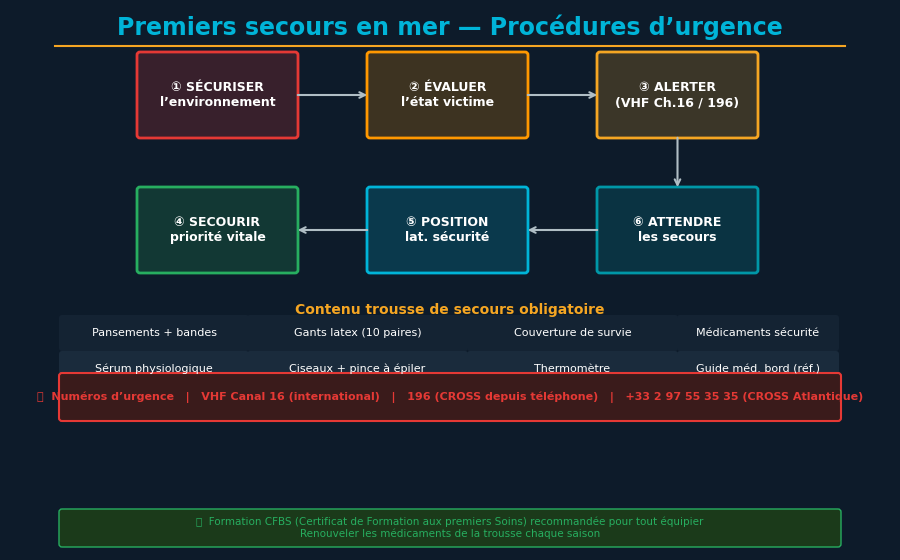
Beyond skills and procedures, every boat must maintain well-stocked marine first aid kit. This kit far exceeds standard domestic kit: it includes specialized marine medications, marine-environment-specific equipment, and essentials for remote emergencies.
Essential Marine Kit Components
Include broad-spectrum antibiotics, powerful analgesics (codeine, morphine by prescription), antihistamines, antiemetics, antidiarrheals, burn-relief cream, anticonvulsants, and bronchodilator inhalers. For equipment: multiple sterile gauze, varied adhesive bandages, elastic compression bandages, improvised splints, automated external defibrillator, emergency venous catheterization equipment, pulse oximeter for oxygen saturation measurement, and suture material for minor wounds. Include marine emergency medicine manual for quick reference during emergency.
- Secure, accessible storage — Store in cool, dry, clearly marked location, with content list displayed externally.
- Regular maintenance — Check expiration dates monthly, replace used items immediately after use.
- Crew training — All members must know kit location and basic function of each item.
Secure Your Crew
Use YachtMate to store emergency procedures, medical contacts, and distress numbers specific to your region.
Setup Safety →