
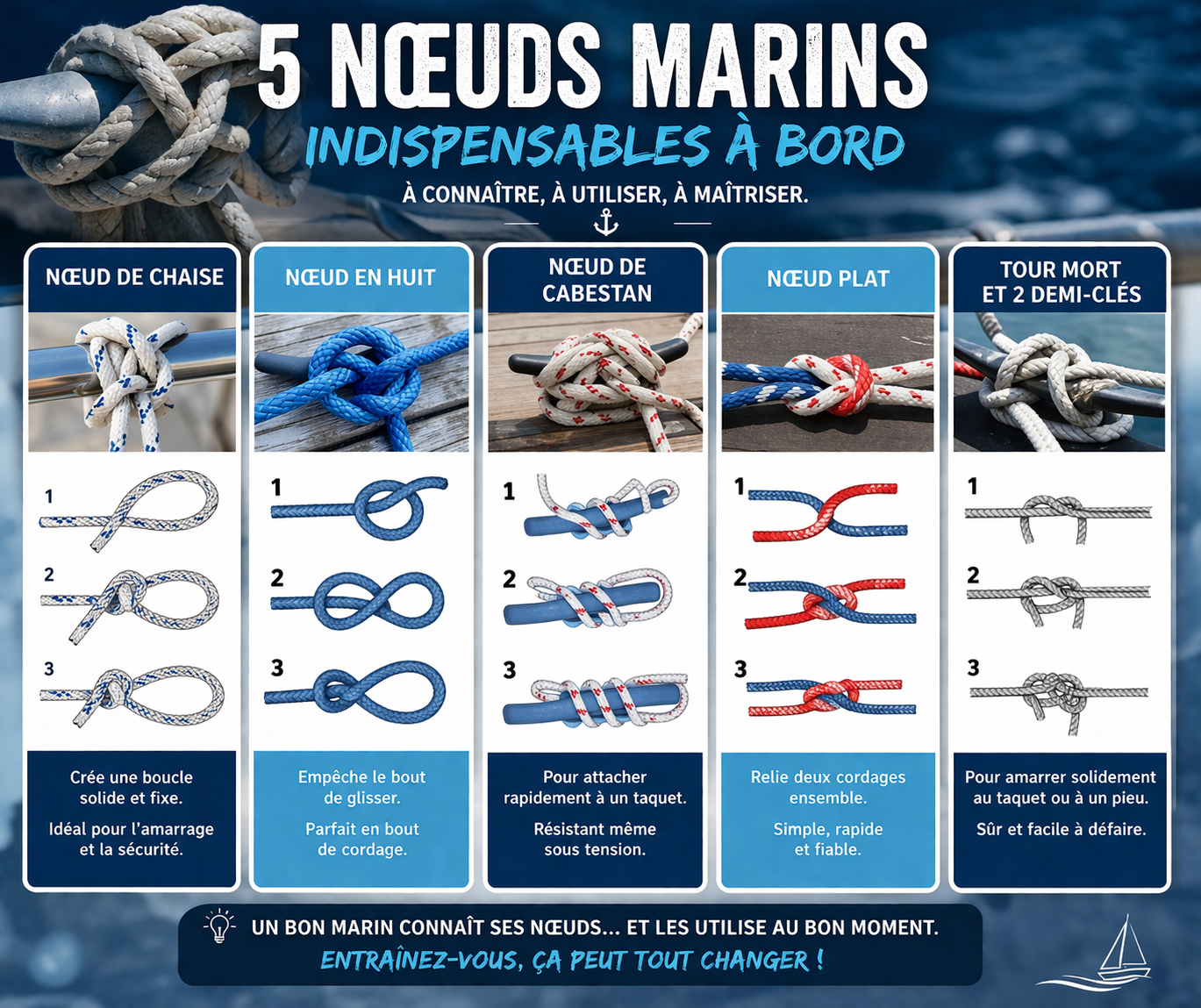
On a boat, knowing how to tie a reliable knot can make the difference between a smooth manoeuvre and a regrettable incident. Yet many boaters make do with a loose half-hitch or a slipping reef knot. The good news is that about ten knots cover 95% of the situations you'll encounter at sea. This guide presents the essentials, with their uses and strengths.
Why Master Marine Knots?
Knots are the universal language of sailors. Each knot was invented to meet a specific need: mooring, joining, shortening, or stopping a line. A good knot must hold under load, not jam after tension is applied, and be quickly released in an emergency. These three criteria guide the choice of the right knot for any situation.
Contrary to popular belief, marine knots are not reserved for sailors. Every boater — whether motoring, sailing a catamaran, or on a RIB — needs to know how to moor, secure a fender, or create a loop in a line. It's a fundamental skill that can be acquired in a few hours of practice.
"A well-tied knot is easy to make and easy to undo. If it's hard to open, it wasn't the right knot for the situation."
Essential Mooring Knots
The Clove Hitch
The clove hitch is arguably the most used knot on board. It allows you to quickly attach a line around a cleat, bollard, or mooring post. Its great quality: it can be tied with one hand and set or removed very quickly.
How to tie it: form two loops in the same direction, overlap them, and slip the assembly over the bollard. Under tension, it tightens automatically. Caution: the clove hitch can slip if the load is applied in only one direction without continuous tension. It's advisable to complete it with a full round turn or a half hitch.
The Cleat Hitch
Technically, the cleat hitch is not a knot in the strict sense, but a mooring technique. Start with a full round turn around the base of the cleat, then figure-of-eights crossing alternately over each horn, and finish with a locking half-hitch. Simple, fast, and universally used for sheets, halyards, and dock lines.
The Bollard Knot
To moor at a dock, the bollard knot combines one full round turn around the base of the bollard, then successive figure-of-eights ascending toward the top, finished with a reversed loop. This knot handles heavy loads without jamming and releases easily even under light tension.
Before setting off, check the harbour information in YachtMate to see if your destination has cleats or bollards. Some Mediterranean ports use mooring buoys — docking there is different and requires a longer bow line. YachtMate provides details on available dock facilities so you can prepare the right gear in advance.
Essential Loop Knots
The Bowline
The bowline is the king of loop knots. It creates a fixed, non-sliding loop that doesn't jam under load and releases easily. It's used for threading through a ring, forming an improvised lifeline, or attaching a sheet to a sail clew.
The classic mnemonic: "the rabbit comes out of the hole, goes around the tree, and back into the hole." The loop is the hole, the working end is the rabbit. This knot is worth practising until you can do it with your eyes closed — or in the dark.
The Figure-of-Eight Knot
An absolute must at the end of sheets and halyards, the figure-of-eight acts as a stopper to prevent a line from running through a block or winch. Easy to tie, it holds well under tension and releases without difficulty even after heavy loading. It's usually the first knot taught on a sailboat.
The Slip Knot (Marine Version)
Unlike a standard slip knot (which jams irreversibly and should be avoided at sea), the marine slip knot releases under slight reverse tension. It is useful for temporarily passing a dock line around a bollard or provisionally holding a line.
Joining Knots
The Double Fisherman's Knot
To join two lines of equal diameter, the double fisherman's knot is particularly reliable. Each end wraps twice around the other before passing through the loops formed. The resulting knot is compact and strong, even with slippery ropes like Dyneema or Spectra.
The Reef Knot and Its Limitations
The reef knot (square knot) is often the first knot learned — and often misused. It works for joining two lines of the same diameter for light loads (tying a bag closed, bundling gear). However, it should never be used for dock lines or sheets: under heavy asymmetric tension it can capsize into a granny knot and slip. Always prefer a fisherman's knot or an appropriate joining knot for marine applications.
Planning a long cruise? YachtMate includes a digital logbook where you can note your specific mooring procedures for each harbour you visit. Some ports require particular configurations (stern-to mooring, Mediterranean mooring) — documenting these details saves valuable time on subsequent visits.
Knots for Sailing Manoeuvres
The Rolling Hitch
This knot attaches a line to another line or spar under longitudinal tension. It's especially useful for securing an awning, providing a temporary preventer, or relieving a sheet jammed in a winch. Its key feature is resistance to axial pull without slipping.
The Reef Gasket Knot
When reefing a sail, the reef ties must be neatly knotted around the bundled sail. Use the gasket knot: a reef knot passed around a bundle of canvas, then secured with a bight on one side. It should be neither too tight (to allow quick release) nor too loose (so it doesn't shake free).
Round Turn and Two Half Hitches
A classic for attaching to a ring or bollard: one full round turn absorbs the load, and two half hitches securely lock the line. This is the all-purpose solution, recommended whenever you're unsure which knot to use.
Line Care and Best Practices
Knots don't exist in isolation — they also depend on the quality and condition of the lines used. A worn, salt-stiffened, or frayed line makes for less reliable knots. Some good habits to adopt:
- Whip or heat-seal the ends of synthetic lines to prevent fraying.
- Rinse lines with fresh water after each outing to remove salt that stiffens fibres.
- Regularly inspect chafe points (fairleads, blocks, winches) where lines wear fastest.
- Coil lines in figure-of-eights rather than tight balls to avoid permanent kinks and twists.
- Replace without hesitation any line showing broken fibres or suspicious discolouration: a dock line that parts at the wrong moment can cause serious damage.
Practice: The Key to Learning Knots
Theory alone isn't enough. A knot learned from a diagram will be forgotten in the first 25-knot breeze. The most effective method is repetition in varied conditions: ashore, on board, eyes closed, with gloves, with wet hands. Here's a quick programme to make progress:
- Choose 5 priority knots: bowline, clove hitch, figure-of-eight, round turn + two half hitches, cleat hitch.
- Practise every day for 10 minutes over a week with a spare piece of line.
- Test yourself under pressure: tie each knot in under 30 seconds.
- Then add secondary knots (double fisherman's, rolling hitch, etc.).
Always keep a practice piece of line on board (a 60 cm length of 8 mm rope is ideal) to revise or learn new knots during long passages or night watches.
YachtMate supports you throughout every phase of your navigation, from route planning to real-time tracking. Before leaving port, use the integrated safety checklists to verify the condition of your dock lines and mooring equipment. A digital checklist in your pocket means greater peace of mind at sea.
Navigate with confidence using YachtMate 🧭
Marine charts, real-time weather, digital logbook, harbour information… YachtMate is the essential navigation app for boaters. Free to download.
Discover YachtMate