
Crossing the English Channel is a rite of passage for any serious recreational sailor. Those 20 to 110 nautical miles separating the French coast from England concentrate some of the world's densest shipping traffic, powerful tidal streams, rapidly changing weather, and short summer nights. An exhilarating adventure — provided you prepare thoroughly. This guide gives you all the keys to confidently tackle your first major offshore passage.
Understanding the Channel's Geography and Challenges
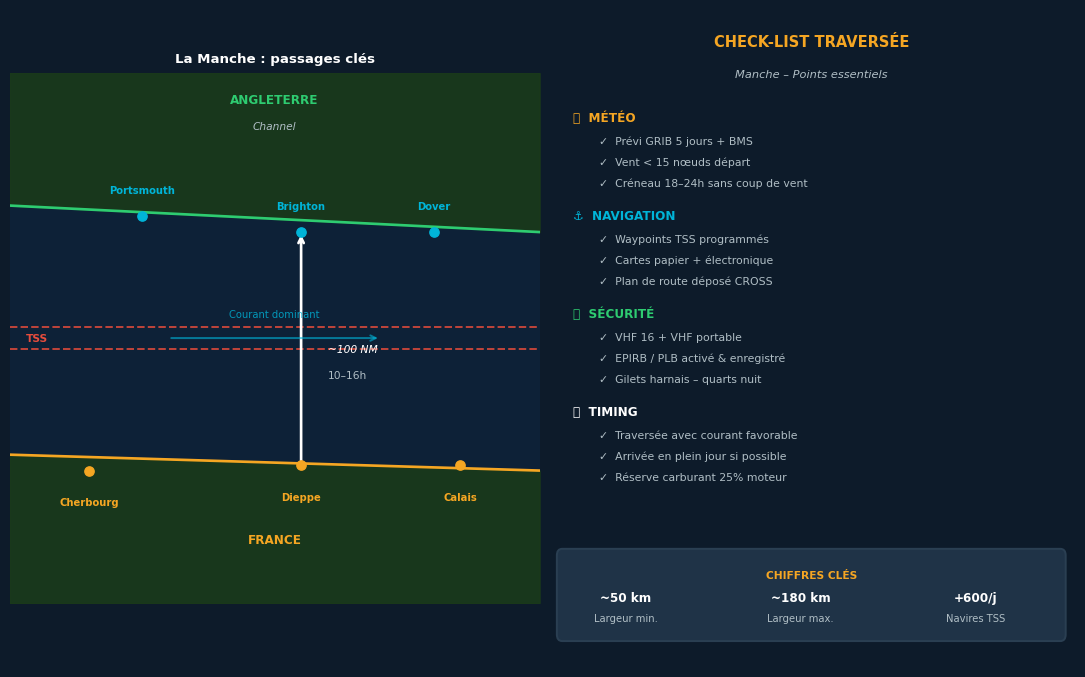
The English Channel is one of the busiest shipping lanes in the world: more than 600 vessels per day use the Traffic Separation Scheme (TSS). This regulated corridor, marked on nautical charts, imposes strict crossing rules on yachts: you must cross it at right angles — meaning your heading (not your course over ground) must be perpendicular to the traffic lanes. This is not a guideline; it is international maritime law (COLREGS, Rule 10).
The width varies considerably depending on your chosen crossing point: just 21 nautical miles at the Strait of Dover (Calais–Dover), but approximately 100 nm between Cherbourg and Portsmouth. This difference implies vastly different passage times, from 4–6 hours at the Strait to 15–20 hours from Cherbourg.
The Classic Crossing Routes
Sailors typically use three main routes. Calais–Dover is the shortest (21 nm, 4–6h) but the busiest and most subject to tidal set. Cherbourg–Portsmouth or Poole is the most popular medium crossing (50–65 nm, 12–18h), with a more manageable TSS crossing. St-Malo or Brest to Plymouth or Dartmouth is the proper offshore passage, often done via a stop at the Channel Islands.
For your first crossing, choose Cherbourg–Portsmouth. The TSS is more straightforward than at Dover, the distance is manageable, and both ports have excellent marina facilities.
Weather: Your Absolute Priority
The Channel is notorious for rapid weather changes. A stable high can deteriorate within 24 hours. Start your weather preparation 5 days before departure and keep monitoring until you cast off. Combine several sources: UK Met Office inshore forecasts, NAVTEX bulletins, GRIB files from Windy or PredictWind, and VHF weather broadcasts from the COAST GUARD. Never leave if a gale warning is in force.
Ideal Conditions
Aim for a steady Force 3–4 (7–16 knots), seas below 1.5m, and visibility above 5nm. In summer, afternoon sea breezes can quickly build the swell along the Norman coast. A late-night or early-morning departure often gives the calmest conditions before the thermal wind sets in.
The Traffic Separation Scheme: How to Cross It Safely
Crossing the TSS is what intimidates most first-timers. In practice, with good preparation and a properly equipped boat, it is very manageable. Key rules: cross at 90° to the lane direction, maintain a reasonable speed to minimise exposure time, keep a permanent watch on VHF Channel 16, and use your AIS receiver to identify commercial traffic. A 300-metre container ship travelling at 20 knots needs 5 miles to stop — and may not see you until you are very close.
Pre-programme your TSS waypoints in your chart plotter or the YachtMate app before departure. At 2am, tired, with tankers on all sides, you will not want to be calculating headings from scratch.
Tidal Streams: Ally or Enemy
Channel tidal streams are among the strongest in Europe, reaching 3–5 knots at the Dover Strait. They follow a semi-diurnal cycle. Used correctly, they can save you hours; ignored, they can push you miles off course. Use a tidal atlas (ADMIRALTY or SHOM, or integrated into YachtMate) to plan your departure so the two tidal phases roughly cancel each other out — the "ferry glide" technique keeps your track over ground surprisingly straight despite the cross-tides.
Preparing Your Boat and Crew
Watch Systems
A night crossing demands a rigorous watch system. With a crew of three, 3-hour watches work well: each person steers for 3 hours, then rests for 6. With two, 2-hour watches prevent exhaustion. The skipper must brief the whole crew in advance: how to call a Mayday, VHF DSC procedures, man-overboard drill.
Safety Equipment
For a Channel crossing, ensure you carry: a 406 MHz EPIRB registered with HM Coastguard or your national authority, a fixed DSC VHF, properly fitted lifejackets and harnesses for night watches, working navigation lights, and an adequate flare pack. File a passage plan with the relevant Coastguard before departure.
Always call your destination marina before departure to give your ETA. If you are significantly overdue, they will alert the Coastguard — which is exactly what you want.
Night Sailing in the Channel
Night passages are unavoidable for most Channel crossings west of Dover. The French and English coasts are very well lit, making navigation relatively straightforward, but commercial traffic does not slow down at night. An AIS receiver is almost essential: for under €200 you can display all AIS-transmitting vessels on your chart plotter. When in doubt about a ship's intentions, call it on VHF Channel 16 with your position and course.
UK Arrival Ports
Portsmouth is the most accessible from Cherbourg — large marina, easy night entry. Brighton suits crossings from Dieppe or Fécamp. Dover is the natural port from Calais, but requires calling Port Control on VHF Channel 74 well before entering. Dartmouth or Plymouth are the prime destinations for crossings from Brittany.
Post-Brexit, you must pre-notify UK Border Force of your arrival using form C1331 (available online or via the CERS mobile app). All crew must carry valid passports.
"The English Channel is not an easy sea, but it rewards those who respect it. Take the time to prepare properly, and the crossing will become one of your finest sailing memories."
Plan Your Channel Crossing with YachtMate
Real-time tidal streams, route simulation, integrated GRIB weather, tide predictions: everything you need to plan and track your English Channel crossing, directly on your smartphone.
Download YachtMate for Free