At sea, an emergency can arise in seconds: an uncontrolled leak, man overboard, fire on board, complete engine failure in rough weather. In these critical moments, the ability to alert rescuers quickly and effectively can mean the difference between life and death. Distress signals are the universal language of maritime emergency — and knowing them is not only a legal obligation, but above all a vital skill for every sailor.
This article provides a comprehensive overview of regulatory distress signals: what they are, how to use them, and what the law requires you to carry on board. Because hoping you never need them doesn't excuse not mastering them perfectly.
What is a Maritime Distress Signal?
A distress signal is any visual, sound, light or radio means intended to indicate that a vessel or persons are in danger and require immediate assistance. The SOLAS convention (Safety of Life at Sea) and COLREGS (International Regulations for Preventing Collisions at Sea) define internationally recognised signals. Annex IV of COLREGS lists exactly 14 recognised categories.
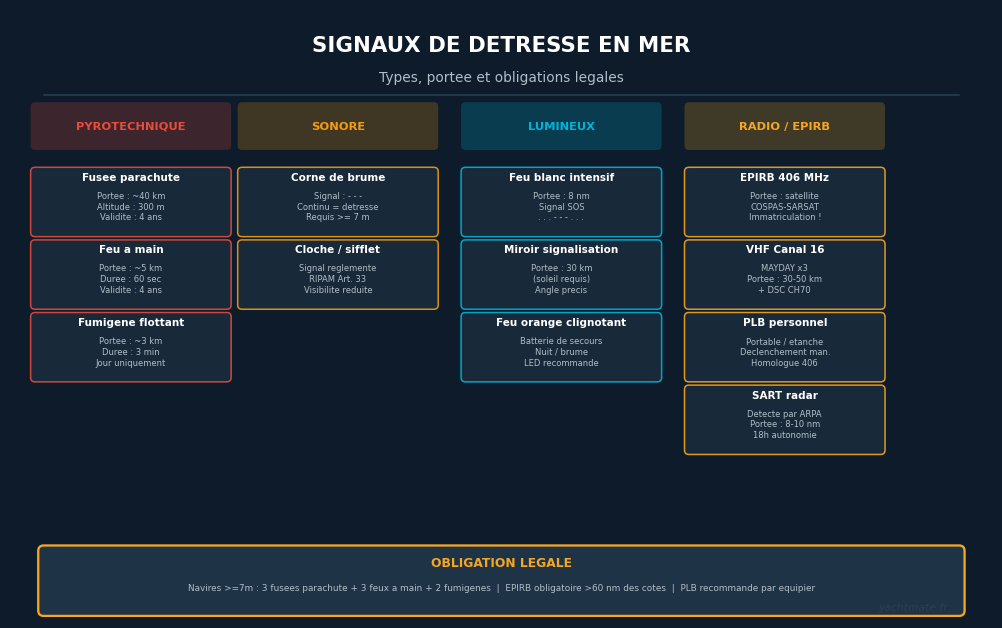
These signals fall into four main families: pyrotechnic signals, sound signals, light signals, and radio equipment. Each has its advantages, range limitations and optimal conditions of use. The golden rule: never rely on a single type of signal. Redundancy is your best ally.
Regularly check the expiry dates of your pyrotechnic equipment. Flares and hand-held signals have a validity of 4 years from their manufacturing date. An expired signal may fail to work at the worst possible moment. Note these dates in the YachtMate app to receive automatic alerts.
Pyrotechnic Signals: Maximum Visibility
The Parachute Rocket Flare
This is the most visible and powerful distress signal in a sailor's arsenal. Fired vertically, the parachute flare rises to approximately 300 metres altitude and deploys a parachute that slows its descent, offering up to 40 seconds of visibility. Its intense red light is visible at over 40 kilometres in clear weather, and 10-15 km in bad conditions. It is effective both at night and during the day. Instructions: hold it firmly, aim slightly downwind at about 15° off vertical to avoid the light falling back on the boat, pull the pin. Fire in pairs, a few minutes apart, to help rescuers triangulate your position.
The Hand-Held Flare (Red Flame)
With a shorter range than the parachute flare (~5 km), the hand-held flare is used to guide rescuers to your exact position once they are in your area. It burns for approximately 60 seconds and produces considerable heat: hold it at arm's length, away from the boat and crew, and downwind to avoid sparks. Always hold a burning hand flare over the water side to minimise risks.
The Floating Smoke Signal
The smoke signal is particularly effective during the day in clear weather. Placed on the water, it releases a thick orange smoke visible for several kilometres. It is widely used to signal position to rescue helicopters searching from altitude. Its burning duration is approximately 3 minutes. At night, it is practically useless.
Radio Equipment: The Digital Revolution in Rescue
The 406 MHz EPIRB: The Vessel's Survival Beacon
The EPIRB (Emergency Position Indicating Radio Beacon) is the vessel's distress beacon. It transmits on the international frequency of 406 MHz, captured by the COSPAS-SARSAT satellite system, which relays the alert to the relevant Maritime Rescue Coordination Centres (MRCC) worldwide. Modern EPIRBs also integrate GPS, enabling the vessel to be located within 100 metres in minutes. The EPIRB can be triggered manually or automatically when immersed (category 1). It must be registered with the relevant national authorities so that it can be associated with your vessel. Without registration, rescuers don't know who is calling or which boat to search for. The EPIRB is mandatory for any vessel navigating more than 60 nautical miles from shore.
The PLB: Personal Locator Beacon
The PLB (Personal Locator Beacon) works on the same principle as the EPIRB, but it is personal and portable. Attached to the life jacket or worn on the person, it allows a man-overboard to transmit an individual alert even if the vessel is out of range. Its compact size and battery life (generally more than 24 hours) make it strongly recommended for every crew member. Like the EPIRB, the PLB must be registered to be operational.
VHF Channel 16 and the MAYDAY Procedure
Any vessel equipped with a VHF radio must maintain a permanent watch on channel 16, the international distress and calling frequency. In case of imminent danger, the MAYDAY procedure is universal and precise. It consists of three parts: the distress call, the distress message, and repetition. The call: "MAYDAY MAYDAY MAYDAY — This is [vessel name] [vessel name] [vessel name]". The message: GPS position or position description, nature of the problem, number of people on board, any information useful to rescuers. Modern VHF radios integrate DSC (Digital Selective Calling) on channel 70: by pressing the red button, you instantly send a digital signal automatically containing your GPS position, time, and your vessel's MMSI identity. DSC is considered the fastest and most reliable distress alert available today.
Register your vessel's MMSI number in your DSC VHF radio as soon as you purchase it. Without a programmed MMSI, the DSC button is inoperative. Your MMSI is a 9-digit number obtainable free from your national maritime authority. The YachtMate app can store these essential administrative details for quick access in any situation.
Sound and Light Signals
Regulatory Sound Signals
Annex IV of COLREGS recognises the following sound signals as distress signals: a continuous sound signal from a horn or whistle, and a gun or other explosive signal fired at approximately one-minute intervals. The foghorn remains an indispensable item of equipment on board, not only for distress but also for navigation signals in reduced visibility. Regular maintenance is essential — check cartridge pressure before every major outing.
Light Signals
The light distress signal recognised by COLREGS is a high-intensity white light flashing 50 to 70 times per minute, or the SOS sequence in Morse code (· · · — — — · · ·). Modern high-intensity LED signal lamps are visible for several nautical miles. During the day, the signalling mirror — also known as a heliograph — can be extraordinarily effective using sunlight: a well-aimed reflective surface can be spotted by an aircraft or helicopter at more than 30 kilometres in good conditions.
The SART: Radar Search-and-Rescue Transponder
The SART (Search And Rescue Transponder) is a radar transponder which, when activated, responds to radar pulses from rescue vessels or helicopters by tracing a line of twelve dots on their radar screen pointing towards your position. Its range is approximately 8 to 10 nautical miles with a standard radar. The AIS-SART (AIS version) is increasingly popular as it is compatible with the AIS receivers increasingly found on board.
Legal Requirements on Board
Regulations require a minimum safety equipment depending on the coastal distance and navigation category of the vessel. For offshore and coastal navigation:
- Basic (coastal) navigation: 2 hand-held flares + 1 floating smoke signal minimum
- Vessels ≥ 7 m (open sea): 3 parachute flares + 3 hand-held flares + 2 floating smoke signals
- Beyond 60 nm from shore: 406 MHz EPIRB mandatory, SART recommended
- Renewal: every 4 years (date stamped on each item)
- Storage: in a dry place, accessible from the cockpit, known to all crew
Expired pyrotechnics must not be thrown overboard — this is prohibited. Collection points are organised in most marinas. Check with the harbourmaster's office.
Before every outing, make sure all crew members — including non-sailors — know where the pyrotechnics are stored and how to activate the EPIRB. A 5-minute exercise before leaving the marina can be decisive. In YachtMate, you can create personalised safety checklists including verification of distress equipment, to be checked before every departure.
Procedures to Follow in a Distress Situation
When faced with an emergency, the sequence of actions must be thought through in advance, not improvised under stress. Here is the sequence recommended by rescue authorities:
- Assess the situation: is this a genuine emergency? Imminent or potential distress? The alert level determines the type of call (MAYDAY, PAN PAN, SECURITE).
- Dress the crew: life jackets, survival suits if available, PLBs on individuals.
- Transmit MAYDAY or press DSC button: VHF channel 16 and/or DSC button. Give your GPS position as soon as possible.
- Activate the EPIRB if you have one on board.
- Fire a parachute flare if you see or hear rescuers nearby.
- Prepare the life raft if abandoning ship is being considered.
- Stay with the vessel as long as possible — a vessel, even in difficulty, is far more visible than one or more individuals in the water.
Finally, remember that distress signals are never used for practice without prior notification to the maritime authorities. Sending a false MAYDAY is a serious criminal offence that mobilises major rescue resources and can endanger real emergency missions.
Navigate with Greater Peace of Mind with YachtMate
YachtMate centralises all your safety information: pyrotechnic expiry dates, MMSI, MRCC emergency numbers, pre-departure checklists. Download the app and turn your smartphone into a true navigation assistant.
Download YachtMate for Free