
Why the rules change the moment you leave national waters
As long as you sail in your own country's waters, your obligations usually come down to carrying the ship's papers and the required safety equipment. The moment your bow crosses a maritime border, you enter a different legal regime: that of the coastal State you are joining. Customs, immigration, maritime police, harbour office – every country sets its own rules for the entry and stay of a foreign pleasure vessel.
The good news is that within the European area, free movement makes life far simpler for a boat flying the flag of a member State. The less good news is that grey areas remain – VAT, crew stay, pets aboard, radio licence – and above all, the moment you head for a third country (United Kingdom, Morocco, Tunisia, Turkey, non-EU islands…), full formalities return: compulsory reporting to the authorities, passport checks and sometimes temporary import duties.
Planning ahead avoids the double pitfall: a fine for irregular entry, and the wasted time of an improvised stop in a harbour that is not an official point of entry. A little preparation at the dock, before departure, beats a long conversation with a customs officer.
The documents to gather before casting off
The ship's papers
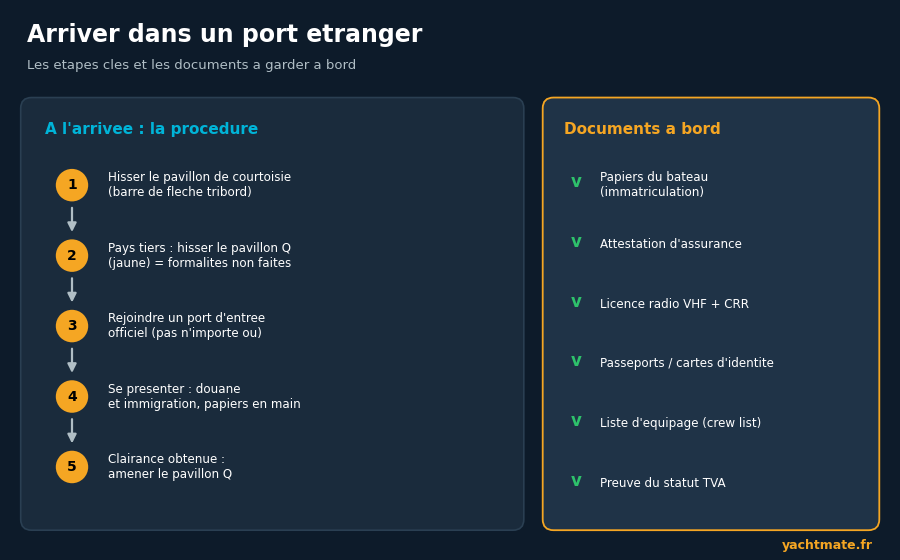
They prove the nationality and ownership of the vessel. Always keep aboard, in the original and ideally a copy:
- the registration certificate or navigation title that establishes the flag;
- the boat's document / record as issued by the country of registration;
- a valid insurance certificate, ideally with an English-language statement;
- the radio station licence (VHF/DSC) and, for the operator, the radio operator's certificate;
- proof of the boat's VAT status (paid invoice, receipt) for checks within the EU.
The crew's papers
Everyone aboard must be able to prove their identity. In Europe, a valid national ID card is often enough between Schengen States; outside Schengen or to a third country, a valid passport is essential, sometimes with a visa. The skipper is well advised to prepare a crew list: name, date and place of birth, nationality and ID number of each person. Many customs offices ask for it exactly as it is on arrival.
Licences and competence
Recognition of boat licences varies from country to country. Some States require an International Certificate of Competence (ICC) to navigate their inland waters or to charter locally. Check before you leave whether your national licence is accepted and whether an extra document is expected.
Build a digital "boat file": scan all your documents (ship's papers, insurance, radio licence, passports, a blank crew list) and keep them in a folder that is accessible offline on your phone, plus a copy in the cloud. If you are inspected, or lose the originals, you save precious time – while keeping the originals dry in a waterproof pouch.
On arrival in a foreign port: the procedure
The courtesy flag
It is a universal custom and a mark of respect: as soon as you enter a country's territorial waters, you hoist its national flag, in a smaller size, at the starboard spreader. This is the courtesy flag. Your own national ensign stays at the stern. A courtesy flag that is worn, faded or flown beneath another is seen as discourteous – get the flags of the countries you intend to visit before you leave.
The Q flag and reporting to the authorities
Bound for a third country, tradition and often regulation require you to hoist the Q flag (plain yellow) on arrival. It means "my vessel is healthy, I request free pratique" and signals that you have not yet completed formalities. You must then make for a designated official port of entry, report to customs and immigration, and only lower the Q flag once clearance is granted. Until formalities are done, the crew is in principle not free to go ashore.
Finding the right entry point
You cannot enter just anywhere: each country publishes the list of its ports of entry authorised to process vessels arriving from abroad. Spot it in advance on your chart and in the pilot book, and plan to call there first, before any coastal cruising. Reporting voluntarily, papers in hand, is always better received than being "discovered" at anchor.
EU versus third countries: what really changes
Moving within the European Union
For a boat flying a member State's flag, with VAT paid and an EU-citizen crew, sailing between European countries is mostly common sense: no systematic formal clearance, but always the duty to be able to show your papers and to respect local rules (anchoring, speed, protected zones). Beware: some geographically European islands or territories are not part of the EU customs or fiscal territory, which can reinstate formalities.
The temporary admission regime
When a non-EU boat, or a non-resident crew, stays in a third country, it usually benefits from temporary admission: the vessel may remain for a limited time (often 18 months in the EU for a non-EU boat, a locally fixed period elsewhere) without paying import duties and taxes, provided it leaves. Exceeding that period, or leaving the boat under the wrong regime, exposes you to taxation. Note the date of entry and keep the document issued by customs.
Rules change (Brexit, bilateral agreements, health regulations…). Before each season, check the formalities at source: the customs website of the country visited, the harbour office of the port of entry, or boating federations. Up-to-date information beats a memory from last year's cruise.
Special cases not to forget
Pets aboard
A travelling dog or cat must be in order: microchip identification, a pet passport, up-to-date rabies vaccination, and sometimes treatment or a blood titre depending on the destination. Third countries apply strict entry conditions; research them well in advance, or risk quarantine or refusal.
Radio, fishing and restricted zones
A radio station licence and operator's certificate are required as soon as a VHF is aboard, including abroad. For recreational fishing, some countries require a paid permit or ban certain species and gear. Finally, beware of military zones, nature reserves and marine parks where anchoring and approach are restricted: they appear on charts and in notices to mariners.
On departure as on return
Leaving a third country often means an outward clearance from customs, with a document to present to the next country. On returning to your home waters, keep your temporary-admission proof and receipts for major purchases made abroad: they may be requested. A well-kept logbook, recording each stop and each formality, remains your best ally in an inspection.
Plan your foreign stopovers with YachtMate
Charts, weather and ports-of-entry spotting: YachtMate is with you from one maritime border to the next.
Discover the app →