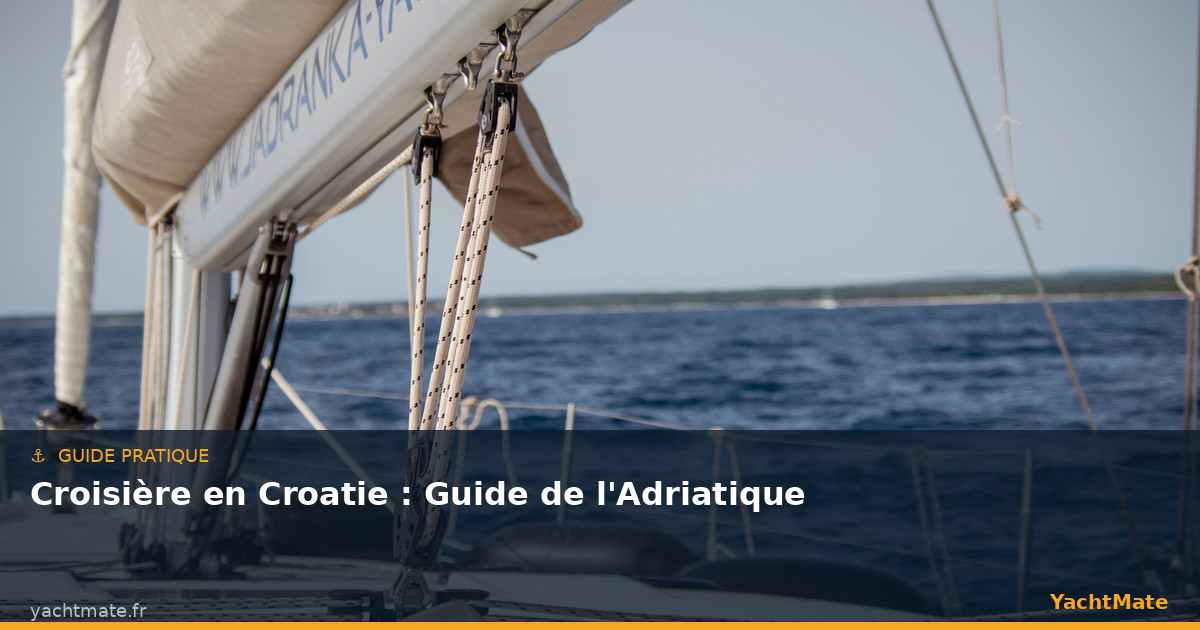
Croatia is one of Europe's most coveted sailing destinations — and for good reason. With over 1,200 islands, islets and reefs, crystal-clear waters ranging from turquoise to deep blue, and hundreds of sheltered natural anchorages, it offers an unmatched cruising experience. Sailing the Croatian Adriatic means stringing together stunning seascapes, anchoring in pristine coves and stopping in UNESCO-listed medieval towns. But a rewarding cruise requires solid preparation.
This complete guide gives you everything you need to plan and enjoy your Croatia sailing trip: the nautical vignette, typical winds, regulated anchorages, top stopovers and expert tips for making the most of the Adriatic.
The Croatian nautical vignette: mandatory and easy to get
Since Croatia joined the European Union in 2013, customs formalities have been simplified for EU citizens. However, the nautical vignette (luka) remains mandatory for all pleasure craft over 3 metres navigating Croatian territorial waters. It is issued by maritime authorities (Lučka kapetanija) in major ports: Split, Dubrovnik, Zadar, Šibenik and Rijeka.
Durations and fees
The vignette is available in several formats: 1 week, 2 weeks, 1 month or 1 year. Fees vary by boat length and engine power. For a 10 to 12-metre sailboat, expect to pay roughly €70 to €200 depending on the option chosen. Payment is accepted in Croatian kuna or euros at the counter.
Prepare copies of your ownership certificate (or charter contract), ID documents and your boat licence before arriving. Croatian coast guard checks at sea are frequent, especially in high season. Keep these documents in a waterproof pouch that's easy to access quickly.
Adriatic weather and winds: what you need to know
The Adriatic is an enclosed sea oriented NNW–SSE, flanked by the Dinaric Alps to the east and the Apennines to the west. This geography generates characteristic winds that every sailor must know before casting off.
The Bora: the wind to watch most carefully
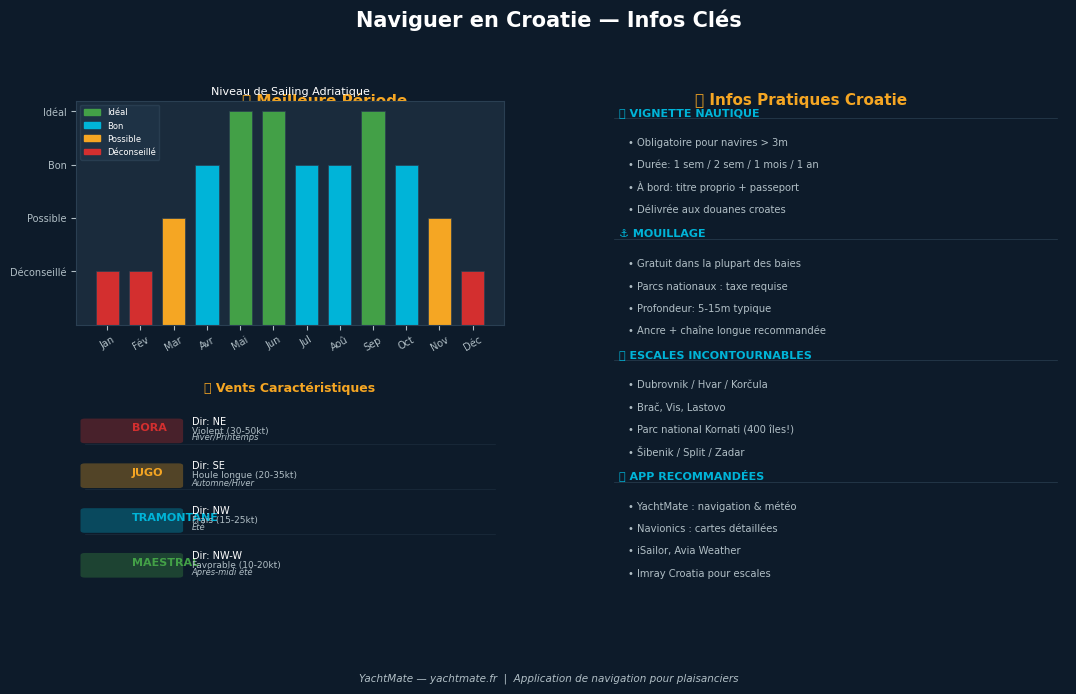
The Bora is a violent katabatic wind blowing from the northeast, caused by cold continental air spilling over the Dalmatian mountains. It can reach 30 to 50 knots — sometimes more — and often rises suddenly within a few hours. The Bora is most common from November to March but spring episodes do occur. Short, fierce gusts create a choppy, uncomfortable sea even under clear blue skies. Always check forecasts carefully before setting sail.
The Jugo: swell and crossed seas
The Jugo (or Scirocco on the Adriatic) is a SE wind that builds gradually, heralding bad weather. It generates a long swell rolling up the entire Adriatic, making sailing uncomfortable even at moderate strengths (20–30 knots). It is often accompanied by heavy rainfall.
The Maestral: the ideal sailing wind
In summer, Croatia's prevailing wind is the Maestral — a thermal NW-to-W sea breeze that arrives every afternoon (between 11 am and 1 pm) and dies down in the evening. Fresh and steady at 10 to 20 knots, it makes for pleasant inter-island day sailing. Mornings are usually calm: use that window to move between anchorages before the breeze fills in.
When is the best time to sail Croatia?
Peak season (July–August) means crowded marinas, higher prices and strong Maestral afternoons. For a first cruise, May–June and September–October offer the best balance: mild temperatures, calm mornings, fewer boats in the anchorages. In May, almond trees and lavender blooms on Hvar and Brač create a breathtaking backdrop.
Use the YachtMate app to check hourly Maestral forecasts straight from the cockpit. By combining weather data with your route waypoints, you can easily plan inter-island passages to make the most of the best wind windows.
Adriatic anchorages: rules and highlights
One of Croatia's greatest pleasures is its abundance of sheltered natural anchorages — called uvala or luka in Croatian. Most are free, unless you're anchoring inside a national park, where a specific fee applies. In the Kornati National Park (200 islands off Šibenik), a dedicated park vignette is required — buy it directly from the patrol boats that circulate the park.
Anchoring tips for the Adriatic
The seabed is often rocky or covered with posidonia meadows (a protected marine grass). Choose sandy patches where possible to anchor without damaging the habitat. Bring a long chain (30–40 metres minimum) and a heavy anchor: the afternoon Maestral can build quickly. Many anchorages offer paid mooring balls or stern-to lines — these are preferable in busy coves.
Must-visit stops on the Croatian Adriatic
Croatia has hundreds of worthwhile stops. Here are the highlights no sailor should miss:
- Dubrovnik: the "Pearl of the Adriatic". Berth in Gruž marina and walk the medieval city walls. Avoid July–August when tourist crowds are overwhelming.
- Hvar: lavender-scented island with a vibrant marina and a beautiful old town. The Riva waterfront is the place to be in the evening.
- Korčula: a perfectly preserved medieval town, reputed birthplace of Marco Polo. Excellent anchorage in the adjacent Luka Korčulanska bay.
- Vis: a preserved island (former military base) with the famous Blue Cave (Biševo) and acclaimed local wines.
- Kornati: a national park of lunar beauty. Dozens of anchorages between limestone islets, with water so clear you can see 20–30 metres down.
- Split: a must-see city break centred around Diocletian's Palace — ideal as a base for boat rentals or provisioning.
- Lastovo: the most remote island and a nature park, perfect for sailors seeking absolute peace and quiet.
Add your stops to YachtMate to access anchorage depths, community notes from fellow sailors, national park boundaries, restricted zones and available services (water, fuel, restaurants) at over 200 Croatian ports and anchorages.
Provisioning, fuel and fresh water
Most Croatian marinas offer fuel and fresh water. Outside the major ACI marinas, small village harbours (lukes) usually provide water and electricity but not always fuel. Pack extra jerrycans for extended stays in the Kornati or around Lastovo. Supermarkets are well stocked in Split, Zadar and Dubrovnik; on the islands, shops are smaller and prices are higher.
Communications and emergencies at sea
VHF Channel 16 is the official watch channel throughout the Adriatic. The Croatian MRCC can be reached on 16 or 195. Italian MRCC Rome covers the northern Adriatic as well. GSM coverage is excellent along the coast and main islands; in remote archipelagos, a satellite phone or EPIRB beacon becomes essential.
Estimated budget for a one-week cruise
For a one-week Adriatic cruise on a 10–11 metre sailboat (charter included), budget between €2,500 and €5,000 depending on season, crew size and sailing style. The nautical vignette costs €80–120, ACI marina berths run €60–120 per night depending on boat size, and free anchorages are plentiful. Fuel costs are modest if you harness the Maestral. Food and dining out are slightly cheaper than in France, especially in fishing villages.
Plan your Adriatic cruise with YachtMate
Waypoints, Maestral forecasts, anchorages, depth charts and community reviews — everything you need to sail Croatia with confidence.
Download YachtMate for free