
Cooking aboard a boat is fundamentally different from land-based cooking. You navigate the constraints of a compact galley with limited storage, unpredictable vessel motion that sends pots sliding across burners, inconsistent fuel supply for stoves, freshwater scarcity that demands conservation, and refrigeration that may fail without warning. Yet feeding your crew well—real food, properly prepared, with flavor and nutrition—is one of the most overlooked yet critical elements of successful cruising. A demoralized crew with poor food becomes a hazard to safety; a well-fed crew with good morale tackles challenges more effectively and enjoys their passage. This comprehensive guide explores galley organization, stove selection, menu planning for passages, practical recipes optimized for boat conditions, freshwater and food preservation strategies, and the special skills required to cook reliably in a moving vessel.
Successful boat cooks develop systems and shortcuts that land-based cooks would never consider. One-pot meals become not just practical but elegant when properly executed. Fresh bread baked in a boat oven becomes a morale booster unattainable on land. Careful provisioning and creative cooking with modest ingredients becomes an art form. These skills transform the galley from a source of frustration into one of the boat's most valued functional spaces.
Galley Design and Organization
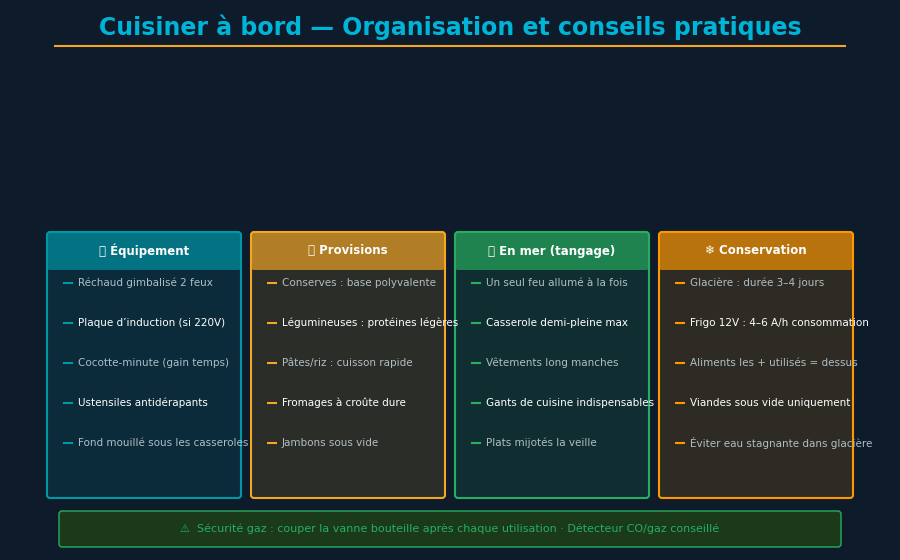
A well-organized galley maximizes efficiency and safety. Critical principles: store heavy items (canned goods, cooking oil) low and near the centerline of the boat to minimize motion effects; keep frequently used items within arm's reach of the cook; organize dry storage by category (grains, legumes, spices, condiments) in waterproof containers labeled clearly; use fiddles (raised edges) on counters and stove surrounds to prevent items sliding during heavy motion; install secure handholds above the stove for safety when the boat pitches unexpectedly.
Storage Solutions
Vertical space is premium real estate in boat galleys. Install sturdy shelving above the sink and cooktop; use hanging nets or bags for fresh produce (onions, garlic, squash) to maximize airflow and prevent rot; repurpose hanging shoe organizers mounted on cabin doors for spice jars and condiments; dedicate one sealed container (with drainage) specifically for fresh vegetable storage (remove outer leaves, trim roots, and this fresh produce lasts 2-3 weeks). Cooler/icebox organization: top layer for items you'll use first (milk, butter); middle layers for proteins and leftovers; bottom layer for ice or ice packs, ensuring cold air circulation below and around foods.
Label everything with expiration dates. Boat motion and dim galley lighting make it remarkably easy to lose track of food age. Invest in a small hanging scale (2-3 kg capacity) specifically for measuring flour, sugar, and other dry ingredients when you can't accurately judge amounts by eye. Waterproof your label maker and tape; moisture destroys regular labels within days.
Stove Types and Fuel Considerations
Most cruising boats use one of three stove types: diesel or liquid fuel (kerosene) stoves, alcohol stoves, or propane stoves. Each has advantages and trade-offs. Diesel stoves provide reliable, controllable heat and can be integrated with heating systems (killing two birds with one fuel); they are heavy and expensive ($1500-$3000). Alcohol stoves (ethanol or methanol) burn clean without explosion risk, making them popular on smaller boats; they provide less BTU output and require larger fuel quantities. Propane stoves offer excellent heat control, fast boiling times, and efficiency; they require careful safety management to prevent gas leaks.
Gimbal Stoves for Heavy Weather
Gimbaled (suspended) stoves pivot with the boat's motion, keeping the cooktop level even when the boat heels 20+ degrees. This is essential for offshore voyaging. Ensure your gimbal stove is well-maintained: pivot points should move freely with minimal friction, and stovetop pots should have high sides and good handles. Even with a gimbal stove, cooking during heavy weather requires respect: secure all pots with davits (snap-secured to stove frame), never leave the galley unattended while the stove is operating, and wear long-sleeved shirts and closed shoes as protection against hot oil or boiling water.
A gimbaled stove in rough seas is not optional for offshore voyaging—it's insurance. The alternative, cooking on a tilted stove with a wall of cabinets blocking your movement, is a recipe for burns and injuries that could escalate into emergencies with limited medical support available.
Menu Planning for Passages
Menu planning requires balancing nutrition, morale, freshwater consumption, and cooking difficulty. For a 10-day passage with a four-person crew, I plan approximately 30 main meals, 20+ breakfasts, and 10+ lunches, ensuring variety but minimizing unique ingredients. Breakfasts are typically simple: porridge, eggs, toast, yogurt with granola. Lunches are often sandwich-based or simple one-pots left over from dinner. Dinners feature one-pot pastas, chilis, curries, and stews that improve with resting and require minimal cleanup.
Sample 10-Day Offshore Menu
- Days 1-2: Fresh vegetables (pasta with pesto, chicken stir-fry with snap peas)
- Days 3-4: Transition to preserved: lentil curry, canned fish tacos
- Days 5-6: Hearty dried provisions: chickpea stew, white bean soup
- Days 7-8: Rehydrated meals: beef stroganoff (dried mushrooms, onions, canned beef)
- Days 9-10: Final provisions: rice and beans with various proteins, pantry-staple pasta dishes
This progression mirrors the natural consumption pattern: fresh items deplete first, then preserved goods. Each dinner fits within 45 minutes of active cooking time and produces one-pot meals with 80% of ingredients prepared before departure.
Bread Baking at Sea
Freshly baked bread is one of the most morale-boosting foods aboard. A boat oven (small, diesel-heated, or cooktop-compatible) can bake one loaf every 12-24 hours. A simple white bread dough requires only flour, water, salt, yeast, and 3-4 hours total time (20 minutes active, then passive rising while you navigate). The key is managing oven temperature: a boat oven heats unevenly, so rotate the loaf halfway through baking. Many boat cooks swear by no-knead dough (mix flour, water, salt the night before, shape briefly in the morning, proof for 2 hours, then bake in a covered Dutch oven at high temperature)—this method forgiving of temperature variations and produces excellent crust.
Keep yeast (vacuum-sealed or in oil-sealed jars) stable by storing in a cool location. Temperature fluctuations degrade yeast. For longer passages, consider sourdough starter (mix of flour and wild yeasts) which remains stable indefinitely and adds remarkable flavor. Feed your starter daily with flour and water (same procedure as on land) and it will reliably leaven bread for months.
Water Conservation and Dishwashing
Freshwater scarcity forces changes to cooking and cleaning habits. Minimize water use in cooking: boil pasta in minimal water (just enough to cover), then drain pasta into a colander, then use the starchy water for cleanup (it cuts grease effectively). Dishwashing uses typically 1-2 liters per meal for four people with efficient techniques: pre-rinse with seawater, scrub with 0.5 liters fresh water and minimal soap, final rinse with seawater. Avoid throwing food scraps overboard (violates MARPOL maritime pollution regulations and attracts unwanted marine life); instead, bag all food waste and dispose in a port trash facility.
Galley Freshwater Systems
Cruising boats typically store 40-150 liters of freshwater depending on tank size and crew size. A four-person crew consumes approximately 30-40 liters daily for all purposes (drinking, cooking, minimal hygiene). Calculate conservatively: if you have 100 liters and consume 10 liters per day, assume a 1-2 day reserve for emergencies. Most cruising boats carry capacity to supplement freshwater through desalination (expensive equipment) or by collecting rainwater (a tarpaulin rigged over the boom, with tubing directing collected water to a clean jerry can). Rain collection yields approximately 100 liters per heavy rainstorm on a 40-foot boat.
Refrigeration and Food Preservation
Proper refrigeration management extends fresh food life dramatically. An icebox (passive cooler using ice or ice packs) requires ice replenishment every 3-5 days and works well for a week; a 12V electrical refrigerator runs continuously from batteries (parasitic load of 10-20W), requires charging from engine or solar, and works indefinitely. Both systems demand organization: coldest spot (often bottom rear) for proteins and dairy; cooler spots (shelves) for vegetables and condiments; warmest spot (door) for condiments used frequently. If refrigeration fails, move to high-temperature preserved foods immediately: canned goods, dried fruits, shelf-stable proteins.
Fresh produce preservation: root vegetables (potatoes, onions, squash) keep 3-4 weeks in cool, dark storage; leafy greens keep 1-2 weeks if wrapped in damp cloths and stored in coolest available space; hard squash lasts 4-6 weeks; citrus fruit lasts 4-6 weeks if stored in open (ventilated) containers to prevent mold. Understanding these windows is critical for passage planning.
One-Pot Meals: The Foundation of Boat Cooking
One-pot meals are not a limitation imposed by boat conditions—they are an elegant solution to fuel conservation and crew morale. A well-prepared one-pot dish (curry, stew, pasta bake) is infinitely superior to multiple-pot reheated provisions. Here's my formula for reliable one-pot meals: sauté aromatics (onions, garlic) in oil; add spices and cook until fragrant (2-3 minutes); add protein (canned, dried, or fresh); add starch or base (rice, pasta, beans); add liquid (broth, tomatoes, water); simmer 20-40 minutes until everything is tender and flavors meld. Serve with whatever bread, crackers, or fresh items you have remaining. The progression from fresh vegetables to canned to dried mirrors the cruise progression naturally.
Cooking During Heavy Weather
Rough seas demand modifications to normal cooking practice. Avoid cooking when the boat is pitching heavily; a simple meal (sandwiches, cold leftovers, energy bars) fed to a demoralized crew in rough weather beats an elaborate hot meal that no one can enjoy or that risks burns. When conditions allow brief cooking sessions, prepare hearty stews or soups that continue cooking as the boat moves and can tolerate temperature fluctuations. Secure all pots with davits, never reach over open flames, and keep one hand free to brace yourself against unexpected pitches. Many experienced boat cooks prep ingredients while sitting (chopping on a cutting board in your lap) rather than standing at the counter in rough motion.
Special Dietary Considerations
Accommodating crew dietary requirements requires planning. Vegetarian provisions (dried beans, lentils, nuts, oils) take up minimal space and last indefinitely. Gluten-free provisioning (rice flour pasta, gluten-free oats) is possible with deliberate menu planning. Religious dietary requirements (kosher, halal, Hindu) require research before departure. Allergies demand extra care: cross-contamination is easy in a small galley, so dedicate separate utensils, cutting boards, and storage areas if necessary.
Conclusion: The Galley as the Boat's Heart
A well-provisioned galley with a competent cook transforms every cruising experience. Food is not merely fuel; it is culture, morale, comfort, and connection aboard a boat. A crew that eats well maintains cohesion, resilience, and humor through the inevitable challenges of offshore passages. Invest time in learning boat cooking, in understanding your galley's unique characteristics, in planning menus thoughtfully, and in practicing recipes before departure. The galley will reward you with some of the most gratifying cooking experiences of your life, and your crew will remember with gratitude the care you put into feeding them well.
Plan Your Boat Meals
Use YachtMate to log your galley inventory, track provisions consumption, and share meal plans with crew. Organize your provisioning for passages with confidence.
Discover YachtMate →