Spotting a distant cardinal mark, identifying the name of an approaching cargo ship, reading a flag across an anchorage, or making out a beacon against the sun: on board, a good pair of marine binoculars is one of the most useful — and most underrated — instruments. Contrary to popular belief, not all binoculars perform equally well at sea. Rolling, spray, low-angle light and dim conditions all impose very specific requirements. This guide explains how to decode the technical specs and choose the pair that truly suits your kind of boating.
Understanding the "7 × 50" format
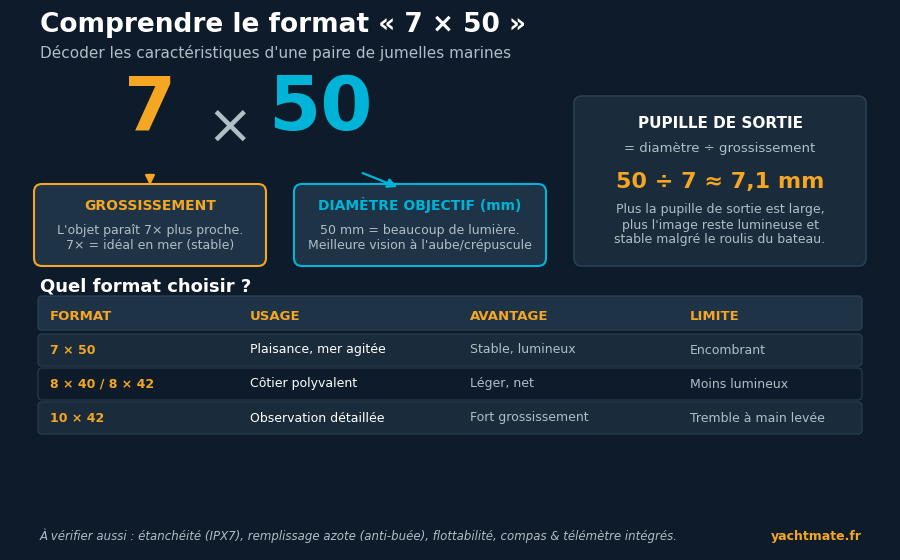
Every pair of binoculars carries a pair of numbers such as 7 × 50, 8 × 42 or 10 × 50. The first number is the magnification: it tells you how many times closer the observed object appears. A magnification of 7 means a lighthouse 700 metres away will look as sharp as if it were 100 metres off. The second number is the diameter of the front lens (objective) in millimetres: the larger it is, the more light the lens gathers, and the brighter the image in low light.
For recreational boating, the historic and still unbeaten reference is the 7 × 50. Why? Because a moderate 7× magnification stays stable despite the boat's movement, while the large 50 mm objective ensures excellent vision at dawn, dusk and at night — precisely the times when you most need to identify lights and marks.
Exit pupil: the secret of a bright image
The exit pupil is a key parameter that's often overlooked. It's easy to calculate: objective diameter divided by magnification. For 7 × 50 binoculars, that gives 50 ÷ 7 ≈ 7.1 mm. This is the diameter of the beam of light leaving the eyepiece and entering your eye. At night, the human pupil dilates to 6–7 mm, so a wide exit pupil lets you make the most of that opening, delivering a clear image even in darkness. A generous exit pupil also tolerates head and boat movement better, without the image "blacking out" at the edges.
On the water, resist the temptation of high magnification. 12× or 16× binoculars, wonderful on land, become unusable on a moving deck: the slightest swell turns the image into a permanent shake. 7× is the best compromise between power and stability at sea.
The must-have criteria at sea
Beyond the format, several features distinguish true marine binoculars from ordinary land binoculars.
Waterproofing and nitrogen purging
This is the non-negotiable criterion. A pair meant for the sea must be waterproof (IPX7 rating or higher), meaning able to withstand temporary immersion. Spray, rain and ambient humidity are fatal to unprotected optics. The best models are also nitrogen- (or argon-) purged: this inert gas drives out internal moisture and prevents fogging on the lenses during temperature swings — a classic problem when moving from a warm cabin to a cold cockpit.
Buoyancy and impact protection
Many marine binoculars are designed to float if they go overboard, or come with a floating strap. A rubber armouring protects against knocks on the pushpit or rail, improves grip when wet and cushions the inevitable bumps. Check that the strap and neck cord are sturdy: dropping your binoculars over the side happens all too easily.
Field of view
Expressed in metres at 1,000 metres (or in degrees), the field of view determines how wide a scene you observe. A wide field makes it easier to locate and track a moving target — useful for finding a buoy again or watching a crew member in the water. At equal magnification, a wider field is generally preferable when navigating.
Pair your binoculars with the YachtMate app: when you spot a landmark, a beacon or a vessel, you can place it instantly on the chart, check its identity via AIS and confirm your position. Eye and screen work together for safer navigation.
Built-in compass and rangefinder: worth it?
Some high-end marine binoculars feature a compass visible within the field of view. You can read the bearing of a landmark or vessel directly without taking your eye off the eyepiece — invaluable for fixing your position by cross bearings or assessing a collision risk (a steady bearing signals a collision course). The compass is usually illuminated for night use.
The rangefinder (a graduated reticle) displays a scale that lets you estimate the distance of an object whose height you know, or its size. It's a welcome bonus for judging how far off a coastline or obstacle is. These features add to the price and weight, but for anyone regularly sailing offshore or at night, they easily justify the investment.
Image stabilisation: the ultimate luxury
Image-stabilised binoculars (such as certain motorised models) electronically compensate for the boat's movement. The comfort is spectacular — you can go up to 10× or 14× without shake — but the price is high, they need batteries and cope poorly with water. An option reserved for generous budgets and specific uses.
Which format for which use?
The final choice depends on your boating programme:
- 7 × 50 — The great classic for cruising and offshore sailing. Stable in a seaway, excellent at night. Its only downside: some bulk and a weight of around 800 g to 1 kg.
- 8 × 42 or 8 × 40 — Versatile and more compact, ideal for daytime coastal navigation. A good compromise for anyone wanting lighter binoculars without sacrificing image quality.
- 10 × 42 — For detailed observation (birdwatching, reading boat names at a distance), but best reserved for calm seas: handheld, the shake becomes distracting.
- Compact models (8 × 25, 10 × 25) — Dim and unstable, to be considered only as backup binoculars, never as your primary watch-keeping gear.
"At sea, a bright, stable image beats an unusable high magnification. The 7 × 50 remains, rightly, the reference on board."
Care and good habits
Quality marine binoculars last for decades if looked after. After each trip at sea, rinse them gently with fresh water to remove salt, dry them and store them in their case away from moisture. Never clean the lenses dry: crystallised salt scratches the optical coatings. Use a blower, then a slightly damp microfibre cloth, and if needed a dedicated lens fluid.
Set the eyepiece spacing to your vision once and for all, adjust the dioptre correction (dial on the right eyepiece) to compensate for any difference between your two eyes, then focus with the central wheel. Always replace the objective caps between uses to protect the front lenses from spray and scratches.
Keep your binoculars within reach in the cockpit, in a dedicated, secured stowage. On night watch or in reduced visibility, they must be instantly accessible — the time it takes to fetch them from the cabin can make all the difference when a vessel is closing in.
In summary
For the vast majority of boaters, a pair of waterproof, nitrogen-purged, floating 7 × 50s is the best choice: bright, stable, rugged and reliable in all conditions. If you often sail at night or offshore, adding a built-in compass turns your binoculars into a genuine navigation instrument. Prioritise optical quality (BAK-4 prisms, multi-coated lenses) and waterproofing over high magnification: at sea, stability and brightness always win over power.
Sail with greater peace of mind using YachtMate
Spot, identify and locate every landmark, beacon or vessel at a glance. YachtMate is the navigation app designed for boaters — marine charts, AIS and weather, available on iOS and Android.
Discover YachtMate →