
When you buy a new recreational boat in Europe, one letter shows up everywhere: on the builder's plate, in the spec sheet, in the listings. Category A, B, C or D. Behind this simple marker lies information that is crucial for your safety and for choosing how you will use the boat. The CE design category states the sea and wind conditions the boat was designed to withstand, based on standardized tests and calculations. Misunderstood, it can lead a boater to overestimate — or underestimate — the real capabilities of their craft.
Contrary to a widespread belief, this category does not say "how far you are allowed to go" in the sense of a regulatory zone. It describes the structural design strength of the boat against given conditions. Here is a complete guide to decoding these four letters, understanding what they mean in practice, and choosing the right boat for your use.
Where do these categories come from?
The design categories derive from the European Recreational Craft Directive 2013/53/EU, which governs the placing on the market of recreational craft from 2.5 to 24 metres within the European Union. Every new boat sold in the EU must bear the CE marking, certifying that it meets the essential requirements for safety, stability, buoyancy and construction.
The precise technical criteria are defined by the harmonized standard EN ISO 12217 (stability and buoyancy), which determines which category a boat can claim. The category is assigned by the builder or by a notified body, based on the wind force and wave height the boat can handle while keeping an acceptable safety margin. Two key parameters stand out: the wind force (on the Beaufort scale) and the significant wave height (the average of the highest one-third of waves).
The design category characterizes the boat, not the area where you sail. A Category C boat can perfectly well make a coastal passage, as long as conditions stay within its operating range.
The four design categories
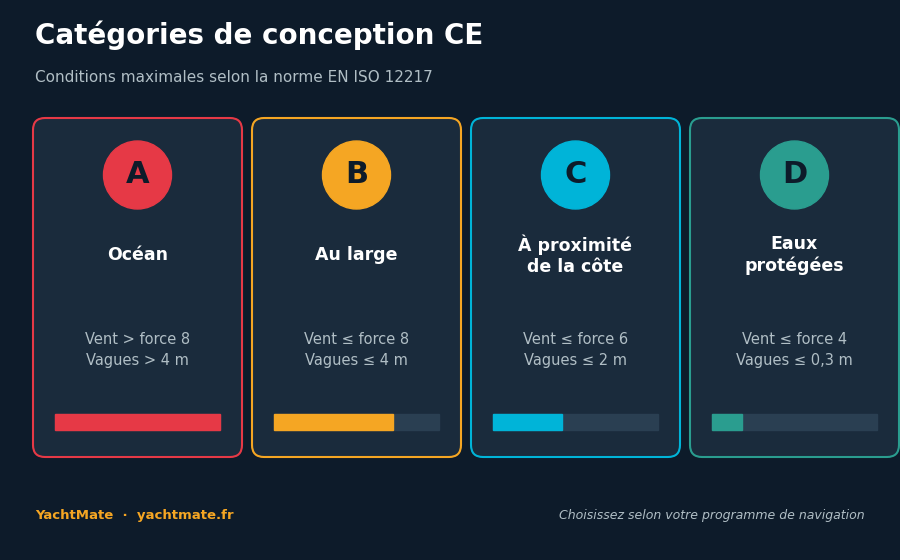
The system has four levels, from A (the most demanding) to D (the most sheltered). Each category corresponds to maximum wind and wave limits the boat is designed to face.
Category A — Ocean
Category A designates boats designed for long-distance voyages, able to face winds of more than Beaufort force 8 (above 40 knots) and significant wave heights over 4 metres, excluding abnormal conditions such as hurricanes. These are the boats meant for ocean crossings and extended offshore navigation, far from any shelter. They feature reinforced stability, scantlings and watertightness.
Category B — Offshore
Category B targets offshore navigation, with winds up to and including force 8 (around 40 knots) and waves up to 4 metres. This is the typical category of a cruising boat with accommodation, able to sail several dozen miles from shore and take a blow, without aiming for a transocean crossing. The vast majority of cruising sailboats and mid-size cabin motorboats fall into Category B.
Category C — Inshore
Category C corresponds to navigation close to the coast, in bays, estuaries, lakes and rivers, with winds up to and including force 6 (around 27 knots) and waves up to 2 metres. This is the realm of a very large number of recreational boats: day-boats, RIBs, small sailboats, leisure cruisers. These boats stay within reach of shelter and should return before the weather deteriorates.
Category D — Sheltered waters
Category D covers sheltered waters: lakes, enclosed bodies of water, rivers, canals and coastal areas in very fine weather. The limits are winds up to and including force 4 (around 16 knots) and waves up to 0.3 metre (with occasional waves of 0.5 m, for instance in another vessel's wake). This category includes small craft, fishing dinghies, motorized pedal boats and tenders.
Before every trip, compare your boat's category with the wind and sea forecast. In the YachtMate app, check the marine weather and forecast sea state: if the announced wind exceeds your category's limit, it is better to postpone or stay in a sheltered area. The category is a reference, not a guarantee in all weather.
Where to read the category on your boat?
The design category appears on the builder's plate, a small plate permanently fixed and visible (often in the cockpit, near the helm or inside). This plate notably shows:
- The builder's name and the CE marking;
- The design category (A, B, C or D);
- The maximum number of persons allowed on board;
- The maximum recommended load (persons, equipment, supplies);
- Sometimes the maximum engine power.
You will also find the category in the owner's manual and in the CE declaration of conformity provided at purchase. For a used boat, check that this plate is present and legible: it is an important element in any transaction.
How to choose for your program?
The right category depends above all on your actual cruising program, not on your dreams of the open ocean. A few benchmarks to guide your choice:
- Lake, river or sheltered roadstead sailing: Category D is enough, provided you respect its wind limits.
- Day trips along the coast, back to port before the breeze: Category C covers most leisure and coastal fishing uses.
- Coastal and semi-offshore cruising, night navigation, stops dozens of miles out: aim for Category B, which offers a real margin in case of a blow.
- Long-distance, transocean crossings: Category A is required, along with suitable equipment and crew.
Be careful: a higher category does not make sailing comfortable in bad weather, it only indicates that the boat is designed to withstand those conditions. A Category A boat can be exhausting to handle in 4 metres of swell, even if it comes out unscathed. Conversely, a good Category C boat, well handled, will be safer than a poorly maintained or overloaded Category B boat.
The load carried directly affects safety. Respecting the maximum number of persons and the maximum load shown on the plate is not a formality: the stability and buoyancy that justify the category were calculated for those limits. Overloading degrades the boat's behaviour well before the sea builds up.
The limits of the category: common sense first
The design category is an excellent benchmark, but it replaces neither the skipper's experience, nor maintenance, nor caution. Several factors fall outside this classification:
- The state of maintenance: tired rigging, seized seacocks or a failing bilge pump cancel out the theoretical safety margin.
- The crew's experience: the same built-up sea is handled very differently depending on the helmsman's level and fatigue on board.
- Safety equipment: the required gear depends on the distance from a shelter, not on the CE category.
- Duration of exposure: taking a one-hour squall is nothing like enduring a two-day blow on the open sea.
In France, it is the division 240 regulation that sets the safety equipment to carry according to navigation zones (basic up to 2 miles from shelter, coastal from 2 to 6 miles, semi-offshore from 6 to 60 miles, offshore beyond). Design category and regulatory navigation zone are therefore two complementary but distinct notions, which must be considered together.
In summary
The CE design categories — A for ocean, B for offshore, C for inshore, D for sheltered waters — provide a common language to situate a boat's capabilities against wind and sea. They help you buy the right boat for your program and avoid exceeding its operating range. But safety at sea remains above all the business of a skipper who pays attention to the weather, to maintaining the boat and to the load carried. The letter on the plate sets the framework; the sailor does the rest.
Prepare every trip with YachtMate
YachtMate gives you the marine weather, the forecast sea state and your nautical charts in one place — so you can check at a glance that conditions stay within your boat's operating range. Available on iOS and Android.
Discover YachtMate →