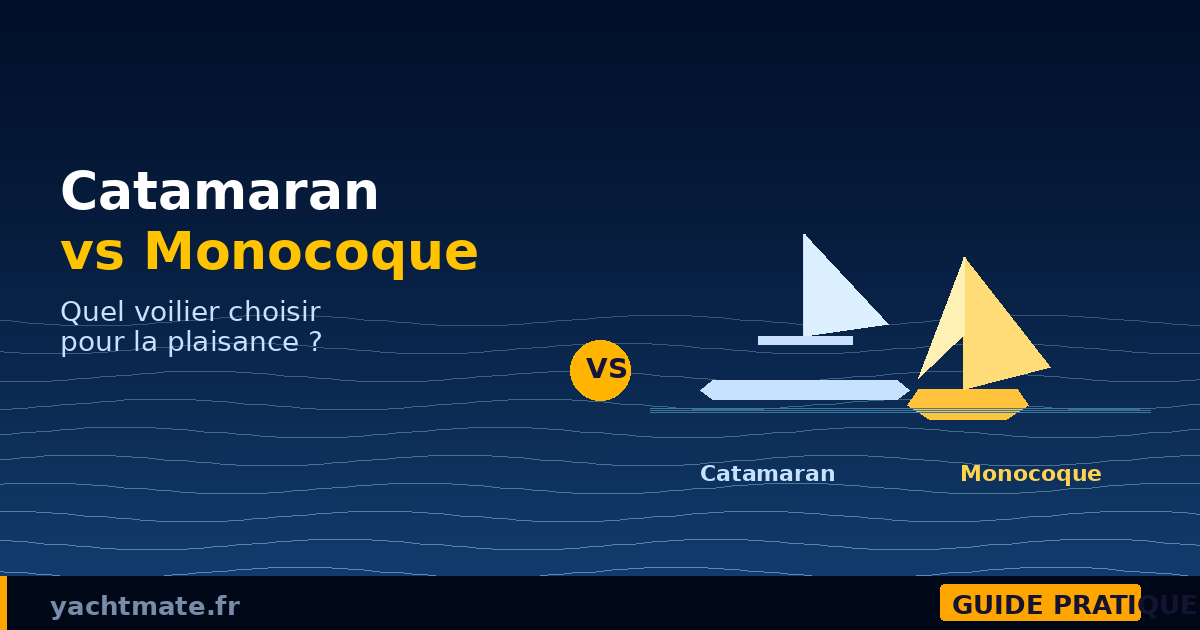
Catamaran or monohull? This question inevitably comes up whenever a sailor considers buying their first — or next — sailboat. It's not simply an aesthetic debate: it's a fundamental choice that will shape your on-board comfort, navigation capabilities, budget and even the destinations you can reach. In this comprehensive guide, we compare both types of sailboats across every dimension to help you make the best decision.
Understanding the Two Architectures
Before comparing, it's essential to understand what fundamentally distinguishes these two types of boats. A monohull is the classic sailboat with a single hull fitted with a ballasted keel that provides stability through counterweight. The boat heels under wind pressure but always returns to vertical thanks to its ballast.
A catamaran rests on two parallel hulls connected by a platform. Stability comes not from ballast but from the width of the architecture (form stability). The boat stays almost flat, even in strong conditions.
Before buying, try to borrow or rent both types of boats for a day sail. Nothing beats direct experience to feel the difference in sea behaviour.
Stability and On-Board Comfort
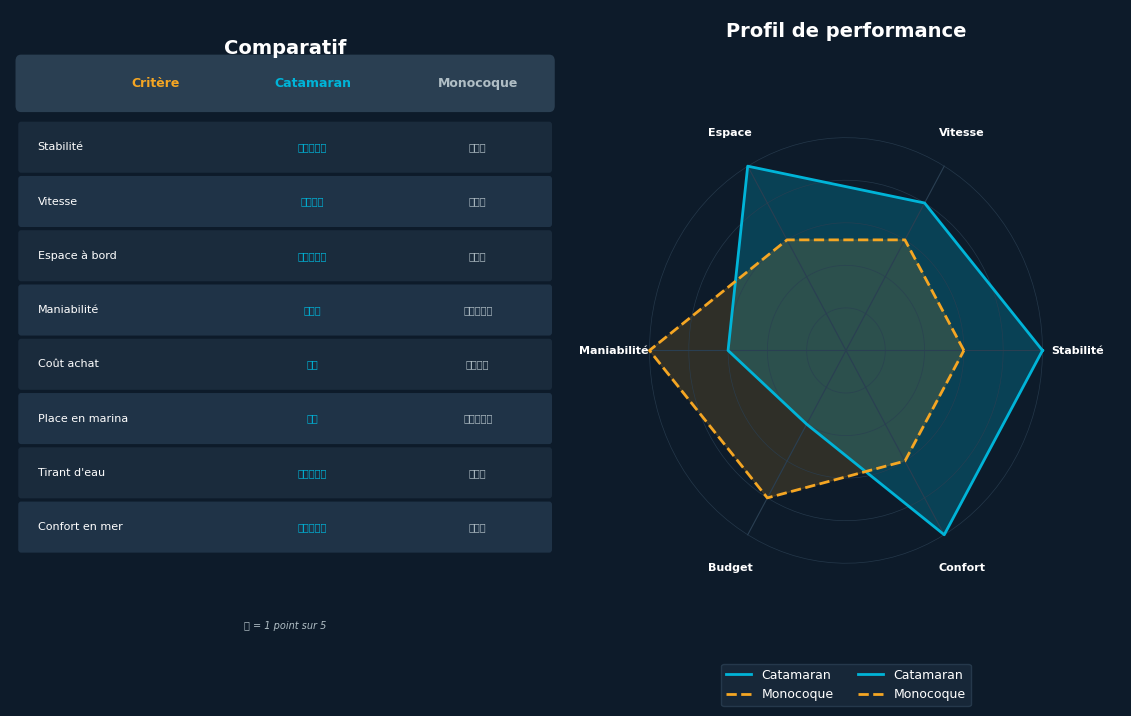
This is the number-one argument for the catamaran: its exceptional stability. Thanks to its two hulls, it remains nearly horizontal even in rough seas. This characteristic is especially valued by people prone to seasickness, families with children, and for cooking or activities aboard during long passages.
The monohull, by contrast, heels according to the point of sail and wind strength. This heel can reach 20 to 35 degrees in certain conditions. While natural for experienced sailors and racers, it can be uncomfortable for occasional crew or long passages. That said, heel is not synonymous with danger: the ballast always brings the monohull back upright.
Volume and Living Space
The catamaran offers significantly more living space. Its two hulls typically house two double cabins — one port, one starboard — each with their own heads, while the central saloon and cockpit benefit from generous surface area. For 4 to 6 people, the comfort of a 40-foot catamaran is unmatched compared to a monohull of the same length.
Performance and Sea Behaviour
Performance-wise, both types have their strengths. The catamaran excels on downwind and reaching points of sail where its two slender hulls allow impressive speeds, often exceeding those of a monohull. It's common to see a cruising catamaran sailing at 12–14 knots in the trade winds.
The monohull is generally more performant upwind (close-hauled against the wind) thanks to its keel and narrow hull. Offshore sailors value its ability to point high, useful in difficult passages. The monohull also responds more precisely to the helm, making it an ideal learning platform.
With the YachtMate app, check marine weather forecasts before every outing and plan your route according to your boat type. Sail trim differs significantly between a cat and a mono!
Budget: Purchase, Maintenance and Berthing
Purchase Cost
This is often the deciding factor. For equivalent performance and comfort, a catamaran typically costs 1.5 to 2 times more than a monohull. A 40-foot cruising catamaran in good condition can be found between €120,000 and €250,000, while an equivalent monohull ranges from €60,000 to €150,000. The gap is even wider for new boats.
Marina and Storage Fees
A catamaran takes up roughly double the width of a monohull of the same length, which directly affects marina fees. In most Mediterranean marinas, rates are calculated by linear width, sometimes with a surcharge for multihulls. Expect 20 to 50% more than an equivalent monohull. Free or inexpensive anchorages like calanques are also more difficult to access for a wide catamaran.
Maintenance
Maintaining a catamaran is generally more complex and expensive: two engines instead of one, twice the hull surface to antifoul, more expensive specific parts. The monohull remains simpler and cheaper to maintain, with easier access to spare parts in most harbours.
Draft and Anchorage Access
The catamaran, with its shallow draft (often 1.0–1.5m for a 40-foot boat), can access shallow areas out of reach for a ballasted monohull. It can dry out on a beach, enter a lagoon, or anchor much closer to shore — a considerable advantage for exploring tropical archipelagos, the shallow Atlantic coast or Corsica.
Safety at Sea
Both types are safe when properly rigged and handled. The capsize question often comes up for catamarans: while very difficult to knock down, a catamaran can in extreme seas turn turtle and remain upside down — a very difficult situation offshore. The monohull is self-righting thanks to its ballast, which is a significant safety argument for offshore passages.
Which Boat for Which Profile?
- Choose a catamaran if you sail with family or inexperienced crew, plan to live aboard for extended periods, sail in shallow areas (Caribbean, Pacific, wild coasts), or prioritise comfort and space.
- Choose a monohull if your budget is limited, you sail mainly in the Mediterranean or coastal waters, you want to learn to sail mastering the fundamentals, you're passionate about performance and responsiveness, or you sail solo or as a couple.
Plan Your Navigation with YachtMate
Whatever your vessel, YachtMate supports you with real-time marine weather forecasts, route planning tools and information on ports and anchorages.
Download YachtMate for Free