
The used market accounts for nearly three out of four boat sales in Europe — and for good reason. A well-maintained sailboat or motorboat depreciates slowly, and buying second-hand opens the door to an ambitious cruising program on a controlled budget. But a boat is not a car: beneath a freshly polished hull can lurk advanced osmosis, a worn-out engine or tired rigging that will cost far more than the discount you negotiated at purchase.
Buying used with confidence means knowing where to look, asking the right questions and, for boats of real value, bringing in a marine surveyor. This guide reviews the areas that make or break a deal, the method for running the sea trial, and how to turn the defects you find into negotiating leverage.
Before the visit: build your file
A good inspection begins long before you step aboard. Ask the seller for as much documentation as possible up front: the engine service log, invoices for recent work (rigging, sails, electronics), the registration or navigation title, and the ownership history. A complete, well-organized file is already an excellent sign; a seller who is vague about maintenance should put you on alert.
Research the model itself. Every series has its known weaknesses: one sailboat may have a keel-hull joint to watch, another motorboat a poorly designed cable run. Owner forums and class associations are goldmines for knowing where to focus your attention on inspection day.
Prepare your visit with the inspection checklist built into the YachtMate app: each area (hull, engine, rigging, safety) becomes a checklist you fill in on the spot, backed by photos. You leave with a time-stamped report — ideal for comparing several boats or supporting your negotiation.
The six areas to inspect first
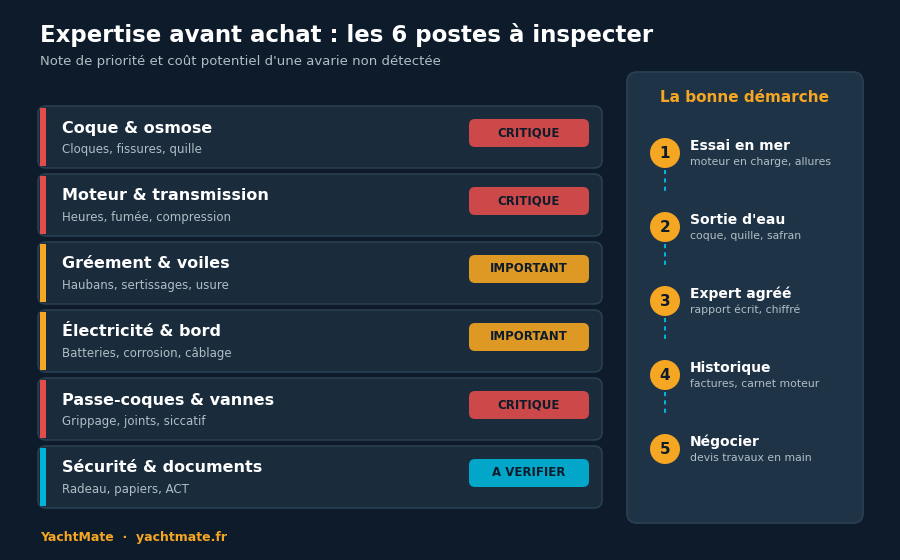
Not all defects are equal. Some cost a few tens of euros to fix; others sideline the boat for weeks and take thousands out of your budget. The diagram below ranks each area by criticality and recaps the survey process to follow.
1. The hull and osmosis
This is the heart of the matter. On a fiberglass boat, hunt for blisters below the waterline (a sign of osmosis), star cracks around fittings, and traces of poor repairs. The keel-hull joint deserves close inspection: a keel that has grounded leaves microcracks or a "smile" of filler. A percussion hammer lets you sound the laminate — a dull sound betrays delamination or a water-soaked zone. Ideally this inspection is done with the boat hauled out, hull dry for at least 48 hours.
2. The engine and drivetrain
An engine replacement often runs 20 to 40% of a used boat's value. Note the hours, but be wary of the counters: real condition comes first. With the engine cold, watch the smoke color at start-up (persistent blue smoke signals worn rings, white smoke a combustion or water problem). Check for oil or water traces under the engine, the condition of hoses and the belt, and the shaft line. On an outboard, check compression and the lower unit.
3. The rigging and sails
On a sailboat, standing rigging (shrouds, stays) has a limited lifespan: beyond 10 to 15 years, a full replacement should be budgeted. Inspect the swage terminals with a magnifying glass (broken strands, rust bleeding), turnbuckles, chainplates and the mast at the spreaders. Sails are judged by feel: fabric that "cracks" dry and tears easily is at the end of its life. A new set of sails quickly amounts to several thousand euros.
4. The electrical system and onboard equipment
The electrical circuit is a sneaky area. Look for green corrosion on terminals, wiring added "on the fly," and tired batteries. Test every piece of equipment: navigation lights, bilge pump, windlass, electronics. A tidy installation reveals a meticulous owner; a chaotic electrical panel foretells hours of troubleshooting.
5. The through-hulls and seacocks
Often overlooked, through-hulls are nonetheless a major flooding risk. Every seacock must operate freely; a seized or corroded valve needs urgent replacement. Check the clamps, double-clamped hoses and the condition of the seals. It is also the moment to inspect the stern gland on the shaft line.
6. Safety and paperwork
Check the validity and compliance of the required safety equipment (lifejackets, liferaft and its service date, extinguishers, flares). Verify that the boat's papers are in order, that the name and hull number (HIN) match the documents, and that no lien or loan is attached to the vessel.
Note the hull number (HIN) engraved on the transom and compare it to the papers before making any offer. A mismatch, however small, should stop the transaction until you have verified the boat's origin.
The sea trial: the ultimate test
No serious purchase should happen without a sea trial. It is the only moment when the boat reveals its true nature, engine under load and rigging under tension. Insist on going out in a steady light breeze rather than in flat calm, so you can test behavior under sail or holding at cruising speed.
During the trial, watch the details: does the engine rev up smoothly without hesitation or overheating? Does the boat hold its course? Are there abnormal vibrations in the shaft line? Do the sails trim correctly, does the autopilot work? Test every maneuver, including reverse under power, which reveals the state of the clutch and propeller.
"I nearly bought a pretty sloop on a dockside visit alone. The sea trial changed everything: at 2,400 rpm the engine was blowing blue smoke and overheating. The repair quote topped €6,000. I walked away — and thanked the sea trial." — A YachtMate user's testimony
Should you hire a marine surveyor?
For any vessel worth more than a few tens of thousands of euros, the answer is yes, without hesitation. A certified marine surveyor carries out a full inspection, boat hauled out, and delivers a written, costed report detailing the condition of each area and the work to anticipate. It comes at a cost (usually a few hundred euros depending on boat size), but that report often proves the best investment of the whole purchase.
The survey report has two virtues: it protects you from nasty surprises and becomes a powerful negotiating lever. Every defect noted, costed by an independent professional, objectively justifies a price reduction. It is also a document most insurers request for boats of a certain age.
Schedule the haul-out and the survey on the same day to share the costs. Keep the report in the YachtMate digital logbook: it will serve as a reference for future maintenance and make eventual resale easier.
Negotiating and securing the deal
Armed with your inspection and, ideally, the surveyor's report, negotiation becomes factual rather than emotional. Present work quotes to back your offer: "the standing rigging needs replacing, here is the rigger's quote." This costed approach is far more effective than haggling on gut feeling.
Once the price is agreed, secure the sale: draft a precise sale agreement stating the condition, the equipment included and the conditions precedent (satisfactory trial, favorable survey). Check the administrative transfer of the navigation title and the release of any liens. Never pay the full price before you have the documents in hand.
Finally, remember that a good used purchase is not necessarily the cheapest: it is the one whose condition you know precisely, whose maintenance is documented, and for which you have budgeted the work to come. A boat bought with clear eyes is a boat you enjoy from the very first outing.
Prepare every visit with YachtMate
Inspection checklist, digital service log, work history and route planning: YachtMate supports boaters from purchase to navigation, season after season.
Download YachtMate for free