
For many boaters, the dreaded moment is neither heavy weather nor the long passage, but the harbour manoeuvre. Slipping into a tight berth, coming alongside a quay in a cross-wind, docking between two boats each worth a small fortune: this is what raises the tension on board. The bow thruster was designed for exactly these situations. In a few seconds it swings the bow in the chosen direction, independently of the main engine and the rudder. Used well, it turns a stressful manoeuvre into a controlled gesture.
But it is no magic accessory. Undersized, poorly powered or over-used, it disappoints. Here is a complete guide to understanding how a bow thruster works, choosing the right model, using it intelligently and maintaining it so it answers the call the day you need it.
What is a bow thruster?
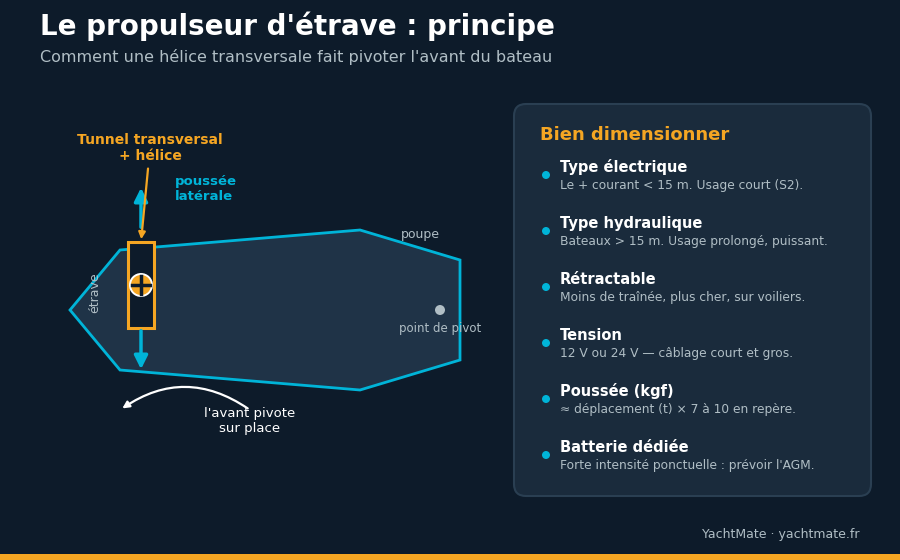
A bow thruster is a transverse propulsion device fitted at the front of the boat. In practice it is a propeller housed in a tunnel that runs through the hull from port to starboard, below the waterline, near the bow. When the propeller turns, it draws water from one side and expels it to the other, creating a sideways thrust that pushes the bow to the right or to the left.
Its role complements that of the engine and the rudder. The engine drives the boat forward or astern, the rudder steers the flow at the stern, but neither can move the bow on the spot, without way on. That is exactly what the thruster provides: at a standstill or at very low speed, it gives the skipper direct control of the bow — precisely where the hull catches the most wind.
How does it work?
The physical principle is simple: a transverse tube runs through the forward part of the hull. Inside, a propeller (or two, in a counter-rotating configuration) is driven by an electric or hydraulic motor. Depending on the direction of rotation commanded from the helm control, water is expelled to port or to starboard, and the bow reacts in the opposite direction.
The tunnel and the propeller
The tunnel is the key component. Its diameter sets the propeller size and therefore the available thrust. It should be positioned as far forward as possible — to maximise leverage — yet deep enough not to draw air whenever the boat pitches. A tunnel too close to the surface "ventilates": it sucks in air, the propeller races and thrust collapses. The tunnel mouths are often slightly rounded or fitted with deflectors to reduce drag and noise.
The effect on the boat
The boat pivots around a pivot point located roughly one third of the way aft from the bow when it is stationary. Because the thruster acts right forward, far from that point, it has a large lever arm: a modest effort is enough to turn the bow. It does not, however, move the whole boat sideways — for that you need to combine a bow thruster with, possibly, a stern thruster, or work the engine.
A bow thruster swings the bow; it does not "park" the boat by itself. It is a precision tool that complements good reading of wind and current, not a substitute for seamanship.
The different types of thruster
Not all thrusters are equal, and the right choice depends on the size of the boat and how often it is used.
Electric thruster
By far the most common on boats under 15 metres. Compact and relatively simple to install, it is powered by the boat's batteries at 12 or 24 volts. Its main drawback is that it draws an enormous current over short bursts: it is designed for intermittent duty (often rated S2, for example three minutes of use followed by a rest). A thermal cut-out stops the motor if it overheats, which can happen if you insist for too long.
Hydraulic thruster
On larger craft, above 15 metres, the hydraulic thruster prevails. Driven by a pump linked to the main engine or to a dedicated unit, it offers higher thrust and prolonged use, without the overheating limit of electric models. More complex and more costly, it equips motor yachts, large sailing boats and professional vessels.
Retractable thruster
On a sailing boat, a fixed tunnel creates permanent drag that penalises performance under sail. The retractable thruster solves this: the propeller deploys below the hull only at the moment of the manoeuvre, then retracts into a housing closed by a hatch. More discreet hydrodynamically, it is also more expensive and demands careful maintenance of the lifting mechanism.
Before manoeuvring, open the YachtMate app to check the forecast wind strength and direction for your area, along with the tide times. Knowing the prevailing wind direction in the harbour tells you immediately which way your bow will be pushed — and therefore which way to anticipate the thruster's push.
Sizing your thruster correctly
An undersized thruster is a false sense of security: it reassures at the pontoon in calm weather but stays powerless on the windy day when you really need it. Two parameters matter above all: thrust and power supply.
Thrust
A thruster's thrust is expressed in kilograms-force (kgf) or in newtons. It must be matched to the boat's displacement and its windage. A common rule of thumb is to aim for a thrust, in kgf, of around seven to ten times the boat's displacement in tonnes, bearing in mind that a sailing boat with high windage or a boat usually handled in strong wind will do well to choose the upper end. Manufacturers publish precise charts by boat length and type: it is wise not to drop below their recommendation.
Electrical supply
On an electric thruster, the cabling and the battery matter as much as the motor itself. The current draw is very high (several hundred amps) and brief. To avoid the voltage drops that throttle thrust, you fit large-section cables, as short as possible, and very often a dedicated battery placed forward, near the thruster, recharged by the boat. An AGM battery or a model designed for high current is preferable. Without this attention to the power supply, even a good thruster disappoints.
Use and best practice
The thruster is used in short bursts, not continuously. You give a push of one or two seconds, watch the bow's reaction, then correct. This approach spares the motor, avoids overheating and gives a finer manoeuvre. A few useful principles:
- Anticipate wind and current: the thruster corrects, it does not fight indefinitely against badly anticipated elements.
- Keep the main engine available: combining ahead/astern engine work with bursts of thruster remains the basis of any harbour manoeuvre.
- Respect the duty cycle: on an electric model, chaining long demands trips the thermal cut-out, often at the worst moment.
- Warn the crew: the thruster's distinctive noise startles, and a bow swinging quickly can unbalance a crew member leaning over the forward pulpit.
Practise at anchor or in an open basin, in calm then moderate wind, before you need it in a real berth. Understanding how your particular boat responds to a one-second burst — and how long the bow keeps swinging on its momentum — is worth all the manuals.
Thruster maintenance
Like any submerged equipment, the thruster needs regular maintenance, or it will fail on the day. Points to watch:
- The anode: the thruster has its own sacrificial anode protecting the propeller and leg against galvanic corrosion. Check and replace it on the same schedule as the boat's other anodes.
- The propeller and tunnel: at each haul-out, check for fishing line or rope wound on the shaft, and clean the tunnel of fouling and shellfish that reduce the flow.
- The electrical connections: on an electric model, inspect the terminals, the relay (solenoid) and the state of the cables, frequent sources of failure through poor contact.
- The shaft seal and oil level of the leg, as the manufacturer recommends, to prevent any water ingress.
Should you fit a bow thruster?
Fitting one to an existing boat means cutting the hull for the tunnel: a significant job, best entrusted to a professional, that affects watertightness and structure. The game is often worth the candle for a heavy boat, with high windage, or handled short-handed in crowded harbours. Conversely, on a light, well-balanced boat, a trained sailor manages very well without one — and some even see it as a loss of the skill of "old-school" manoeuvring on engine and lines.
The bow thruster is therefore neither essential nor superfluous: it is a manoeuvring aid whose value depends on the programme, the boat and the crew. Well chosen, properly powered and maintained, it brings real peace of mind in difficult harbours. But it remains a tool in the sailor's service, never an autopilot for docking. The best manoeuvre is still the one you have anticipated, by reading the wind, the current and the available space before you even engage gear.
Prepare your harbour manoeuvres with YachtMate
Wind, tide, currents and harbour charts in one place: YachtMate helps you anticipate your dockings and pick the right moment to enter port. Available on iOS and Android.
Discover YachtMate →