
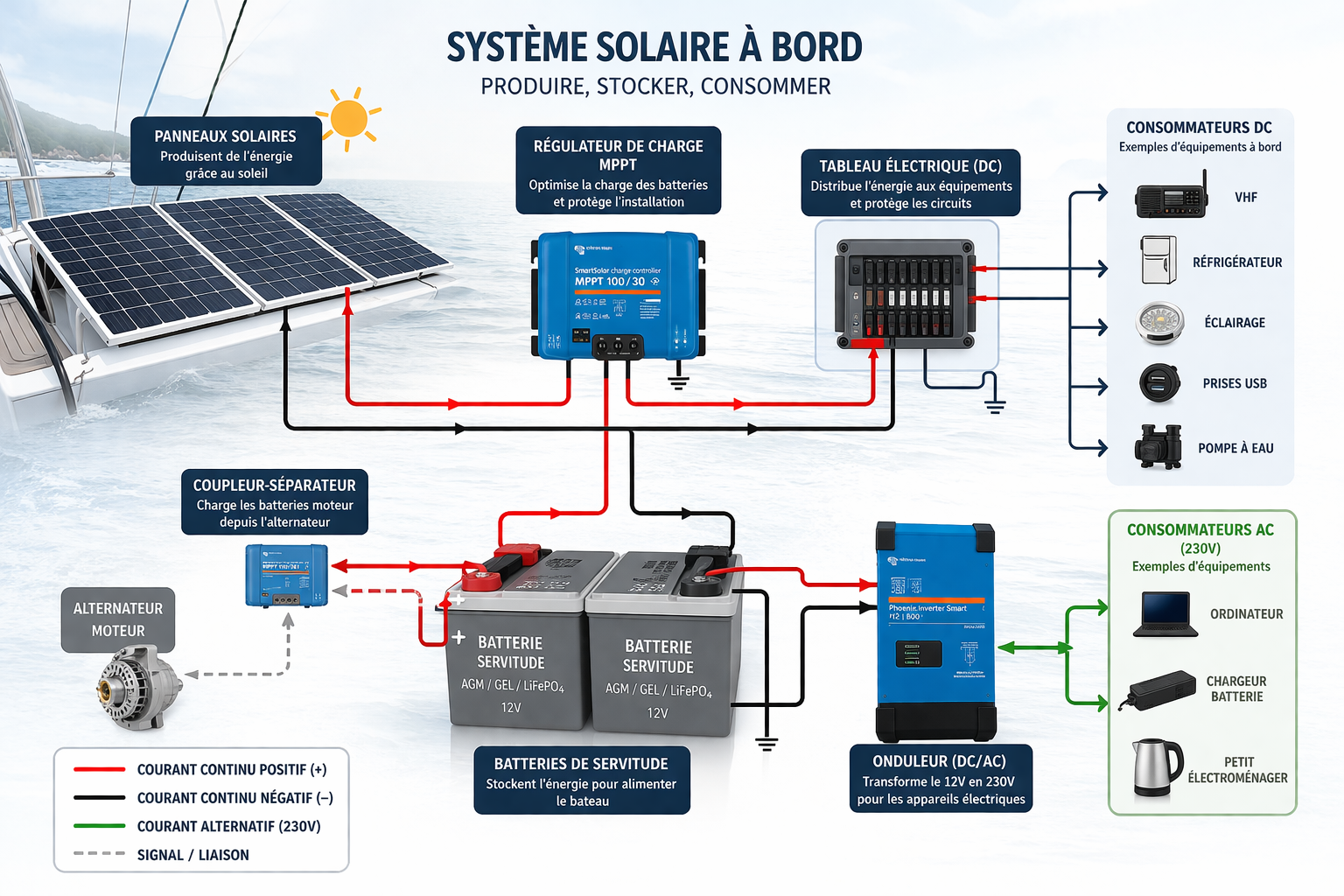
Onboard electricity is often the first source of anxiety for novice sailors — and sometimes even for experienced ones. A flat battery on a quiet anchorage morning, a fridge that stops working, or navigation lights failing at night: electrical failures at sea are as frequent as they are unpredictable. Yet, with a few basic concepts, proper sizing and the right equipment, you can sail with complete peace of mind and never run out of power.
In this complete guide, we cover the fundamentals of marine electricity: understanding your energy needs, choosing the right battery type, optimising charging from the alternator and solar panels, and establishing an effective energy management plan.
Understanding Your Boat's Electrical Needs
Before talking about energy sources, you must first establish a precise power budget for your boat. This means listing all electrical consumers and estimating their daily consumption in amp-hours (Ah).
The Main Consumers Onboard
- Refrigerator / freezer: the biggest consumer, often 30 to 80 Ah/day depending on the model and outside temperature.
- Navigation electronics (VHF, GPS, autopilot, AIS, radar): between 5 and 30 Ah/day depending on use.
- Lighting (cabins, cockpit, nav lights): 2 to 10 Ah/day with modern LEDs.
- Pumps (bilge, freshwater, shower): low intermittent consumption, 1 to 5 Ah/day.
- USB chargers and personal electronics (phones, tablets, handheld VHF): 2 to 5 Ah/day.
- Electric winch, windlass: very power-hungry but used briefly.
A coastal cruising sailboat typically consumes between 60 and 120 Ah per day. A bluewater catamaran can exceed 200 Ah/day. These figures are essential for properly sizing your battery bank.
The YachtMate app lets you plan your voyages with your stopovers in mind. Before leaving on a cruise, check the anchorage map and see if marinas with shore power are available along your route — a quick shore charge can prevent a lot of trouble.
Onboard Batteries: Choosing the Right Type
The battery bank is the heart of the electrical system. There are generally two types on board: the starter battery, dedicated to the engine, and the service batteries (or "house bank"), which power everything else. These two banks must remain separate to avoid being left without engine start after a night of consumption.
Battery Technologies
Flooded lead-acid (wet batteries): old technology, inexpensive but heavy, requires regular maintenance (checking electrolyte levels) and does not handle deep discharge well.
AGM (Absorbent Glass Mat): the current standard for cruising. Sealed, maintenance-free, better resistance to vibration, and can be discharged down to 50% capacity. Mid-range price.
Gel: similar to AGM, slightly better at deep discharge, but more sensitive to overcharging. Ideal when combined with solar panels.
Lithium (LiFePO4): the technology of the future. Three times lighter, usable down to 80-90% depth of discharge, lifespan 3 to 5 times longer. The initial investment (roughly 3 to 5 times the price of an equivalent AGM) pays off over time, especially for long-distance sailors.
Sizing Your Battery Bank
The basic rule: plan for twice your daily consumption in usable capacity. If you consume 100 Ah/day and use AGM batteries (50% discharge), you need 400 Ah of gross capacity (100 ÷ 0.5 × 2 days of autonomy). With lithium (80% discharge), 250 Ah is sufficient.
Never undersize your battery bank. A battery constantly deep-discharged ages two to three times faster.
The Alternator: Charging Under Way
The alternator driven by the main engine is the most powerful charging source onboard. Unfortunately, it is often underused or poorly adjusted.
Understanding How It Works
A standard alternator delivers between 60 and 120 amperes on modern motorboats. But be careful: the standard charge regulation (internal regulator) stops too early. From 70-80% charge, it significantly reduces current even if the batteries still need it. The result: one hour of engine running doesn't charge as much as you think.
Improving Alternator Charging
- Install an external regulator (Balmar, Sterling, Victron) that maintains a "bulk" charge phase longer and optimises the charge cycle.
- For lithium batteries, an adapted regulator is essential: a standard alternator can permanently damage a LiFePO4 battery.
- Regularly check alternator belts: a loose or worn belt drastically reduces charging efficiency.
With YachtMate, plan your passages intelligently around your charging needs. The app helps you estimate the motoring time required between two anchorages to sufficiently recharge your batteries — very useful when cruising in remote areas without shore power available.
Solar Panels: Free Energy from the Sun
Solar panels have become indispensable on cruising sailboats. Silent and maintenance-free, they keep the battery bank topped up during anchorage stays or passages in fair weather.
Choosing the Right Output
In the Mediterranean in summer, a solar panel receives approximately 4 to 5 peak sun hours per day. A 100 Wp panel will therefore produce 50 to 70 Ah/day in good conditions. To cover a 100 Ah/day consumption, you will need approximately 200 to 300 Wp installed.
Monocrystalline panels offer the best efficiency per surface area (up to 23%) and are best suited for roof and stern rail installations. Flexible panels can adapt to curved surfaces but have a shorter lifespan and slightly lower efficiency.
The MPPT Charge Controller
Inseparable from solar panels, the charge controller converts the panel's energy into current suited to the battery. Always choose an MPPT (Maximum Power Point Tracking) model rather than a simple PWM: it is 20 to 30% more efficient and adapts in real time to variations in sunlight. Victron Energy, EPEVER and Renogy offer excellent models suited to marine use.
Installation and Precautions
- Avoid partial shading (cables, shrouds, bimini) which can drastically reduce output.
- Orient panels southward if possible, with a slight inclination (15-30°).
- Use adequately sized cables to minimise losses (≥ 6 mm² for lengths > 3 m).
- Protect connections with waterproofed marine terminals to prevent corrosion.
Other Onboard Energy Sources
The Marine Wind Generator
Complementing solar, a wind generator produces energy even at night or in overcast conditions. Marine models (Air Breeze, Rutland, Superwind) are quiet and robust. Ideal for offshore sailing or wintering in windy regions. It works from 3-4 knots of wind and can produce 10 to 30 Ah/day in average conditions.
The Diesel Generator
For heavy consumers (air conditioning, electric oven, watermaker) or periods of low sunlight, a 2 to 4 kW diesel generator is a reliable solution. Noisy and fuel-hungry, it is best reserved for intense, short-term use.
The Hydrogenerator
Less common but very effective on offshore passages: a towed propeller driven by the wake produces energy continuously from 4-5 knots of boat speed. Watt&Sea or Eclectic Energy models can produce 100 to 400 Ah per day of sailing, enough to make a cruising yacht fully energy-independent.
Before setting off on a cruise, log your battery state of charge and estimated daily consumption in YachtMate. The app helps you organise your stopovers strategically: ports with shore power, motoring time needed for alternator charging, optimal sunshine zones by season. A well-prepared passage is a passage free of nasty electrical surprises!
Daily Energy Management
Even the best electrical setup requires good daily energy habits. A few simple reflexes can make all the difference:
- Install a battery monitor (shunt ammeter) to know your bank's real state of charge at all times. Victron BMV-712 and Simarine Pico are the market references.
- Switch off unused instruments: a radar on standby often draws 2-3 A continuously.
- Replace halogen bulbs with LEDs wherever possible: 5 to 10 times lower lighting consumption.
- Adjust the fridge thermostat to the outside temperature: one degree warmer means up to 10% energy saving.
- Make use of engine-on motoring time for the most power-hungry tasks (charging devices, running the watermaker).
In Summary
Onboard electricity doesn't have to be a source of worry. With an accurate consumption budget, a well-sized battery bank and a charging mix tailored to your sailing (alternator, solar, wind), you can be fully energy-independent on the water. Invest in a good battery monitor to track your consumption, adopt good daily habits, and you'll sail with complete peace of mind whatever the weather.
Navigate with Greater Confidence Using YachtMate
Plan your cruises, discover the best anchorages and manage your passages with confidence using the YachtMate app — the reference for French-speaking sailors.
Discover YachtMate →