
Crossing the Atlantic under sail is the ultimate dream for many sailors. This 2,800 to 3,000 nautical mile adventure — typically from the Canary Islands to Martinique or Barbados — represents a powerful symbolic milestone. When well-prepared, it is within reach of experienced crews aboard a reliable offshore sailboat. This guide walks you through every step, from planning to arrival in the Caribbean.
Why Choose the Trade Wind Route?
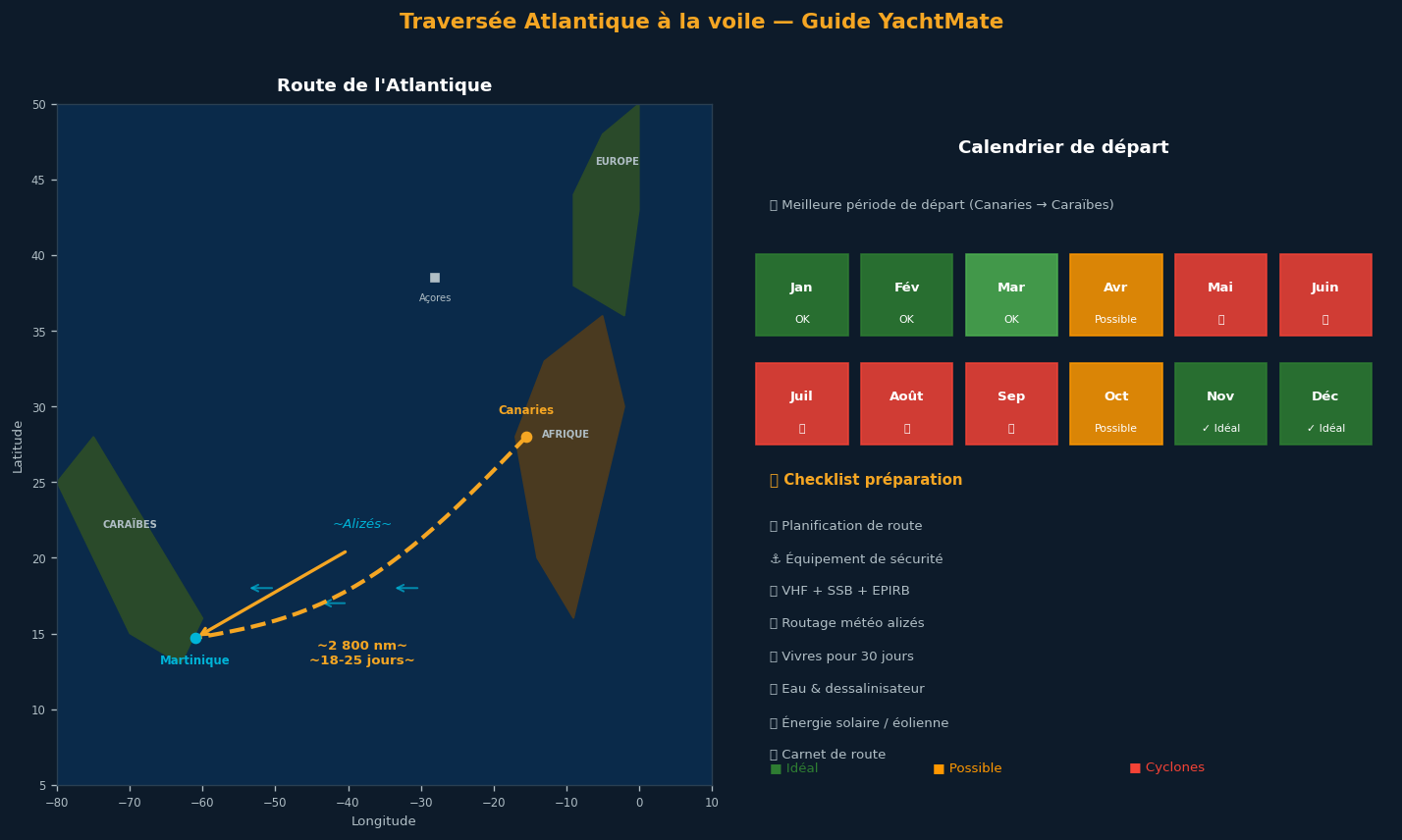
The classic Atlantic route first heads south toward the Canary Islands to pick up the northeast trade winds, those steady, favorable winds blowing 10 to 25 knots the entire way. This route choice is no accident: for centuries, merchant ships and cruising yachts have taken advantage of this constant flow to cross the Atlantic comfortably on a downwind run. The crossing typically takes 18 to 25 days depending on conditions and the boat.
The most popular departure point remains Las Palmas de Gran Canaria, with its excellent marina, boatyards, and spare parts suppliers. Others depart from Porto Santo (Madeira) or the Cape Verde Islands for a shorter route or different conditions.
Consider joining the ARC (Atlantic Rally for Cruisers) if this is your first crossing. This annual rally (departure late November from Gran Canaria) brings together several hundred boats and offers a safe framework with weather tracking, VHF watch, and emergency assistance.
Choosing the Right Timing: The Crossing Calendar
Timing is critical. The Atlantic hurricane season officially runs from June 1 to November 30, peaking in August-September. Crossings happen mainly between November and March, with an optimal window in November-January when trade winds are most consistent and Caribbean hurricane season is over.
- November-December: ideal period, established trade winds, formed but regular seas
- January-February: excellent conditions, slightly choppier seas at the start
- March: possible but trade winds can weaken toward the end
- April-October: absolutely avoid due to hurricane risk in the Caribbean
The Ideal Offshore Sailboat
There is no "perfect boat" for the Atlantic, but certain characteristics are essential. Your boat must be mechanically reliable, with a recently serviced diesel engine, sound rigging, and sails without urgent repairs. A robust electric windlass makes anchoring at stopover ports before departure much easier.
Mandatory Safety Equipment
For an offshore crossing, you must carry at minimum: a Category 1 EPIRB (auto-activation), a certified life raft for all crew members, a fixed VHF with DSC, and an HF/SSB radio or NAVTEX receiver for offshore weather. An AIS transceiver is strongly recommended.
Use the YachtMate app to plan your crossing waypoints and receive real-time GRIB weather alerts. The intuitive interface lets you visualize depression systems and the Intertropical Convergence Zone (ITCZ) that can disrupt trade winds at the end of the crossing.
Technical Preparation: 8 Key Priorities
1. Full Engine and Systems Overhaul
Even if you sail 95% of the passage, the engine is your insurance during windless stretches (doldrums) or arrival maneuvers. Change belts, filters, water pump impeller, check cooling and anodes. Verify the windlass, autopilot, and generator if fitted.
2. Sails and Rigging
The crossing is predominantly downwind. Ensure you have an asymmetric spinnaker or a code zero sail suited to the trade winds. Inspect all seams, halyard shackles, and replace worn sheets. Bring a sail repair kit (sail needle, thread, neoprene glue) and a piece of sailcloth for at-sea repairs.
3. Electricity and Energy
Electrical autonomy is critical over a long passage. Calculate your needs (navigation, refrigeration, lighting, electronics) and ensure they are met by solar panels, a wind generator and/or a charger-inverter. Keep a fuel reserve for the generator in emergencies and for stopovers.
4. Fresh Water and Watermaker
Allow a minimum of 2 liters per person per day for drinking, plus water for cooking and hygiene. For 3 people over 25 days, that is at least 150 liters. An onboard watermaker is a great comfort, even a necessity on larger crewed vessels.
5. Provisions and Supplies
Provision for 30 days (25 days crossing + 5 days margin). Favor dry foods (legumes, pasta, rice, cereals), canned goods, robust vegetables (cabbage, onions, carrots) and long-life proteins. Avoid fragile fresh produce beyond the first week.
6. Medical Kit
Your offshore medical kit must include antiemetics (seasickness), broad-spectrum antibiotics, painkillers, antiseptics, dressings, suture materials, and an at-sea medical reference. Consult your doctor before departure for appropriate prescriptions.
7. Communications and Weather
Beyond VHF channel 16, an SSB or HF radio lets you receive offshore weather bulletins and communicate with other boats en route. A satellite weather routing subscription (Iridium GO!, Garmin inReach) adds a valuable safety layer.
8. Documentation and Formalities
Gather your documents before departure: vessel registration, offshore insurance valid in the Caribbean, passports valid 6 months after planned arrival, crew list, and equipment inventory. Check entry requirements for each planned Caribbean island.
Life Aboard During the Crossing
Daily routine is key to maintaining morale and safety. Set up 3-hour watches (or 4-hour night watches) so every crew member gets enough rest. Each watch change includes: instrument check, course and speed review, VHF monitoring, and sail inspection.
Passing through the Doldrums (Intertropical Convergence Zone, between 5° and 15° N) is the most unpredictable part of the crossing. Violent squalls and flat calms alternate, sometimes for several days. Be patient, reef before each squall approaches, and use the calms to check equipment.
Arrange regular check-in calls to a shore contact (family member, fellow sailor) via SSB or satellite to report your position. If contact is lost for 48 hours, this person alerts the maritime authorities. A simple procedure that can save lives.
Arriving in the Caribbean
Spotting the first islands on the horizon after 2 to 3 weeks at sea is an intensely emotional moment. Rodney Bay (St Lucia) or Le Marin (Martinique) are the most popular arrival points for Atlantic crossings. Plan your approach for daylight: Caribbean coral reefs demand careful navigation, especially after long hours on watch.
Once alongside or at anchor, allow yourself a few well-deserved days of rest before beginning your Caribbean exploration. The Atlantic crossing will remain, for all who have done it, one of the most defining experiences of their sailing lives.
"The sea does not reward those who are too anxious, too greedy, or too impatient." — Anne Morrow Lindbergh
Plan Your Crossing with YachtMate
Route planning, real-time GRIB weather, digital logbook, safety alerts: YachtMate is the essential app for your offshore adventure.
Download YachtMate for Free