
Anchoring is a fundamental coastal sailing skill requiring deep understanding of region-specific maritime conditions. The Mediterranean and Atlantic present radically different anchoring challenges related to currents, seabed types, weather patterns, and local anchoring practices. This detailed exploration of distinct anchoring techniques enables you to adapt procedures to each region, maximizing boat safety and comfort. Experienced navigators master regional specifics and continuously adjust anchoring strategies based on geography, season, and forecast weather conditions.
Understanding fundamental differences between Mediterranean and Atlantic anchoring isn't merely technical adaptation—it's nautical safety. The Mediterranean generally offers calmer waters with predictable seabeds, while the Atlantic brings unpredictable conditions with powerful tides, complex currents, and dramatic bathymetric variations. Site selection strategies, anchor deployment techniques, and vessel monitoring vary considerably based on these environmental factors.
Mediterranean Conditions and Anchoring Strategies
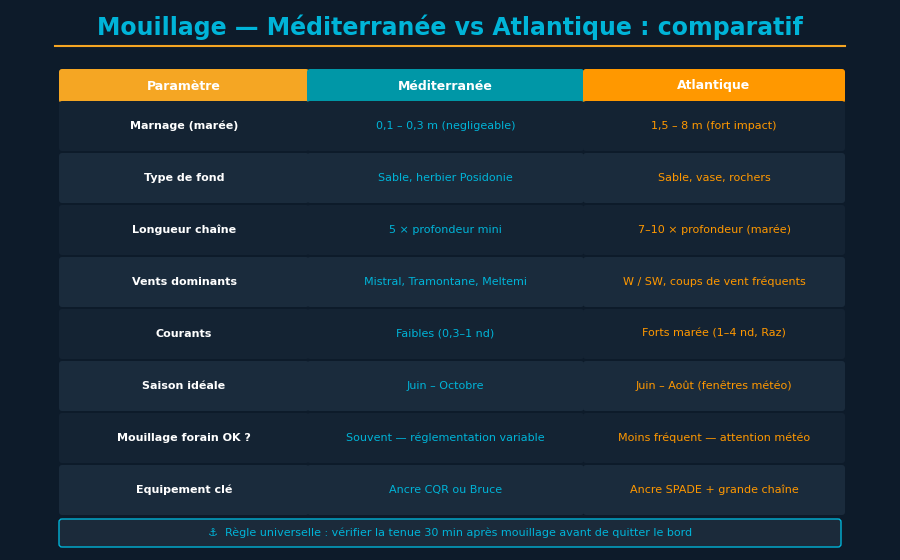
The Mediterranean features relatively calm waters, particularly in summer, with generally predictable seabeds composed of sand, mud, and small rocks. Mediterranean tides are minimal, typically under one meter, greatly simplifying anchoring calculations and reducing grounding risk from water level changes. Mediterranean bays offer natural protection against dominant winds, creating relatively secure anchorages with exceptional holding characteristics.
Mediterranean Anchorage Site Selection
When choosing Mediterranean anchorages, seek well-enclosed bays with narrow entrances minimizing incoming swell. Verify depth using your sounder and identify submerged obstacles like isolated rocks or debris. Most Mediterranean anchorages provide excellent holding in sand or fine mud, allowing even small anchors to grip firmly.
- Ideal holding grounds — Fine sand, mud, light silt offer excellent Mediterranean holding, allowing anchors to penetrate and establish firm grip.
- Tandem anchoring — During strong northerly Mediterranean winds (mistral), deploying two anchors in tandem significantly strengthens anchoring safety.
- Anchoring depths — Mediterranean anchorages typically range 5-15 meters, rarely deeper, simplifying required chain length calculations.
Use YachtMate's interactive anchorage chart, which integrates depths, seabed types, wind protection conditions, and crowd-sourced navigator reports. This feature enables precise anchorage selection matched to current conditions and weather forecasts.
Atlantic Conditions and Anchoring Challenges
The Atlantic presents a radically different environment characterized by powerful tides, complex currents, and variable bathymetry. Atlantic coasts experience tides reaching 10-12 meters in bays like the Bay of Fundy, forcing navigators to anticipate depth changes and tide-related vessel movements. Atlantic seabeds are often rocky, stony, or grassy, requiring distinct anchoring techniques and heightened vigilance regarding anchor holding.
Adapting to Atlantic Tidal Conditions
Navigating the Atlantic requires precise mathematical understanding of tidal behavior. Before anchoring, consult local tide tables to determine tidal range during your stay. Calculate minimum depth your vessel will experience at low tide and vertical clearance above obstacles (rocks, wrecks) at high tide. Always maintain additional safety margins due to tidal prediction variability.
"In the Atlantic, understanding tides isn't optional—it's fundamental safety. A calculation error of just 30 centimeters can transform safe anchorage into dangerous situation."
- Tide-adapted chain ratio — In the Atlantic, use 1:5 or 1:6 chain-to-depth ratios to compensate for rising tides and potential dragging.
- Rocky seabeds — Anchors must bite rocky or stony bottom. Bruce or claw anchors (Rocna) offer superior rocky-ground performance compared to traditional anchor types.
- Tidal currents — Anticipate current direction changes during tidal reversals. Vessels pivot around anchors during current direction shifts, potentially creating entanglement or grounding risks.
Anchoring Techniques and Anchor Deployment
Despite regional differences, basic anchoring principles remain identical in all waters. Correct positioning, methodical anchor deployment, and holding verification are essential everywhere. However, specific technique varies slightly based on seabed type, currents, and anticipated anchoring conditions.
Standard Anchoring Procedure
Approach the anchorage facing prevailing wind or current, whichever dominates. Progressively reduce speed and position perpendicular to current or wind direction. Gradually release chain, allowing natural backward drift. Never drop anchors at speed, as this creates chaotic deployment and unstable holding.
- Controlled chain deployment — Deploy chain slowly and consistently while communicating with helmsman to maintain position and backing speed.
- Anchor engagement — Once chain is deployed, slowly back down to set anchor in bottom. Verify setting by observing fixed land references (trees, buildings) confirming no slippage.
- Final visual inspection — Snorkel dive if conditions permit to visually verify anchor holding and absence of entwined obstacles around chain.
Activate YachtMate's anchor watch alert after deploying anchor. The app creates a geofence around your current position and notifies immediately if your vessel drifts beyond, indicating potential anchor slippage during night.
Anchor Selection and Maintenance
Anchor choice is fundamental to anchoring safety. Different anchor types deliver variable performance based on seabed type. Anchors optimized for rocky Atlantic ground may underperform in Mediterranean sand. Most cruisers maintain two anchors: primary holding-power anchor (Rocna or Bruce) and lighter backup anchor.
Anchor Performance by Seabed Type
In the Mediterranean, where sand or mud dominates, Danforth or claw-type anchors offer excellent holding. In the Atlantic, where rocky seabeds prevail, Bruce or Rocna anchors offer superior rocky-ground bite capability. Backup anchor can be lightweight Danforth, deployed in tandem if primary anchor provides insufficient holding.
- Anchor weight and size — Use anchors weighing one kilogram per meter of boat length (12-meter boat requires minimum 12 kg anchor).
- Regular inspection — Check anchors for wear, corrosion, or structural damage. Damaged anchors deliver unpredictable and dangerous holding.
- Chain versus rope — Use chain comprising 40-50% total anchor rode length to minimize mechanical strain on anchoring equipment and improve anchor bite angle.
Overnight Anchorage Monitoring and Management
During night anchoring, vigilance never diminishes. Establish monitoring combining visual watch (hourly check-ins) with drift-detection technology. Nocturnal winds strengthen drift effects, particularly in the Atlantic where coastal breezes create complex air circulation patterns.
"Safe night anchorage never results from luck. It's outcome of meticulous planning, appropriate site selection, and constant vigilance."
- Anchor watch alarms — Configure anchor watch alerting you immediately if drift occurs. YachtMate integrates this feature, using GPS to detect even microscopic drift.
- Condition monitoring — Listen to local weather bulletins and prepare response if conditions deteriorate (wind strengthening, sudden storms, sea state changes).
- Prepared emergency procedures — Identify backup anchorage or sheltered port in advance if conditions degrade. Knowing alternate positions enables rapid, panic-free response.
Check YachtMate's integrated marine weather before sleeping and configure alerts for wind changes exceeding 10 knots. The app sends real-time notifications, enabling rapid response to weather deterioration or anchorage condition changes.
Regional Distinctions and Best Practices
Synthesizing Mediterranean and Atlantic anchoring differences reveals each region demands mental and practical technique adaptation. Mediterranean anchoring rewards simplicity and prudent site selection, while Atlantic anchoring demands mathematical rigor and technological vigilance. Superior cruisers master both approaches and continuously adapt strategies to immediate environment.
- Local documentation — Consult regional nautical guides and other navigators' experiences. Modern sailing forums like YachtMate offer detailed, current local feedback.
- Progressive adaptation — Begin with safe, well-documented, protected anchorages, progressing to challenging anchorages as experience increases.
- Local rule respect — Some bays and regions enforce strict regulations regarding authorized anchorages, marine protected areas, and environmental practices. Always respect local regulations.
Optimize Your Anchoring
YachtMate helps you select best anchorages with interactive charts and real-time drift alerts.
Explore Anchorages →